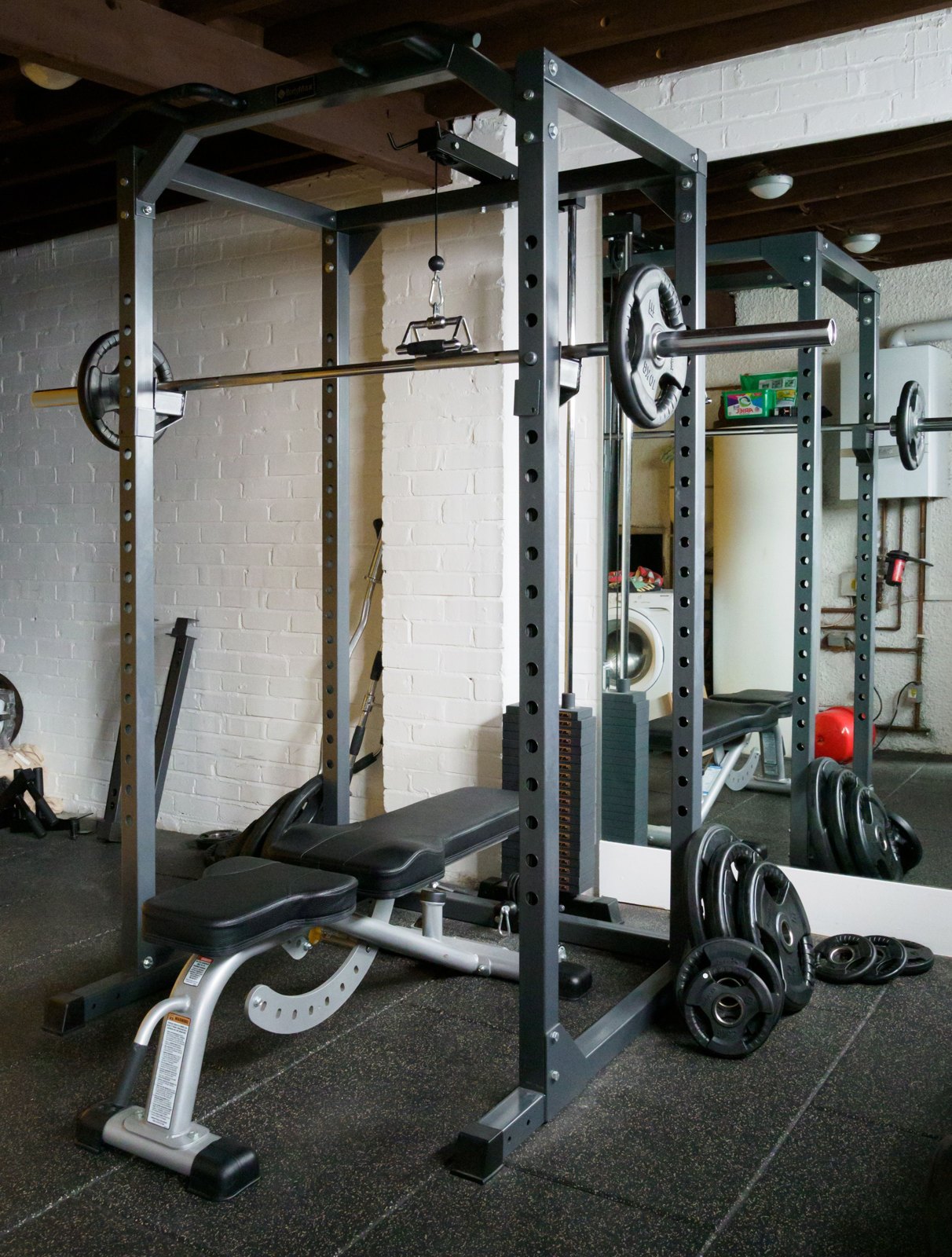
Can a power rack fit under a 7-foot ceiling? The measurements that matter
An 84-inch ceiling doesn't automatically rule out a real power rack. But a rack that barely clears the ceiling may still be the wrong rack for your workouts.
Sources last checked 2026-11-11.
Jump to a section
Start with 84 inches, not the words 'seven feet'
Let's say your basement ceiling measures exactly seven feet. That's 84 inches from finished floor to the lowest surface above the rack. A 72-inch rack sounds easy. An 83.6-inch rack sounds as if it fits too, until you realize there's less than half an inch left. Neither number tells you whether you can assemble the rack in place, reach an overhead attachment or do a pull-up.
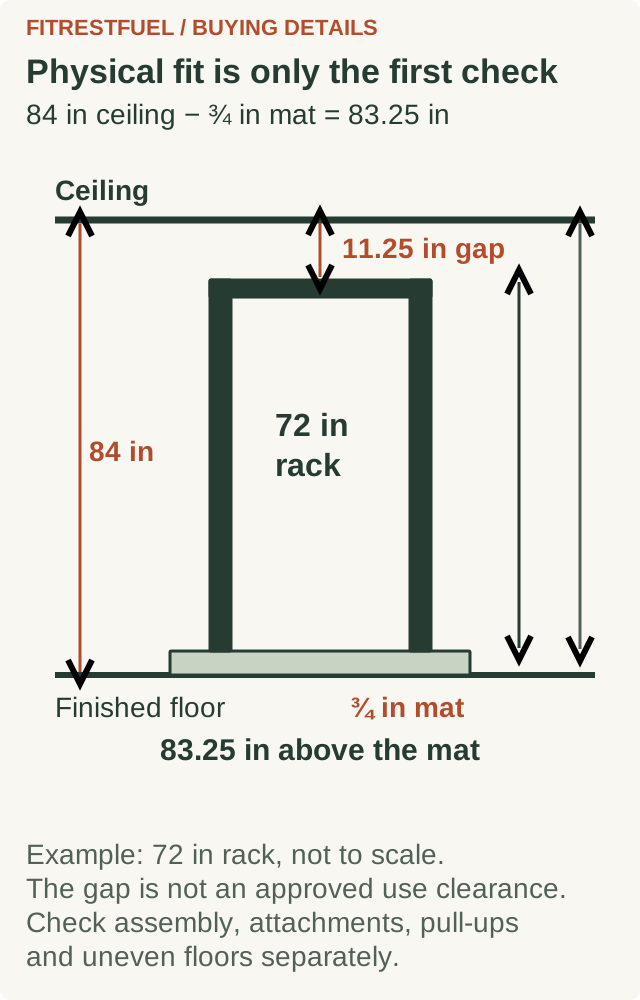
Measure at the exact spot where every upright will stand. Ducts, pipes, beams, sloped concrete, a raised platform and stall mats can all change the available height. If you measured before adding a three-quarter-inch mat, an 84-inch room effectively gives you 83.25 inches above the mat. The same 72-inch rack now has 11.25 inches left, not 12. These are fit calculations, not manufacturer-approved installation clearances.
In a garage, check the door closed, open and moving through its full path. The tracks, opener or raised door may hang well below the ceiling. Include the space used by the barbell and your movements, not just the uprights. In a basement, moving the rack away from a low beam or duct may give you more usable height without changing equipment.
Four racks and stands compared against a real 84-inch ceiling
These published heights describe the specified base equipment. An accessory, raised pull-up bar or different configuration can change your assembled height. The remaining-space column subtracts each published height from 84 inches before flooring. It does not declare that a rack is safe to assemble or operate.
On a small screen, swipe the table sideways.
| Exact model | Listed total height | Nominal room left | What that means |
|---|---|---|---|
| REP PR-1050 short power rack | 72 in | 12 in | A genuine enclosed rack option, with included J-cups and pin-pipe safeties; overhead exercises still need their own clearance check. |
| Rogue SML-1 squat stand | 72.25 in | 11.75 in | Short enough on paper, but not an enclosed rack; add compatible safety spotter arms if your lifts require them. |
| REP PR-1000 power rack | 83.6 in | 0.4 in | Almost no allowance for flooring, installation or uneven surfaces. Don't buy on a nominal height match. |
| REP PR-1100 power rack | 85 in | Standard configuration: 1 inch too tall. | Inverting the pull-up bar lowers the rack. Get the assembled height from REP and allow for flooring, assembly and exercise space. |
The PR-1050 gives you 11.6 inches more nominal headroom than the PR-1000 in the same room. That is why I'd shortlist the PR-1050 first for an enclosed rack rather than gamble on the taller model. The SML-1 makes sense for someone who specifically prefers an open stand, not as an identical substitute for a cage.
REP lists the PR-1050's exterior footprint as 58 inches wide by 48 inches deep and its working area as 44.1 inches wide by 26 inches deep. The SML-1 uses a 49-by-48-inch footprint. You still need space outside either footprint to load plates onto a bar, enter the rack, move a bench and escape a failed lift safely.
Which setup makes sense for your exercises?
On a small screen, swipe the table sideways.
| Your goal under 84 inches | Starting point | Biggest caveat |
|---|---|---|
| Squat and bench inside a cage | REP PR-1050 | Confirm bar height, safeties and assembly room. |
| Squat and bench on an open stand | Rogue SML-1 plus matched spotter arms | Not a cage; some accessories are unsuitable. |
| Full-height pull-ups, standing press, tall cable stack | Do not assume a low rack solves it | Measure movement path and attachment height before purchase. |
The thing that fits may still not let you do pull-ups
REP includes dual pull-up bars on the 72-inch PR-1050. That doesn't mean you have enough room above them to get your chin over a bar. With exactly 12 inches between the rack top and ceiling, the head clearance available for a pull-up is limited; the actual bar position, your head, grip and movement all matter. A taller lifter or anyone planning kipping movements should not assume this setup works. REP itself says to allow extra overhead clearance for pull-ups.
Use clear ceiling height minus actual pull-up-bar height to find your available headroom. Bells of Steel tells buyers to plan for about 6 to 8 inches above the pull-up bar. That is manufacturer guidance, not a guarantee for every body or pull-up style. If you have access to a bar, have someone measure how far your head rises above it during a controlled pull-up. A proposed bar at 88 inches plus 8 inches for your head already uses all 96 inches of an 8-foot ceiling, with no margin. A lower bar may help overhead but leave a taller user starting with bent knees.
The Rogue SML-1 has no pull-up bar connecting its uprights. Rogue specifically cautions against certain attachments, including the Monster Lite Matador and plate storage posts, on that stand because the missing connecting bar changes what is appropriate. Don't add a random crossbar to turn it into a short pull-up station. If pull-ups are essential, pick and verify a separate solution with proper headroom or reconsider the room.
Squats and bench presses are more realistic, with the right safeties
A short rack can still make sense for squats and bench pressing, but check the bar height you personally need. Set your shoulders beneath an unloaded bar, stand tall enough to unrack it without tiptoeing, and make sure there is room to step back and move. For bench pressing, bring your actual bench dimensions into the check, especially if its backrest adjusts. Short uprights may also rule out a standing overhead press inside the rack even when squats and bench presses fit comfortably.
The PR-1050 includes J-cups and pin-pipe safeties in REP's 1000 Series comparison. The SML-1 includes J-cups, but Rogue lists the appropriate Monster Lite safety spotter arms as an optional add-on. That is a meaningful difference in both cost and solo-lifting setup. Don't judge a stand's advertised price until you add the safeties you require. Follow each manufacturer's load, placement, assembly and anchoring instructions; neither a weight-capacity number nor a low ceiling makes a bad safety setup acceptable.
The accessory trap: short racks aren't just tall racks cut down
Buying the PR-1050 because it is shorter also means accepting a smaller upgrade path. REP's selectorized 1000 Series lat pulldown and low-row attachment explicitly excludes the PR-1050 because that rack is too short. It is designed for the PR-1000 and PR-1100 instead. A generic 'compatible with 1000 Series' label isn't enough for an attachment purchase.
If cable training is a major part of your plan, price a separate compact machine or resistance-band setup that actually fits your room. You may be better off with an open stand and a different pulley solution. For a small basement, the right answer could even be a bench, dumbbells and floor-based exercises rather than buying a cage you can't use fully.
What changes under an 8-foot ceiling?
Eight feet gives you 96 inches. The same calculation still applies: clear room height minus assembled rack height equals remaining clearance. REP's PR-5000 comes with 80- or 93-inch uprights. Rogue's RML-490 Power Rack 3.0 is listed at 80.375 or 90.375 inches, while the RML-390F Flat Foot rack reaches 92.25 inches.
Against a true 96-inch clear ceiling, the listed base heights leave the following space before flooring and attachments. These are physical-clearance calculations, not assembly or exercise clearances.
On a small screen, swipe the table sideways.
| Rack / selected height | Listed height | Room below 96-inch ceiling |
|---|---|---|
| REP PR-1050 | 72 in | 24 in |
| REP PR-5000, 80-inch uprights | 80 in | 16 in |
| Rogue RML-490 3.0, shorter option | 80.375 in | 15.625 in |
| REP PR-1100 | 85 in | 11 in |
| Rogue RML-490 3.0, taller option | 90.375 in | 5.625 in |
| Rogue RML-390F Flat Foot | 92.25 in | 3.75 in |
| REP PR-5000, 93-inch uprights | 93 in | 3 in |
Three inches above a 93-inch rack tells you that the bare structure is shorter than the ceiling. It does not give your head room above a pull-up bar near the top. If you're choosing between 80- and 93-inch uprights for an 8-foot room, the shorter option leaves much more overhead space. Check the actual bar position and the attachments you want before choosing the tallest rack that fits.
Cable systems can make the finished rack taller
Do not measure only the bare rack if you already know you want to add a cable system. On an 80-inch PR-4000 or PR-5000 configuration, REP lists the completed Ares 2.0 height at 82.1 inches. On the 93-inch version, the total is 93.9 inches.
Under a 96-inch ceiling, 96 - 93.9 = 2.1 inches. Someone planning around a bare 93-inch rack would lose another 0.9 inch after installing that configuration. REP also notes that the 80-inch Ares 2.0 configuration has less range for lat pulldowns, trolley positioning and attachment-height adjustments than the 93-inch version.
Rogue's Monster Lite Lat Pull Low Row Trainer provides another example. The 90-inch rack configuration is listed at 91.5 inches overall, with 92 inches required for assembly. Use those finished-system and assembly figures, not the nominal rack name.
Overhead pressing is a separate ceiling calculation
A rack can fit comfortably and still leave too little space for a standing overhead press. Measure your own lockout: stand where you expect to press and hold an unloaded bar, PVC pipe or similar straight object in your normal locked-out overhead position. Measure from the finished floor to the center of the bar, then add the radius of the largest plates you expect to use.
A full-size bumper plate such as Rogue's Echo is about 450 mm, or 17.72 inches, in diameter. Its radius is approximately 17.72 ÷ 2 = 8.86 inches. Simply reaching your hands overhead misses that extra height above the bar.
On a small screen, swipe the table sideways.
| Hypothetical bar-center lockout | Plus 8.86-inch plate radius | Result under 96 inches |
|---|---|---|
| 84 in | 92.86 in total | 3.14 in remains |
| 89 in | 97.86 in total | 1.86 in too tall |
The same rack can therefore allow overhead pressing for one person and not another. These examples show nominal space, not a safe operating margin. Use your actual movement and plate diameter, allow room to move, and account for obstructions. Smaller-diameter plates may change the calculation; the largest plate you intend to press is the one to measure.
Sources: 12
The rack may fit after assembly but not during assembly
Product dimensions normally describe the equipment after it has been built. Some racks can be assembled largely upright. Other installation sequences may involve building a frame section lower to the floor and rotating or positioning it. Follow the manufacturer's actual assembly instructions.
If a rectangular frame has to be tilted upright as one piece, its top corner can need more height during the rotation than it does once standing. For a hypothetical section exactly 80 inches high and 30 inches deep, the diagonal is √(80² + 30²), or about 85.4 inches. For a hypothetical 93-by-30-inch section, √(93² + 30²) is about 97.7 inches, too tall for that full rotation beneath a 96-inch ceiling.
These are geometry examples, not assembly requirements for a specific rack. Real racks have different dimensions and assembly sequences. Check the instructions before delivery, and ask the manufacturer about a tight installation instead of assuming that finished height is also installation height.
Sources: 11
Measure these six things before checkout
First, measure the lowest ceiling point over the rack's entire footprint, not the highest spot in the room. Second, subtract the thickness of any mats or platform you intend to install. Third, compare that result with the exact manufacturer's assembled height, including any selected pull-up bar, attachment or storage hardware. Fourth, ask the manufacturer if the assembly sequence requires lifting parts above the final height. Fifth, mark out barbell length and plate-loading space on the floor. Sixth, act out your planned squat, bench and overhead movements with an unloaded bar, including any spotter or escape path.
For example, a measured 83-inch beam above a three-quarter-inch mat leaves 82.25 inches from the mat to the beam. A 72-inch PR-1050 would have 10.25 inches of nominal clearance there. A PR-1000 at 83.6 inches would exceed it by 1.35 inches. Don't order based on the room's advertised seven-foot height when the lowest actual spot is different.
My recommendation is simple: if you need an enclosed rack and are willing to give up some tall-rack accessories, investigate the PR-1050 first. If you specifically need an open squat stand, investigate the SML-1 plus properly matched safeties. If standing overhead pressing, full pull-ups or a rack-mounted cable stack is non-negotiable, don't force this ceiling to work. Choose different equipment or a taller room.
Products in this guide
Compare the exact model, included accessories, delivery, and return terms on the seller’s page.
These seller links are not currently affiliate links. How our links work. Prices, stock, and terms can change.
REP PR-1050 Short Power Rack
Choose it for: You want the enclosed lifting area, included rack safeties and a documented 72-inch base height.
Check before ordering: Verify exact assembly height, usable lift positions and accessory compatibility. REP excludes this model from its selectorized 1000 Series lat pulldown.
See REP rack dimensionsOpens repfitness.comRogue SML-1 Monster Lite Squat Stand
Choose it for: You want a short, open stand rather than a four-post cage.
Check before ordering: No included spotter arms or pull-up bar. Check compatible arm cost and Rogue's attachment cautions.
Check SML-1 and safety optionsOpens roguefitness.comA few more questions
Does the REP PR-1000 fit under an 84-inch ceiling?
Its published 83.6-inch height is technically below 84 inches, but leaves only 0.4 inch before flooring, overhead accessories, beam variations and assembly needs. That is not a reliable purchase fit without exact confirmation from REP and your own measurements.
Is the REP PR-1050 a real power rack or a squat stand?
It is a four-post short power rack with an enclosed lifting area and manufacturer-listed J-cups and pin-pipe safeties. Its shorter 72-inch height limits certain attachments and overhead movements.
Can I add a lat pulldown to the PR-1050?
Do not assume so. REP says its selectorized 1000 Series lat pulldown and low-row attachment is incompatible with the PR-1050 because the rack is too short. Check any different attachment against the exact model and available room.
Will flooring change which rack fits?
Yes. Subtract mat or platform thickness from your measured ceiling height. A three-quarter-inch mat reduces 84 inches of room height to 83.25 inches above the mat, before any overhead obstructions.
Sources & research notes
Sources checked 2026-11-11.
- REP Fitness rack guide: PR-1050, PR-1000, PR-1100 dimensions, working area, included equipment and rack compatibility (opens in new tab)
- REP PR-1100 listing: 85-inch rack height and working area (opens in new tab)
- Rogue SML-1 official listing: 72.25-inch total height, footprint, attachments and J-cups (opens in new tab)
- REP rack collection: overhead clearance and safe placement guidance (opens in new tab)
- Rogue SML-1 listing: prohibited accessory cautions and pull-up options (opens in new tab)
- REP selectorized 1000 Series lat pulldown: PR-1050 incompatibility (opens in new tab)
- Bells of Steel rack buying guide: 6 to 8 inches above the pull-up bar (opens in new tab)
- Rogue RML-490 Power Rack 3.0: exact 80.375- and 90.375-inch heights (opens in new tab)
- Rogue RML-390F Flat Foot rack: 92.25-inch overall height (opens in new tab)
- REP Ares 2.0: total height, rack compatibility and shorter-rack range of motion (opens in new tab)
- Rogue Monster Lite Lat Pull Low Row Trainer: 90-inch configuration total and assembly heights (opens in new tab)
- Rogue Echo Bumper Plates: 450 mm / 17.72-inch diameter (opens in new tab)