REP PR-1100 vs. PR-4000 vs. PR-5000: Which Rack Is Worth It?
The cheaper rack may stop being the better deal once you add cables. Compare the setup you'll actually use, including a spotter's room around the bench.
We may earn a commission from qualifying purchases through these links. As an Amazon Associate I earn from qualifying purchases. Amazon prices are shown on Amazon; dated prices from other retailers are not Amazon quotes. How our links work. Prices, stock, and terms can change.
Sources last checked October 31, 2026.
Jump to a section
Start with the choice you need
It's tempting to look at REP's three rack series and think you'll regret buying anything but the biggest one. You might get thicker steel, closer adjustment positions, or more attachment choices as you move up. But if you mainly want to squat, bench, and do pull-ups, paying for features you'll never use doesn't improve your workouts.
We based this comparison on REP's published specifications and configuration guidance, not our own physical testing of these rack models.
The key differences
The table is based on REP's published rack guide and the PR-1100 product specification. Note that REP lists 3/8-inch hardware for the PR-1100 but 1-inch attachment holes. Those are different measurements. The PR-1100's listed dimensions are approximately 48.5 inches long by 58.1 inches wide by 85 inches high; the other two racks come in multiple configurations. Do not mistake one rack's upright measurement for the total assembled height of every possible setup.
Prices are deliberately left out of the comparison table. REP sells configurable racks and preselected packages whose totals depend on uprights, depth, safeties, J-cups, stabilizers, crossmembers, and other selections. A generic starting at figure is not a verified price for a complete, safe configuration.
A rackable-capacity rating is not a safe-load rating for every attachment or exercise. Check the exact safeties, J-cups, installation and use instructions separately.
Compare the selected configurations
On a small screen, swipe the table sideways.
| Specification | PR-1100 | PR-4000 | PR-5000 |
|---|---|---|---|
| Main upright construction | 2 x 2 in, 14-gauge steel | 3 x 3 in, 11-gauge steel | 3 x 3 in, 11-gauge steel |
| Published rackable capacity | 700 lb | 1,000 lb | 1,000 lb |
| Pin-hole diameter | 1 in (on 2 x 2 uprights) | 5/8 in (on 3 x 3 uprights) | 1 in (on 3 x 3 uprights) |
| Hole spacing | 3 in | 1 in in bench zone; 2 in elsewhere | 2 in generally; lowered J-cups change practical bar position |
| Rack attachment ecosystem | REP 1000 series | REP 4000 series | REP 5000 series |
| Published upright height choices | PR-1100 is approximately 85 in overall | 80 or 93 in uprights | 80 or 93 in uprights |
| Common buyer | Budget-minded home gym | Lifter seeking flexibility and upgrades | Builder committed to premium attachment ecosystem |
PR-1100: the budget entry that already covers the basics
For many people, a rack doesn't need to become the center of a complicated cable-machine system. They want a place to squat, bench with appropriate safeties, perform pull-ups, and store some gear. The PR-1100 is designed for that simpler job.
REP lists a 2-by-2-inch, 14-gauge frame, 700-pound rackable capacity, 3-inch hole spacing, and a multi-grip pull-up bar. It uses the 1000-series attachment family.
The tradeoff is adjustment and expansion. Compared with the PR-4000's closer hole spacing through the bench area, the PR-1100 gives you fewer positions to fine-tune a J-cup or safety. If an exact attachment is on your shopping list, check whether it's specifically supported by the PR-1100 instead of assuming all REP racks accept it.
For a budget barbell setup, the PR-1100 makes sense when its capacity and dimensions suit your intended lifts and you do not need premium accessories.
Already planning around a 4000- or 5000-series attachment? That changes the calculation. Starting with the cheaper frame only to replace it later may cost you more.
Price the bar, plates, flooring and bench alongside the rack; savings on the frame matter only if the whole setup meets your capacity, safety and installation needs.
PR-4000: the upgrade we'd compare first
The PR-4000 moves to a 3-by-3-inch, 11-gauge frame and a published 1,000-pound rackable capacity. It offers 80- or 93-inch upright choices and 16-, 24-, 30-, and 41-inch crossmember depth options in REP's rack guide.
For barbell work, one useful difference is the 1-inch hole spacing in the bench zone and 2-inch spacing elsewhere. Closer positioning can help when you want a liftoff or safety position between wider 2-inch increments.
Its 5/8-inch pin holes also define the attachment ecosystem. Do not assume a 5000-series attachment fits just because both rack frames use 3-by-3 uprights. Check the exact model and REP's compatibility chart.
The PR-4000 is the middle ground when you want finer bar positioning and room to expand, but cannot name a 5000-series feature that justifies its cost.
If your planned cable system or a particular 1-inch-hole attachment requires the PR-5000, the middle option is not an economical substitute.
PR-5000: premium for a reason, but not automatically better for everyone
The PR-5000 shares the PR-4000's 3-by-3-inch, 11-gauge construction and published 1,000-pound rackable capacity. Paying more for the frame doesn't automatically increase that particular stated limit.
Instead, REP emphasizes the PR-5000's larger attachment ecosystem, 1-inch pin holes, and numbered holes throughout. The rack guide lists 80- and 93-inch upright choices with 16-, 30-, and 41-inch crossmember depths.
Its standard hole spacing is 2 inches. REP also notes that its Lowered J-Cups allow more precise practical bar placement. If you want the 1-inch bench-zone hole spacing of the PR-4000 without buying special J-cups, that's a real comparison point.
A PR-5000 makes more sense once you have identified the 5000-series accessories you intend to use or priced a complete configuration that fits your longer-term plan.
If you mainly squat, bench and do pull-ups, the extra attachment possibilities may never earn their cost.
Draw up the actual attachment list before choosing a frame, then check the required rack series, space and complete price.
Check bench-spotter clearance before adding cables
The selectorized lat pulldown and low row attachment for REP's 1000 Series works with the PR-1000 and PR-1100, but not the shorter PR-1050. REP says it adds 23.6 inches to rack depth and about an inch to height. That is additional room behind an already assembled rack, not a replacement for the rack's footprint. The attachment is sold separately from the rack.
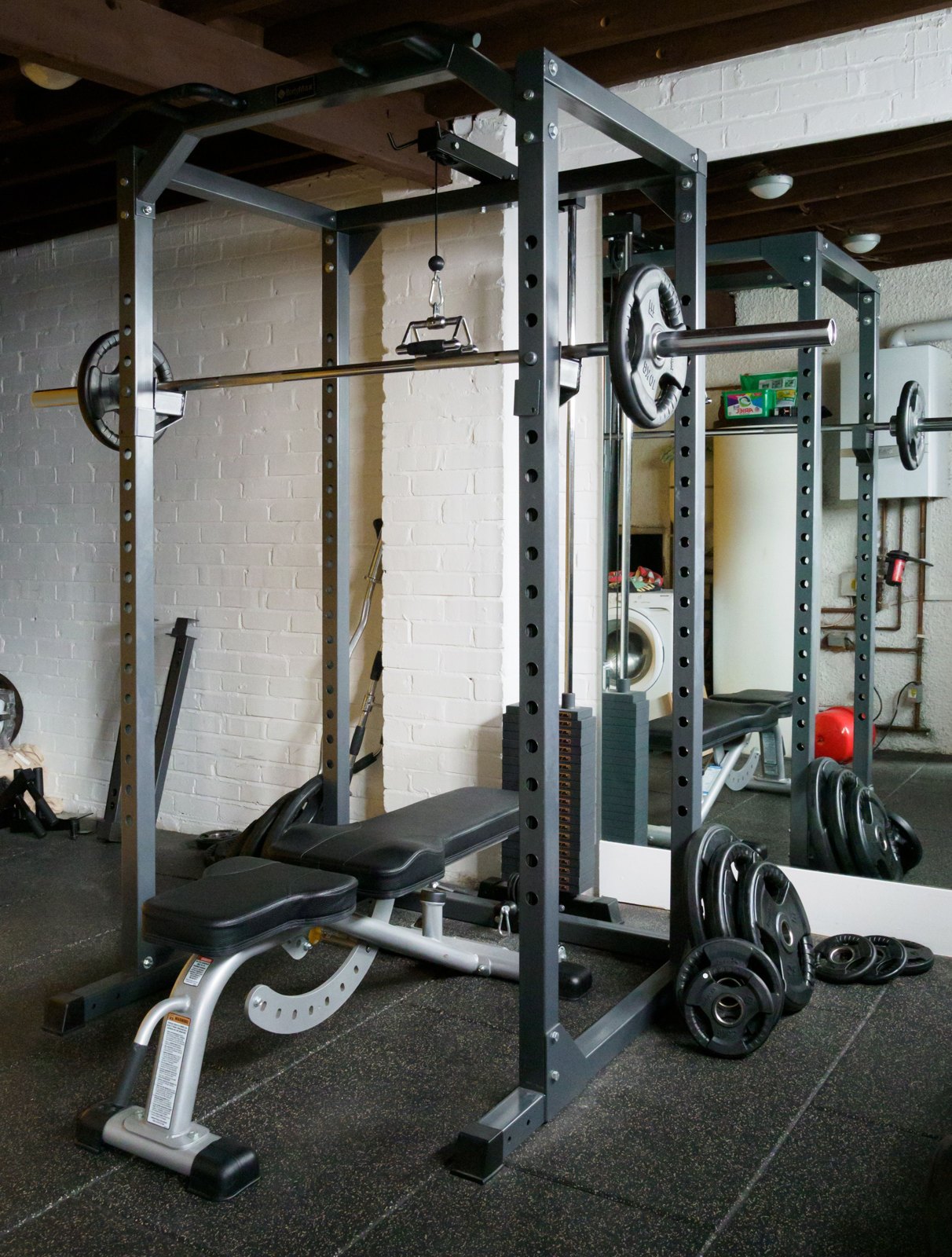
Here's the easily missed restriction: REP says the 1000-Series selectorized attachment's footplate leaves too little room to bench with a spotter inside that setup. Its FAQ recommends benching with a spotter outside the rack. If having someone spot your bench press inside the cage is a requirement, the accessory changes your plan. Ask REP about bench placement and compatible safeties for the exact assembled configuration before ordering. Moving outside does not automatically make every setup safe.
REP answers yes to spotter clearance for its different 4000/5000-Series selectorized lat pulldown and low row. That is a meaningful distinction for someone building around both barbell benching and cable work, but it is not blanket approval of every rack depth and accessory combination. REP lists different added depths for four- and six-post setups. Confirm the chosen configuration, installation instructions, complete price and actual floor space with REP. These manufacturer FAQ details were checked November 5, 2026.
The hidden expense: compare complete rack packages, not bare starting prices
Suppose one rack appears just a little more expensive than another on a collection page. That difference might disappear or grow once you choose the parts needed to train safely. Price the complete setup using the checklist below.
Also check whether your ceiling and surrounding floor area allow assembly, pull-ups, plate loading, and bar movement. The rack's advertised width and upright height are not an installation certification, and a 16-inch crossmember depth isn't the entire front-to-back footprint of every assembled system.
This matters even more with attachments that change how loads act on a rack. REP's installation guidance includes configuration-specific bolting and stabilizer requirements. Follow the current manufacturer instructions for your exact build and don't assume an accessory is safe without the specified mounting arrangement.
For bar and plate compatibility, see our first barbell and plates guide. If you're not sure whether you need an enclosed rack at all, start with our power rack vs. squat stand comparison.
- The exact upright height and rack depth.
- All required crossmembers and structural components.
- The correct J-cup pair and safety system for that rack series.
- Pull-up bar, if it isn't already in the selected package.
- Any stabilizer, floor anchors, or other accessories required by REP for the configuration and planned exercises.
- A compatible barbell and plates, unless you already own them.
- Any bench you need, chosen once, not once for each exercise.
Sources: 6
Two exact configured price snapshots
On October 31, 2026, REP’s builder priced a Metallic Black, 4-post PR-4000 with 93-inch uprights, 30-inch crossmembers and the entry attachment package at $969.93. It included the uprights, crossmembers, 1.25-inch pull-up bar, matching pin-pipe safeties, Standard J-Cups 2.0 and logo plate crossmember. This is a specific package total, not the collection’s starting price.
The corresponding PR-5000 entry package was $1,144.93, a $175 difference. Its Standard J-Cups 2.0 were preorder with an expected November 17 shipping date, so we do not automatically add that package to a ready-to-buy plan. Both examples still need the site-specific installation checks and any required mounting extras. Recreate the stated selections; the seller link does not lock in a configuration.
A rack that fails the installation check is not an upgrade
If the rack you like won't fit your ceiling, costs more than you can spend, or can't be installed the way REP requires, cross it off. A cheaper or smaller rack only helps if it actually works for your lifts and room. It's okay to leave the Home Gym Builder with no rack recommendation until those requirements can be met.
Products in this guide
Compare the exact model, included accessories, delivery, and return terms on the seller’s page.
We may earn a commission from qualifying purchases through these links. As an Amazon Associate I earn from qualifying purchases. Amazon prices are shown on Amazon; dated prices from other retailers are not Amazon quotes. How our links work. Prices, stock, and terms can change.
REP PR-1100 Power Rack, metallic black
Choose it for: Pin-pipe safeties and J-cups included; 85 inches tall; 58.1 inches wide and 48.5 inches deep.
Check before ordering: Verify ceiling, assembly and exercise clearances. Listed 700 lb rackable capacity is not a universal safe-use assessment. Not for kipping or muscle-ups.
View on AmazonOpens AmazonREP PR-4000 4-post, 93-inch, 30-inch, Metallic Black entry package
Choose it for: 3 × 3 inch, 11-gauge uprights; 5/8-inch attachment holes. Includes upright and crossmember sets, 1.25-inch pull-up bar, matching 30-inch pin-pipe safeties, Standard J-Cups 2.0 and logo plate crossmember.
Check before ordering: Recreate this exact entry package in the builder. Rack dimensions are not operating clearance. Follow current configuration-specific anchoring/stabilizer instructions; these installation costs are not included.
Check price & availabilityOpens repfitness.comREP PR-5000 4-post, 93-inch, 30-inch, Metallic Black entry package
Choose it for: 3 × 3 inch, 11-gauge uprights; 1-inch attachment holes. Includes upright and crossmember sets, 1.25-inch pull-up bar, matching 30-inch pin-pipe safeties, Standard J-Cups 2.0 and logo plate crossmember.
Check before ordering: Recreate this exact entry package in the builder. Rack dimensions are not operating clearance. Follow current configuration-specific anchoring/stabilizer instructions; these installation costs are not included. Standard J-Cups 2.0 were preorder with expected November 17, 2026 shipping. Excluded from automatic plans until availability is rechecked.
Check price & availabilityOpens repfitness.comSources & research notes
Sources checked October 31, 2026. Rack specifications and configured October 31 prices come from REP’s documentation and order summaries. The selectorized cable-attachment spotter and footprint details were checked against REP’s product FAQs November 5, 2026. The PR-5000 preorder qualification remains. We have not load-tested or installed these racks.
- REP rack comparison guide with PR-1100, PR-4000 and PR-5000 specifications (opens in new tab)
- REP PR-1100 product page distinguishing 1-inch holes from 3/8-inch hardware (opens in new tab)
- REP comparison details and attachment differences (opens in new tab)
- REP rack builder for exact 4000-series configuration (opens in new tab)
- REP PR-5000 rack builder for exact 5000-series configuration (opens in new tab)
- REP rack installation guidance and depth considerations (opens in new tab)
- REP PR-4000 4-post, 93-inch, 30-inch, Metallic Black entry package: configured order summary, October 31 (opens in new tab)
- REP PR-5000 4-post, 93-inch, 30-inch, Metallic Black entry package: configured order summary, October 31 (opens in new tab)
- REP selectorized 1000-Series lat pulldown and low row: compatibility, depth and bench-spotter restriction (opens in new tab)
- REP selectorized 4000/5000-Series lat pulldown and low row: spotter clearance and configuration-dependent depth (opens in new tab)