Home gym flooring: rubber or foam, and how much do you need?
Rubber or foam under your home gym? It depends on what you'll do on top of it, and what floor you're trying to protect underneath.
Sources last checked October 24, 2026.
Jump to a section
Buy for the activity that is hardest on the floor
A soft puzzle mat may feel great when you're stretching on your knees. Put a heavily loaded bench on it, though, and you've got a different job to solve. And there's no reason to haul thick rubber tiles home if all you need is a spot for floor exercises. Decide what the area must handle before you compare colors and thicknesses.
Tell the flooring supplier exactly what you plan to do: stretch, park a machine, lift weights under control, or drop a barbell. Those activities place different demands on the surface. Thick flooring alone is not permission to drop weights on whatever floor is underneath.
Check the existing floor’s compatibility before ordering a fitness surface. A material suited to your workout can still damage the finish underneath.
Check the floor underneath before ordering
A protective mat can still be incompatible with the finish beneath it. Armstrong’s maintenance guidance, for example, warns that some rubber products can stain vinyl and says contacting rubber should be a non-staining type. That is not a reason to rule out all rubber. It is a reason to ask the manufacturer of your particular floor.
Get the answer for the actual combination: the flooring already in the room, the mat you want to add, and any underlay or adhesive. Do not assume a generic sheet of plastic solves compatibility or moisture concerns. It may introduce a different problem.
For a basement or garage, the subfloor condition also belongs in the decision. REGUPOL’s installation documents specify preparation and moisture requirements for its systems. Use the instructions for the product you buy rather than borrowing a requirement from a different floor.
If you have an uneven surface, unresolved dampness, or concerns about what an upstairs floor can support, deal with those first. A mat is not a structural assessment or a repair.
Considering a permanent stack machine? Our Marcy MWM-990 vs. MKM-81010 comparison separates the listed machine weights from the unanswered question of what your floor can support.
Foam or rubber, after checking your floor
On a small screen, swipe the table sideways.
| Question | Foam tiles | Rubber flooring |
|---|---|---|
| Primary shopping reason | Removable area and comfort for floor exercises | Purpose-made surface for a dedicated fitness area |
| Before putting equipment on it | Verify stability and permitted equipment use | Verify intended loads and installation |
| Floor compatibility | Check the exact material and existing finish | Check staining, moisture, and installation guidance |
| Order calculation | Use tile layout, borders, and actual package coverage | Include format, delivery, edges, and installation |
| What it cannot guarantee | Protection from every impact or quiet neighbors | Protection from every impact or quiet neighbors |
Foam is convenient when you need a removable exercise area
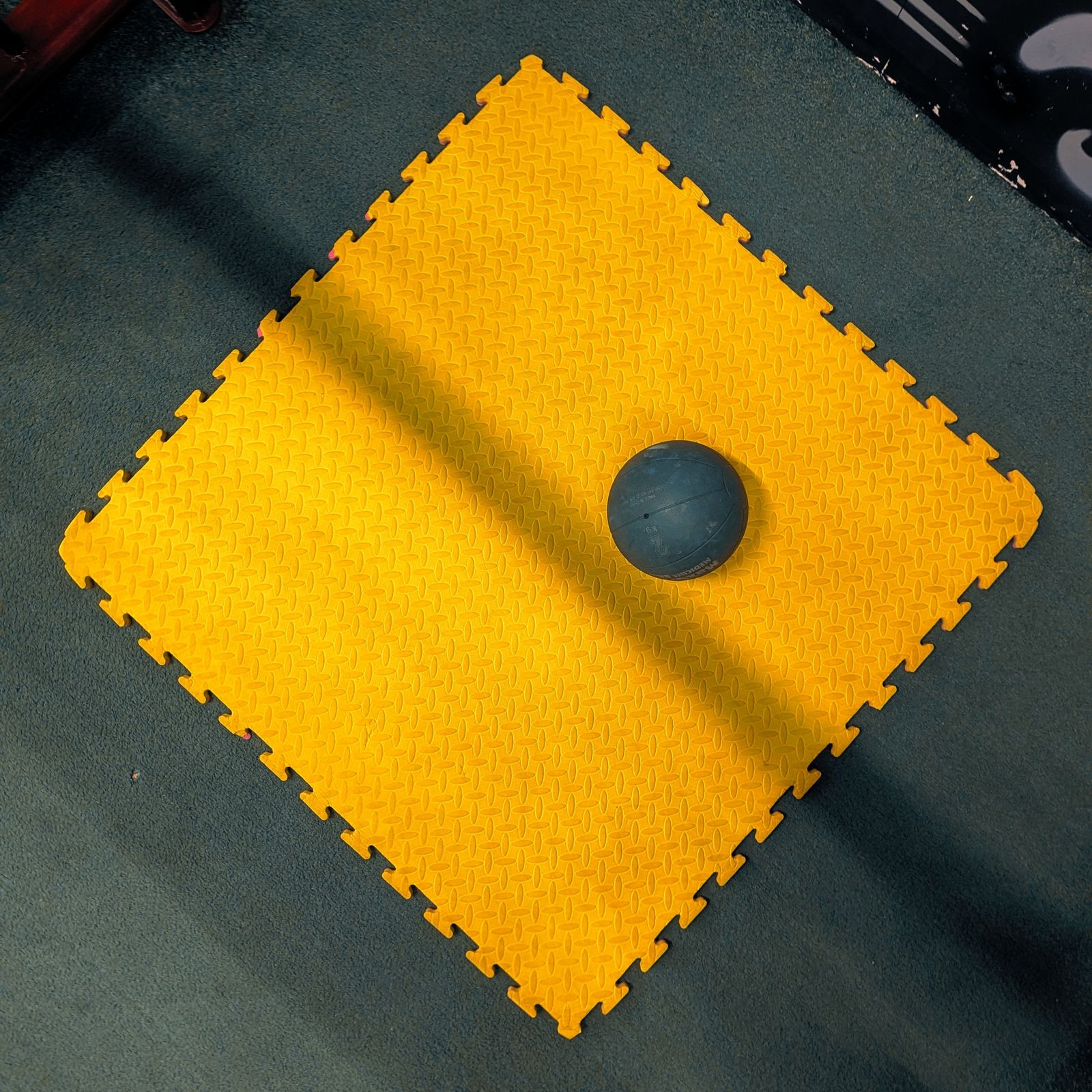
Interlocking foam is appealing because you can cover a small area without installing a permanent floor. It can make kneeling and other floor-based movements more comfortable, and the individual tiles are straightforward to pack away.
The ProsourceFit Diamond Plate Exercise Puzzle Mat 1/2-in is an example made from EVA foam. Look at the exact dimensions and package coverage before ordering, and read the current instructions for the use you have in mind. A package photo showing a roomy gym does not tell you how many packages created it.
For a bench or other equipment, confirm that the mat supports the feet and loads involved. Softness under your knee does not establish stability beneath a loaded bench.
If your main goal is floor exercises and you need to remove everything after use, foam deserves a place on the shortlist. If you want a permanent weights area, compare the rubber options before assuming the softer material is the better deal.
Sources: 1
Rubber needs a closer look than the thickness number
Rubber flooring comes in sheets, rolls, and interlocking tiles. The format affects delivery, installation, seams, and how easily you can move it later. Thickness is one specification, not the entire purchase decision.
Rogue lists a 25-mat bundle with each mat measuring 4 by 6 feet and 3/4 inch thick. That works out to 600 square feet before cutting or layout losses. It is a large-area specification example, not a sensible default shopping recommendation for a small room.
Ask suppliers to confirm the intended exercise use, total weight, edge treatment, and installation method. If the product needs adhesive, that is a different commitment from loose-lay tiles. If you rent, make sure the plan fits what you are allowed to install.
Cover the area your equipment and movements need first. Expanding a suitable installation later is preferable to covering the whole room with the wrong material.
Sources: 2
Measure the usable area, including the awkward edges
Start with a simple sketch. Mark the door swing, storage, bench, weights, and the area where you move around them. A neat rectangle under the equipment is not always enough room to exercise comfortably.
Say the space you've measured is 8 by 10 feet, or 80 square feet. If each package covers 24 square feet, 80 divided by 24 is 3.33, so you'd need at least four packages. That's just the area math, though. Draw how the actual tiles will fit, because seams, cuts, borders and the manufacturer's usable coverage could change the quantity.
Sketch the individual tiles before buying. Decide which edges need a finished border and whether offcuts can be used elsewhere. Ask whether replacement tiles will remain available, especially if you may add to the area later.
Also check door clearance at the finished height. Finding out the door catches the tiles after you have trimmed every edge is an avoidable nuisance.
A quieter landing is not a silent apartment
Flooring may be sold with cushioning or sound-related claims, but do not assume those claims mean a neighbor below will hear nothing. A product description without test conditions is not a useful prediction for your building.
If sound is the main reason for buying, ask for acoustic information relevant to the complete floor assembly and activity. A treadmill, a dumbbell set down gently, and a dropped weight are not the same problem. For a rental, building rules and considerate training hours may affect what you can do regardless of the mat.
Choose movements and handling that suit the room. Place weights down under control, keep equipment stable, and do not use flooring as a reason to ignore an equipment manufacturer’s no-drop instructions. Our adjustable-weight comparisons make those restrictions part of the purchase.
Work out the delivered cost and the cleanup
Compare the total price for your drawn layout: flooring, shipping, borders, approved installation materials, and any help needed to move or fit it. Heavy flooring can be awkward to transport, and an attractive per-square-foot price may not reflect the checkout total.
Ask for cleaning instructions too. Can you use the cleaner you already own? Do you need to lift removable tiles periodically? What does the supplier recommend if water reaches the area? Knowing how you will maintain the floor is part of knowing whether it suits the room.
When reading reviews, look for useful details about the exact product: edge fit, delivery condition, installation, and the surface underneath. Odor reports may help you decide what to ask about, but neither a pleasant smell nor a strong one establishes emissions safety. Ask for relevant product documentation instead.
Ask the supplier to resolve any unanswered use, coverage, or compatibility question before ordering. Shipping and trimming heavy flooring make mistakes costly to undo.
Equipment in this guide
Compare the exact model, included accessories, delivery, and return terms on the seller’s page.
These seller links are not currently affiliate links. How our links work. Prices, stock, and terms can change.
ProsourceFit Diamond Plate Exercise Puzzle Mat 1/2-in
Choose it for: You want to compare removable EVA foam tiles for a home exercise area.
Check before ordering: Confirm suitability for your equipment, existing floor, and layout before buying.
Check price & availabilityOpens prosourcefit.comA few more questions
Is 3/4-inch rubber necessary for every home gym?
No. The appropriate system depends on your activities, equipment, subfloor, and manufacturer instructions. A thickness alone is not a safety rating.
Sources & research notes
Sources checked October 24, 2026. This setup guide draws on the linked flooring manufacturers’ instructions. The coverage calculation is an area estimate, not a tested installation, acoustic result, or structural assessment. Follow the instructions for your exact flooring combination.