Will a Short Barbell Fit Your Power Rack?
A short barbell can fit a power rack, but the total length printed in the product name does not tell you whether it will.
Sources last checked November 11, 2026.
The measurement that matters first is the usable shaft between the sleeves.
A compact bar can be 69 or 72 inches long and still work in a fixed power rack if the manufacturer leaves enough shaft between the sleeve shoulders. Another bar of nearly identical overall length may devote more of that space to its sleeves and become too narrow to sit correctly on standard J-cups.
That is why buying a "6-foot Olympic bar" because your room is small can solve one problem and create another.
Before ordering, check three separate dimensions:
- overall bar length
- distance between the sleeves, or the manufacturer's stated rackable length
- loadable sleeve length
They answer different questions.
Jump to a section
Total bar length only tells you how much room the bar occupies
A normal full-length Olympic-style bar is around 7 feet long.
For example, Rogue lists its 20 kg Ohio Power Bar at 86.52 inches overall.
That number matters when you are trying to fit a rack and bar between garage walls, storage cabinets or other equipment.
It does not establish whether a shorter bar will fit your rack.
A manufacturer can shorten a bar in at least two important places:
- the shaft between the sleeves
- the loadable sleeves themselves
Where that length is removed changes what the bar can do.
Sources: 3
Rogue's C-70 and C-70S show the difference
Rogue currently sells two compact bars that make this unusually easy to see.
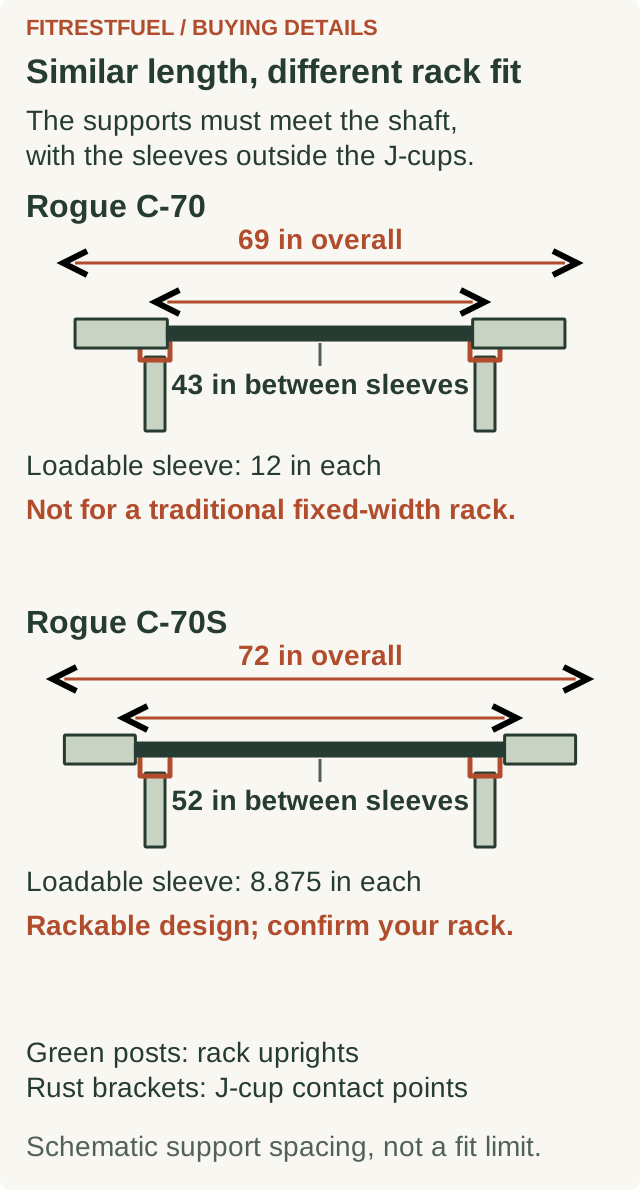
Rogue C-70
The C-70 is:
- 69 inches long
- 43 inches between the sleeves
- 12 inches of loadable sleeve per side
Rogue specifically states that the 43-inch spacing between its sleeves does not allow it to be racked on traditional power racks or fixed squat stands.
It can be used with independently positioned squat stands such as Rogue's S-4 because those supports can be moved closer together.
Rogue C-70S
The C-70S is:
- 72 inches long
- 52 inches between the sleeves
- 8.875 inches of loadable sleeve per side
Rogue designed that 52-inch spacing so the bar can be used on standard power racks and squat stands.
So the C-70S is only 3 inches longer overall than the C-70, yet one is designed to be rackable and the other is not.
The difference is where those inches went.
The C-70S preserves more shaft between its sleeves, while giving up some loadable sleeve length.
A shorter bar usually forces a trade somewhere
Compare those two Rogue bars directly.
The C-70 has:
12 inches of loadable sleeve per side
The C-70S has:
8.875 inches per side
That is:
12 - 8.875 = 3.125 inches less loadable sleeve on each side
In return, the space between the sleeves increases from 43 inches to 52 inches:
52 - 43 = 9 inches
That extra central shaft length is what allows the C-70S to work in standard rack applications.
This is the trade that a product title such as "short Olympic barbell" does not explain.
You can preserve rackability by shortening the sleeves, shorten the central shaft and lose rackability, or use some combination of both.
Two 69-inch bars can have completely different compatibility
Bells of Steel makes the same point from another direction.
Its Short Rackable Barbell is 69 inches overall, yet the company specifically designs it to work with racks within its published width limit.
Its separate Short Utility Bar is also 69 inches long, but Bells of Steel warns that it is not rackable on a standard power rack because the shaft between the collars is shorter.
So "69-inch barbell" is not a compatibility specification.
Neither is "6-foot barbell."
You need the geometry between the sleeves.
What does "rackable length" actually mean?
For a normal fixed power rack, the bar shaft needs to extend far enough across the supports that the J-cups contact the shaft while the sleeves remain outside the rack.
Manufacturers describe this measurement in different ways.
You may see:
- distance between sleeves
- distance between collars
- rackable length
- shaft length between sleeve shoulders
The wording varies, so look at the manufacturer's dimensional drawing or specification table.
Do not confuse it with loadable sleeve length.
Loadable sleeve length describes how much bar is available for weight plates and collars.
A bar can have generous sleeves and still be too narrow through the center to rack.
The Rogue C-70 is a good example.
Do not compare rack width and bar length blindly
Power-rack manufacturers also describe width differently.
One company may publish:
- total outside width
while another gives:
- inside width
- upright spacing
- crossmember length
- J-cup spacing
Those measurements are not interchangeable.
For example, REP currently lists the PR-5000 itself at 50.8 inches wide.
That does not mean you should simply buy any bar with more than 50.8 inches between the sleeves and declare it compatible.
The actual support geometry includes the uprights and J-cups, and cross-brand tolerances may differ.
If the bar manufacturer publishes a specific rack-width limit or explicit rack compatibility, use that information.
If it does not, compare the actual dimensional drawings and confirm uncertain combinations with the manufacturers before buying.
A difference of an inch is not a good place to guess.
Short bars save less usable room than the headline might suggest
A compact bar can still make a meaningful difference in a small gym.
Compare the Rogue C-70S with Rogue's 20 kg Ohio Power Bar.
Ohio Power Bar:
86.52 inches
C-70S:
72 inches
Difference:
86.52 - 72 = 14.52 inches
If the bar is centered in the same position, that removes approximately:
14.52 ÷ 2 = 7.26 inches from each end
That can matter if one sleeve currently sits close to a wall, garage cabinet or another machine.
But do not stop the measurement at the end of the empty bar.
You still need room to load and unload plates.
A bar that technically clears the wall by an inch is not necessarily practical if you cannot comfortably get a plate onto the sleeve.
Sleeve length can become the next problem
The easiest way to make a rackable short bar is to preserve the central shaft while shortening the sleeves.
That solves rack compatibility but reduces loading space.
Rogue's current C-70S has 8.875 inches of loadable sleeve per side.
Its 20 kg Ohio Power Bar has 16.875 inches.
The difference is:
16.875 - 8.875 = 8 inches less loadable sleeve per side
That is substantial.
Rogue says the C-70S can accommodate three of its 45-pound competition-style bumper plates or five standard iron plates on each end while leaving space for collars.
That example should not be treated as a universal plate count.
Plate thickness varies by model. Your own bumpers, irons and collars determine how much weight will physically fit.
If you train with thick bumper plates, sleeve length deserves as much attention as rackability.
Calculate your own plate stack before buying
If the manufacturer gives you loadable sleeve length, compare it with the plates you actually use.
Suppose a short bar has 9 inches of usable sleeve.
Do not simply ask whether your target weight is below the bar's stated capacity.
Instead, add up the physical thickness of the plates you expect to put on one side and include the collar according to its instructions.
For example, a stack of thin steel plates may fit easily where the same weight in thicker bumper plates does not.
Weight capacity and sleeve capacity are two separate limits.
A 1,000-pound-rated bar does not automatically have enough sleeve space for every possible 1,000-pound plate combination.
A shorter bar does not automatically mean a lighter 45-pound bar
Short bars often use different starting weights.
Rogue's C-70 is listed at 35 pounds.
Rogue lists the C-70S at 15 kg with collars included.
A standard men's Olympic or power bar is commonly 20 kg or 45 pounds depending on the model.
That changes your loading calculations.
If your training program assumes a 45-pound empty bar, account for the short bar's actual weight rather than loading plates from habit.
This is particularly relevant when several people use the same home gym and switch between bars.
Independent squat stands change the problem
A non-rackable short bar is not automatically useless for squats or benching.
Some independent squat stands can be positioned closer together.
Rogue specifically points to its independently based S-4 stand as a way to use the C-70 despite that bar's 43-inch spacing.
That does not mean you should modify or narrow a fixed power rack to imitate independent stands.
Use equipment in the configurations its manufacturer permits.
If your goal is to use an existing fixed rack, choose a bar designed to span that rack.
If your goal is simply to save room and you already use appropriate independent stands, a non-rackable short bar may remain an option.
Sources: 1
Measure the room after you confirm rackability
Once you know the bar will work with the rack, check whether it actually solves the room problem.
Measure from the centerline where the bar will sit to the nearest obstruction on each side.
Possible obstructions include:
- walls
- garage-door tracks or framing
- plate trees
- storage shelves
- dumbbell racks
- cable machines
- cars
- doors and cabinets
Then compare that available width with the bar's full length.
Leave usable access at the sleeves for loading and unloading.
There is no single clearance number that works for every setup because plate diameter, plate thickness, grip position and nearby equipment vary.
The useful test is physical: can you bring your largest plate to the end of the sleeve and slide it on without fighting the wall or another machine?
Do not forget collars
A short bar's listed sleeve length is not automatically all available for plates.
Your collar also occupies space.
Different collars use different widths and engagement systems.
If your planned plate stack nearly consumes the entire sleeve, check the collar you actually intend to use before ordering the bar.
Do not plan on running the plates to the absolute end of the sleeve and then discover there is nowhere appropriate to secure them.
A short bar can also affect grip options
Preserving rackability does not guarantee that every short bar reproduces every dimension of the full-length bar you are replacing.
Check:
- shaft diameter
- knurl pattern
- center knurl
- knurl-mark spacing
- bar weight
- permitted uses
Rogue's C-70S, for example, retains a 52-inch distance between the sleeves but uses shorter sleeves and has no center knurl.
That may be perfectly acceptable for the training you do.
It is still different from buying a full-size power bar and simply cutting several inches off each end.
Sources: 2
What should you measure before ordering?
Start with the bar.
Write down:
Overall length: Will the complete bar physically fit the room?
Distance between sleeves or rackable length: Will the shaft span the rack supports correctly?
Loadable sleeve length: Will your plate and collar combination fit?
Then check the rack.
Find the manufacturer's actual rack dimensions and any bar-compatibility guidance.
Do not compare two numbers with different definitions.
Finally, measure the room with the rack where it will actually stand.
The rack fitting in the room and the bar fitting the rack are separate questions.
When a short rackable bar makes sense
A rackable short bar is worth considering when a normal 7-foot bar creates a real side-clearance problem but you still want to squat and bench from a fixed rack.
The C-70S illustrates the design well. Compared with Rogue's 86.52-inch Ohio Power Bar, it saves 14.52 inches of total room while maintaining 52 inches between the sleeves.
The cost is much shorter loadable sleeves.
If your plate stack fits and those roughly 7.26 inches saved at each end solve the room problem, that trade can be useful.
If you have plenty of side clearance already, a full-length bar gives you considerably more sleeve space and avoids creating a constraint you did not have.
Before buying any 6-foot or short barbell
Do not buy from the overall length alone.
Find the manufacturer's specification for the shaft between the sleeves and compare it with the rack it must sit on.
Then check sleeve length using your actual plates and collars.
Only after those two compatibility checks should you decide whether the shorter overall bar saves enough room to be worthwhile.
A short barbell can solve a cramped home gym.
The wrong short barbell can arrive, fit beautifully between the walls, and still be unusable in the rack you bought it for.
Sources and research notes
Sources checked November 11, 2026. This article was researched using current manufacturer specifications and compatibility information from:
- Rogue Fitness C-70 Bar (opens in new tab)
- Rogue Fitness C-70S Bar (opens in new tab)
- Rogue Fitness 20 kg Ohio Power Bar (opens in new tab)
- Rogue Fitness RML-390F Monster Lite Rack (opens in new tab)
- Bells of Steel Short Rackable Barbell (opens in new tab)
- Bells of Steel Short Utility Barbell (opens in new tab)
- REP Fitness PR-5000 (opens in new tab)
No barbells or racks were personally tested for this article. Compatibility conclusions are based on manufacturer specifications, dimensional information and purchase analysis. Confirm an unusual or cross-brand bar-and-rack combination with the manufacturers before ordering.