Can You Put a Treadmill or Walking Pad Upstairs? Floor Safety, Noise, and Vibration
What to check about the floor, the room below and the trip up the stairs before you order.
Sources last checked November 23, 2026.
Yes, a treadmill or walking pad can work in an upstairs room. But whether it belongs in your room depends on the floor, the machine, the way you plan to use it, and what happens downstairs.
A walking pad used gently at a standing desk creates different demands from a full-size treadmill used for running.
There are two separate questions to answer:
Can the floor safely support it? That depends on the floor, the machine, and how you'll use it.
Will people downstairs hear or feel it? That's a noise and vibration question.
A suitable floor doesn't guarantee a quiet workout. A quiet motor doesn't mean your neighbor won't hear your footsteps.
Before ordering, resolve those two questions along with the building rules and the practical cost of getting the machine upstairs.
Jump to a section
Start with your actual situation
On a small screen, swipe the table sideways.
| Your plan | Biggest question to resolve first |
|---|---|
| Walking pad in an upstairs apartment | What vibration reaches downstairs, and what does the building allow? |
| Walking pad in a second-floor home office | Is the floor suitable, and will the room below be disturbed during work hours? |
| Running treadmill in an upstairs bedroom | Can the structure support its intended use, and will running create disruptive impact? |
| Heavy treadmill in an older house or converted room | Has the actual floor structure been assessed for the equipment and activity? |
None of these situations is automatically approved or prohibited.
The correct first check changes with the room.
If you haven't chosen the machine yet, our walking pad versus treadmill comparison explains which type is appropriate for desk walking, faster workouts and running.
Can an upstairs floor safely support a treadmill?
You cannot establish that from the treadmill's weight alone.
Suppose a product listing tells you the machine weighs 250 pounds and supports users up to 300 pounds.
Those numbers answer two useful equipment questions. They do not establish that your upstairs floor is suitable.
The manufacturer's maximum user-weight rating describes a limit of the machine, not the building.
An upstairs installation also involves:
- The floor's framing and support conditions.
- The condition of its structural materials.
- Where the equipment's feet or supports contact the floor.
- The equipment, user and other applicable loads.
- Repeated forces from walking or running.
- Any model-specific installation requirements.
Running produces changing forces over time rather than a single motionless load.
Even knowing the machine's weight and your own weight is not enough to calculate the structural capacity of an unidentified upstairs floor.
Don't use a generic pounds-per-square-foot shortcut
You may see claims that residential floors are designed for a particular number of pounds per square foot.
Those design figures have specific structural meanings. They are not a simple instruction to divide the treadmill's weight by its footprint and declare the installation safe.
They also cannot establish the capacity of a particular existing floor without knowing how that floor was constructed and its current condition.
That shortcut cannot tell you whether your upstairs floor is safe for the equipment.
What should you check before buying?
Start with information you can actually obtain:
- The exact treadmill model. Obtain the current manual, product weight, footprint and installation requirements.
- The planned activity. Are you walking slowly, incline walking or running?
- The building. Is this an ordinary upstairs room, an attic conversion, an older structure or a room with known concerns?
- The floor condition. Have you noticed sagging, unusual movement, damage or changes that need investigation?
- Who can confirm suitability. Ask the property manager or building owner where relevant, or a qualified structural engineer when structural capacity is uncertain.
Do not use a brief exercise session to test whether a questionable floor is strong enough.
A manufacturer example: WOODWAY Curve LTG 2.0
WOODWAY's official Curve LTG 2.0 owner's manual explicitly addresses upper-floor installation.
Its section 5.2 requires the building structure to be checked in advance and gives model-specific guidance on upper-floor positioning and adequate support.
It also identifies the treadmill's weight and the dynamic loading of a person running as relevant to installation.
That is an actual manufacturer requirement, not a general statement about every treadmill.
WOODWAY Curve LTG 2.0 Owner's Manual, printed page 21
Don't turn WOODWAY's specific placement instructions into a universal rule that every treadmill becomes safe when positioned in a corner or beside a wall.
The actual structure still matters.
Walking pad versus full-size treadmill: What changes upstairs?
A compact walking pad can be easier to transport and store, but that doesn't settle floor suitability or downstairs sound.
A full-size running treadmill may have a larger frame, running deck and cushioning system. Those features don't automatically make it quieter through a floor.
On a small screen, swipe the table sideways.
| Factor | Walking pad | Full-size running treadmill |
|---|---|---|
| Intended activity | Often slow walking | Walking, jogging or running, depending on model |
| Typical installation concern | Stable support, desk fit, vibration | Equipment load, running impact, clearance and delivery |
| Downstairs disturbance | Repetitive footfall and machinery vibration | Footfall and machinery vibration, potentially more substantial during running |
| Moving upstairs | Often easier, but check the actual weight and route | Frequently a major delivery and assembly consideration |
| Storage | Some fold compactly | Some fold upward but remain bulky |
| Floor approval | Still building-specific | Still building-specific |
These are category-level distinctions. Specific designs vary.
A walking-only product must not be used for running merely because its motor can reach a speed you find challenging.
If your primary concern is upstairs disturbance, choosing a smaller machine does not guarantee the problem disappears.
Will a treadmill disturb people downstairs?
It might, even if the treadmill sounds quiet to you.
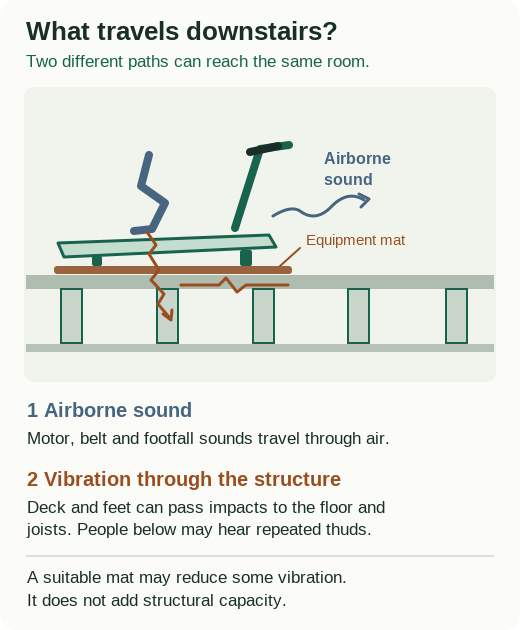
Two paths matter here. Listen for airborne sound near the machine, then have someone listen below during ordinary use. A soft motor hum upstairs can coexist with a distinct thud downstairs.
1. Sound traveling through the air
This includes the hum of the motor, the running belt and ordinary mechanical sound.
You can often hear these sounds beside the treadmill.
2. Impact and vibration traveling through the building
Each footstep loads the running deck. Mechanical movement can also enter the floor through the treadmill's feet.
Those vibrations can travel through connected floors, ceilings and walls, where people in other rooms may hear a repeated thud or feel a rhythmic vibration.
Someone upstairs may hear a soft belt hum while someone downstairs hears repeated footsteps.
Published building-acoustics research distinguishes these sound paths because they behave differently.
National Ready Mixed Concrete Association: Acoustics Information, page 4
Does a concrete floor prevent treadmill vibration?
Not necessarily.
Concrete and wood-framed floors have different acoustic characteristics. But neither construction type is automatically soundproof.
Research from the National Research Council of Canada identifies impact-sound complaints in both concrete-slab and wood-joist buildings.
Hard finishes installed over concrete can still transmit substantial impact noise.
National Research Council: Controlling the Transmission of Impact Sound through Floors
The actual floor assembly matters more than simply identifying it as concrete or wood.
Is walking quieter than running?
Walking usually involves less forceful footstrike than running, making it a sensible activity to examine first when noise is a concern.
But the result still depends on the machine, pace, walking style, floor and building.
A walking pad can produce enough repeated vibration to disturb someone downstairs.
A compact machine advertised as quiet may have a low motor-noise figure without any reliable measurement of how its vibration travels through your particular floor.
Don't use a manufacturer's room-level decibel claim as a prediction of what your neighbor will hear.
Sources: 3
Do treadmill mats reduce downstairs noise?
A suitable equipment mat may help. It cannot guarantee silence.
The most useful approach is to identify what you need the mat to accomplish.
On a small screen, swipe the table sideways.
| Goal | Can a mat help? | What it cannot establish |
|---|---|---|
| Protect the floor finish | Yes, with compatible materials | Protection from all marks or staining |
| Reduce sliding or direct contact | Potentially, if stable and correctly fitted | Stability on an unsuitable floor |
| Reduce some transmitted vibration | Sometimes | Quiet operation in the room below |
| Increase structural floor capacity | No | Safe support of the treadmill |
| Fix a noisy or damaged treadmill | No | That maintenance or repair is unnecessary |
Don't choose the softest material automatically
Soft foam tiles, thick rugs and improvised padding can make a machine unstable.
A mat should support the equipment as its manufacturer requires, without curling, sliding, blocking ventilation or interfering with moving parts.
Avoid stacking miscellaneous pads, foam tiles or folded towels in an attempt to stop vibration.
There is no verified universal mat thickness or material density that makes every upstairs treadmill quiet.
Check the exact equipment's placement instructions and the flooring manufacturer's compatibility guidance.
Some floor finishes can also react badly to certain rubber or backing materials.
Our home gym flooring guide explains those material and surface-compatibility considerations.
What about carpet?
Carpet may affect room sound and impact transmission, but a thick or padded carpet can also make an exercise machine unstable or interfere with its airflow.
For the C2, WalkingPad’s treadmill support guidance advises against direct carpet placement and recommends a rubber equipment mat. The machine still needs firm, level support and airflow underneath.
Our WalkingPad C2 carpet guide addresses that specific model.
Do not transfer the C2's instructions automatically to a different walking pad.
Sources: 4
The upstairs treadmill decision checklist
Before placing an order, work through these checks.
On a small screen, swipe the table sideways.
| Question | What resolves it? |
|---|---|
| Is the floor structurally suitable? | Relevant building information and qualified assessment where needed |
| Does the machine suit the intended activity? | Exact product specifications and manual |
| Can it sit securely on the available surface? | Manufacturer-approved placement, leveling and stability |
| Will the building permit the equipment? | Lease, condominium rules or property-management confirmation |
| Is the operating area large enough? | Model-specific clearance, ceiling height and safe access |
| Can it receive appropriate electrical power? | Manufacturer's electrical instructions |
| Is the noise acceptable downstairs? | A practical evaluation after installation suitability has been established |
| Can it be delivered and returned? | Confirmed transport, assembly, removal and return arrangements |
If an essential answer is missing, resolve it before ordering rather than assuming a mat or a quieter model will make the problem disappear.
Ceiling clearance is easy to forget
For a running treadmill, the ceiling needs to accommodate the user standing on the running surface, not merely the user's height standing on the room's floor.
Consider the deck height, running movement and any incline-related change in height.
A sloped upstairs ceiling makes the location especially important.
Use your exact model's manual and the actual position where you intend to exercise.
Also preserve the manufacturer-required clearance behind and around the machine.
Check the electrical requirements
Full-size treadmills can have model-specific requirements for circuit capacity, grounding, outlet type and use of extension cords.
Do not improvise an electrical setup because an upstairs room has a conveniently located outlet.
For more detail, see Does Your Treadmill Need a Dedicated Electrical Circuit?.
How to test whether your walking pad is too loud downstairs
A downstairs listening test is useful for evaluating noise, but only after building suitability, manufacturer instructions and any applicable rules have been addressed.
It is not a test of structural capacity.
Step 1: Set up the machine properly
Use the approved floor surface and any compatible mat.
Make sure the machine sits flat and stable, has adequate clearance and is free of loose objects that might rattle.
Follow its startup and safety instructions.
Step 2: Arrange a downstairs listener
If possible, ask someone to listen in the occupied room directly beneath the machine.
Choose a reasonable time and agree on a short evaluation.
Step 3: Walk at your intended pace
Start at a comfortable, manufacturer-permitted walking pace.
Have the listener report what they hear.
Is it:
- A steady mechanical hum?
- A repeating footstep thump?
- A buzz or rattle?
- Physical vibration in the room?
These observations can help identify what to investigate.
Do not run an unapproved speed test or continue if the machine shifts, the floor moves unexpectedly or concerning mechanical noise appears.
Step 4: Compare one appropriate change
If the setup is stable, try one manufacturer-approved change, such as correcting the machine's placement or using a compatible equipment mat.
Then compare the downstairs sound again.
Changing several things at once makes it harder to know what helped.
Step 5: Decide whether the setup works
A useful test can show whether the current arrangement is tolerable to the people involved.
It cannot guarantee the same result at every pace, every hour or throughout the machine's life.
If nobody can listen downstairs, you cannot reliably judge their experience from the sound in your own room.
Treat that uncertainty as part of the purchasing decision, especially if returning the machine would be expensive.
What if your downstairs neighbor has already complained?
Don't immediately buy more foam.
First, find out what the person is actually noticing.
If they hear rhythmic thumping, walking impact may be a major factor.
If they hear rattling or buzzing, check whether the machine is stable, contacting furniture or developing a mechanical problem.
If they feel vibration rather than hearing a loud motor, the building transmission path may matter more than the machine's advertised noise rating.
Try reasonable measures that fit your equipment:
- Confirm the machine is stable and correctly positioned.
- Follow the manufacturer's maintenance instructions.
- Consider a lower, comfortable walking pace.
- Compare a compatible mat or different approved location.
- Arrange another downstairs listening check.
- Discuss a workable schedule if that would help.
Do not open the motor housing or modify the frame to chase a noise problem.
A new grinding sound, damaged belt, unusual heat or unstable movement is a reason to stop the machine and seek appropriate service.
If the disturbance remains unacceptable, a downstairs room, a different form of exercise or returning the machine may be the practical solution.
A mat is not a promise that the problem can be fixed.
Apartment and condo rules: Check before buying
Living in an upstairs apartment adds a restriction that a single-family homeowner may not face.
Your lease, condominium association or building management may have requirements concerning exercise equipment, noise, floor coverings, delivery or building access.
Before buying, ask two separate questions:
Is this equipment permitted in the room?
Are there restrictions on how or when it can be used?
A manufacturer calling a walking pad "apartment-friendly" does not establish permission from your building.
And using a treadmill during ordinary daytime hours does not guarantee it won't disturb someone downstairs.
Find out what the actual rules require, then evaluate the equipment within those conditions.
When should you avoid installing a treadmill upstairs?
There are situations where the next step should be further investigation, not another accessory purchase.
Pause the installation when:
- The floor has visible structural concerns or unusual movement.
- You don't know whether a heavy machine is appropriate for the building.
- A manufacturer requires structural approval that hasn't been obtained.
- The machine cannot sit level and stable.
- The proposed mat or carpet arrangement conflicts with the equipment instructions.
- Required operating or emergency clearances cannot be met.
- The building does not permit the intended setup.
- The required electrical supply is unavailable.
- The equipment cannot be safely delivered to the room.
If structural capacity is uncertain, get qualified advice before using the machine.
A floor that feels solid during an ordinary walk has not automatically been approved for treadmill running.
Before buying: Can you get the machine upstairs and return it?
A treadmill can fit beautifully in an upstairs bedroom and still be the wrong purchase because of the staircase.
The difficult measurements may involve the carton, the main frame, a narrow landing or the turn at the top of the stairs.
"Folding" describes a storage mechanism. It doesn't establish that a delivery crew can carry the machine upstairs.
Check what delivery actually includes
WalkingPad's official FAQ says its standard shipping does not guarantee delivery inside the home, into a particular room or upstairs.
White-glove placement is not listed as a standard service.
That matters even for smaller exercise equipment.
For a full-size running treadmill, ask whether the selected service includes stairs, room placement and assembly, and whether access limitations can change the service.
Check how a return works
Suppose the machine arrives upstairs, but the noise is unacceptable.
You may have to arrange for the treadmill to be disassembled, repackaged, moved downstairs and collected.
The return cost may differ from the delivery cost.
Before checkout, confirm:
- Who carries the machine upstairs?
- What happens if it cannot fit around the stair turn?
- Who moves it downstairs if returned?
- Is the original packaging required?
- What return shipping or removal charges apply?
- How long is the return window?
Our detailed treadmill doorway, stair and room-fit guide covers these measurements and delivery questions.
For someone whose main concern is downstairs noise, the return policy is especially important. You may not know how the completed setup behaves until it is operating in your building.
So, should you put your treadmill upstairs?
An upstairs setup makes sense when the floor and machine are suitable, the building permits it, and you can get the equipment into the room safely.
If downstairs noise is your main concern, don't buy solely because a product is advertised as quiet. Plan how to evaluate the setup and check the return and removal terms before ordering.
Uncertain structural capacity is a reason to stop until the floor has been assessed. And if reasonable attempts to address a downstairs complaint don't work, another location may be the better choice.
The goal is a treadmill you can use comfortably without creating a structural, noise or delivery problem.
Frequently asked questions
Can you put a treadmill on the second floor of a house?
Potentially, yes. The floor structure, equipment, activity and manufacturer's instructions determine whether a particular installation is suitable. Don't rely on a generic floor-weight formula to approve it.
Is a walking pad too noisy for an upstairs apartment?
Not necessarily. Your building's construction, the machine and the way you use it determine the result.
Will a treadmill damage hardwood floors?
An unsuitable machine or mat arrangement can cause movement, marks or finish damage. Check that the equipment is properly supported and that the protective material is compatible with your floor finish.
Will a rubber mat stop vibration downstairs?
It may reduce some transmission in some setups, but it cannot guarantee that the person below won't hear or feel the treadmill.
Is a heavier treadmill automatically more dangerous upstairs?
Not automatically. Machine weight is one relevant factor alongside the building's structure, equipment contact points and intended activity. It is not enough by itself to determine suitability.
What if I can't access the downstairs room for testing?
You can check machine stability, maintenance and setup from your own room, but you won't know exactly what someone below hears. If that uncertainty matters, examine the building's rules and the return arrangements before buying.
Should I buy a walking pad instead of a full-size treadmill?
Choose for the activity first. A walking pad may be more convenient for desk walking and storage, but it is not automatically silent or approved for every upstairs floor. If your goal is running, choose equipment intended for running and evaluate the proposed installation separately.
Sources and manufacturer documentation
Sources checked November 23, 2026.
- WOODWAY Curve LTG 2.0 Owner's Manual, section 5.2, printed page 21 (opens in new tab)
- National Research Council Canada, Controlling the Transmission of Impact Sound through Floors (opens in new tab)
- National Ready Mixed Concrete Association, Compilation of Acoustics Information for Concrete Construction and Other Materials, July 2022 (opens in new tab)
- WalkingPad, Walking Pad on Hardwood Floors: A Safe Setup Checklist for Upstairs Use, November 17, 2026 (opens in new tab)
- WalkingPad, Frequently Asked Questions, including upstairs delivery guidance (opens in new tab)
- WalkingPad Canada, How to Reduce Treadmill Noise at Home, October 27, 2026 (opens in new tab)
- NordicTrack, Can You Use a Treadmill in an Apartment?, July 20, 2026 (opens in new tab)
- WalkingPad product support, carpet placement guidance (opens in new tab)