Will Your Treadmill Fit Through the Door and Into the Room?
A treadmill fitting in the room does not mean you can get it into the room.
Sources last checked November 11, 2026.
The assembled dimensions are only one part of the check.
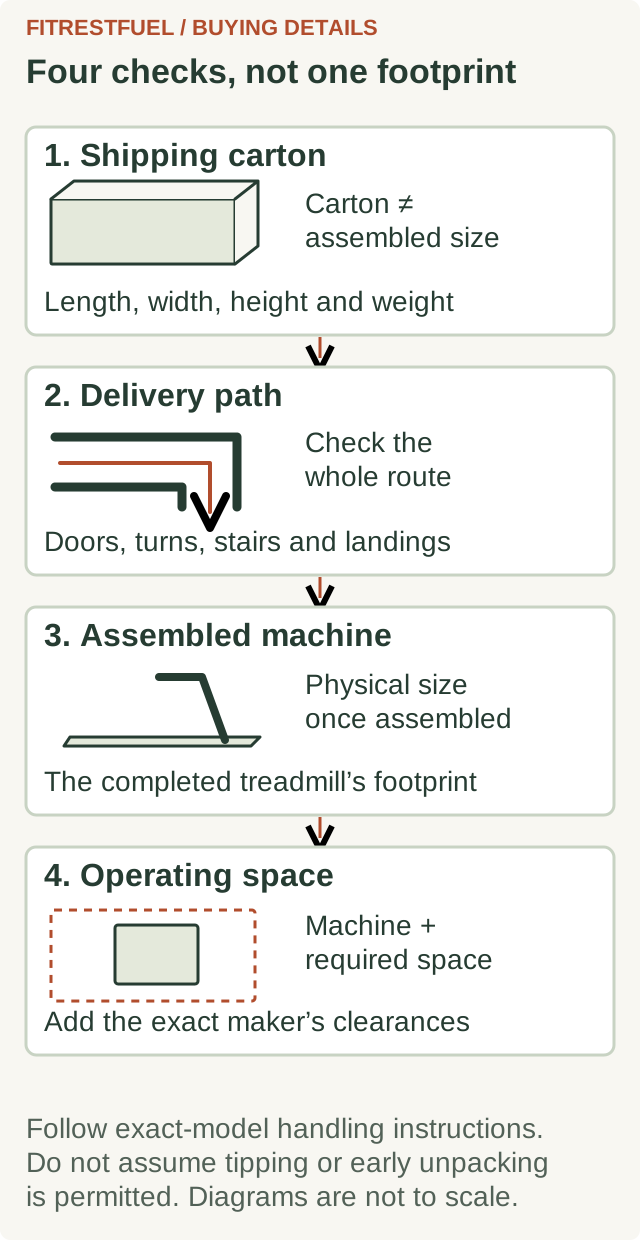
Before ordering a full-size treadmill, you also need to know how large it will be when delivered, whether the manufacturer expects it to be unpacked in the final room, whether the carton can make every turn along the route, and how much usable space the treadmill needs once it is running.
Those are separate problems.
A machine can fit beautifully against the basement wall and still get stuck at the top of the stairs.
Jump to a section
Check three different footprints
For a large treadmill, record three sets of dimensions. Dimensions below are length × width × height.
Shipping dimensions
This is the carton that has to get from the delivery point to wherever the machine will be unpacked.
Assembled dimensions
These tell you whether the completed machine fits through a doorway if it ever has to move after assembly and whether the physical treadmill fits in the intended room.
Operating clearance
The treadmill needs more room than its steel frame occupies.
Manufacturers may specify open space behind or beside the machine for safe access and emergency exit.
Do not combine these three measurements into one "will it fit?" calculation.
Measure the route before the room
Walk from the delivery entrance to the treadmill location.
Measure the narrowest point along the entire path.
That can include:
- exterior doors
- interior doors
- hallway width
- 90-degree hallway turns
- stair width
- stair landings
- railings
- low ceilings over stairs
- basement bulkhead doors
- closet corners
- furniture that cannot easily move
A 36-inch doorway halfway through the route does not help if there is a 29-inch opening at the end.
Write down the narrowest clear measurement at every stage.
Measure the actual open doorway, not the number on the door
If someone tells you the room has a 30-inch or 32-inch door, measure it anyway.
You need the clear opening with the door in its actual open position.
The door itself, hinges, stops and hardware can reduce usable space.
Measure:
Clear width: from the narrowest obstruction on one side of the opening to the narrowest obstruction on the other.
Clear height: from the finished floor or threshold to the lowest point at the top of the opening.
Also check whether the door can swing fully out of the delivery path.
Removing a door temporarily may create additional room in some homes, but do not build the entire delivery plan around that assumption without measuring what the opening becomes.
The shipping box can matter more than the treadmill width
Consider the current U.S. Horizon 7.0 AT, SKU HTM1457-01.
Horizon lists the assembled treadmill at approximately:
76 × 35 × 67 inches
Its shipping carton is approximately:
79.5 × 30 × 13.4 inches
The assembled machine is wider than the shipping box, but the carton is longer and weighs about 332 pounds.
That tells you two things.
First, checking only the assembled 35-inch width could make you think a narrower doorway automatically rules out delivery.
It does not.
Second, checking only the 30-inch carton width does not prove the box will make it through the house either.
The box is almost 80 inches long, and it still has to be moved through the route using handling orientations permitted by the manufacturer.
SOLE provides another good example
The 2026 U.S. SOLE F80 measures approximately:
77 × 36 × 59 inches assembled
Its carton measures:
81 × 31 × 13 inches
The machine weighs about 223 pounds, while the packaged shipment is about 244 pounds.
Notice what happened.
The treadmill becomes wider after assembly, while the carton is longer than the finished machine.
So neither set of dimensions can replace the other.
If the carton is going upstairs before assembly, use the carton measurements for that route.
If you ever expect to move the completed F80 out of the room later, the 36-inch assembled width becomes relevant too.
Sources: 4
A big treadmill can arrive in a surprisingly thin carton
NordicTrack's Commercial 1750, model NTL17125, provides an even more dramatic example.
The assembled treadmill is approximately:
77.3 × 37 × 59.5 inches
The shipping package is approximately:
84.1 × 35 × 14.8 inches
The package weighs more than 300 pounds.
If the manufacturer permits the required handling orientation, its 14.8-inch thickness may help with certain openings. The carton is also more than 7 feet long.
A doorway is therefore not a one-number test.
You have to think about the box as a three-dimensional object that may need to change orientation while moving through the house.
Sources: 6
A box wider than the doorway does not automatically mean it cannot pass
Suppose a treadmill carton measures:
81 × 31 × 13 inches
and your doorway is less than 31 inches wide.
That does not automatically prove the package cannot pass.
If the manufacturer permits that handling orientation, the carton may be able to turn so the 13-inch dimension passes through the door instead.
Whether it can pass depends on the carton’s orientation, the doorway’s clear width and height, and the space on both sides for maneuvering. Turning the carton onto its narrow edge does not necessarily mean standing its full length upright.
This is why comparing:
box width vs. door width
is only the first check.
A long rigid object may pass through a narrow opening edge-on but still fail because there is no room in the hallway to turn it.
Corners are often harder than doors
A straight doorway can look like the tightest part of the trip.
Then the treadmill reaches a 90-degree hallway corner.
Long boxes need room to swing.
Measure both hallways as well as the open area at the turn.
Pay attention to:
- wall corners
- door frames
- radiators
- railings
- built-in cabinets
- low light fixtures
A package that fits independently down Hallway A and Hallway B may still be unable to transition between them.
There is no useful universal "minimum hallway width" for treadmills because carton length, width, thickness and the exact corner geometry differ.
If the turn looks close, give the manufacturer or delivery company the actual measurements before ordering.
Stairs need more than stair width
For basement and upstairs installations, measure:
- clear stair width
- ceiling height over the stairs
- landing dimensions
- railing clearance
- turn at the top
- turn at the bottom
- doorway immediately before or after the staircase
The landing deserves special attention.
A straight flight of stairs may be wide enough for the treadmill carton, but a small square landing at the bottom can leave nowhere to rotate an 80-inch package toward the basement room.
Low headroom over the stairs can create the same problem.
The box may fit through the doorway horizontally but need to tilt upward on the stairs, bringing one end into the ceiling.
Weight changes what is realistically movable
Dimensions tell you whether an object can theoretically fit.
They do not tell you whether people can safely maneuver it.
Current examples show why.
The Horizon 7.0 AT ships at roughly 332 pounds.
NordicTrack lists the current Commercial 1750 package at approximately 311.5 pounds.
Matrix lists the assembled T30 itself at about 289 pounds.
Those are not ordinary furniture-box weights.
If the route includes stairs, sharp turns or other difficult movement, professional room-of-choice or assembly delivery may be worth more than trying to solve the geometry after curbside delivery.
Check exactly what the retailer's delivery service includes before paying for it.
Do not assume you can unpack the treadmill early to make it fit
Opening the carton outside the room and carrying the treadmill in separately may sound like an easy solution to a tight doorway.
Before planning around that approach, read the unpacking and assembly instructions for your exact model and generation.
Check where the manufacturer says to unpack it, which packaging or transport restraints must remain in place, and when the machine may be lifted or moved.
Do not remove restraints or move a partially assembled treadmill unless the manufacturer's instructions permit it.
If your delivery route depends on unpacking the machine before it reaches the room, confirm that plan with the manufacturer or delivery company before ordering.
Matrix explicitly designs its packaging around door access
Matrix gives buyers a useful piece of information in its current return policy.
The company says its packaging is designed to fit through 30-inch doors.
That is notable because the current Matrix T30 is about:
77 inches long × 35 inches wide × 62 inches high
once assembled.
So the finished treadmill's 35-inch width does not tell you how wide the delivery package is.
Matrix's return policy also states that the customer is responsible for moving the product beyond the threshold and that Matrix is not responsible if the product does not fit through the doorway.
That is worth knowing before delivery day.
Measure first.
For a specific owner's assembly experience, see the Matrix T30 review.
Room-of-choice delivery does not eliminate the fit problem
Some manufacturers and retailers offer:
- threshold delivery
- room-of-choice delivery
- white-glove delivery
- room-of-choice plus assembly
Those services are useful, but the delivery crew still has to physically get the equipment through the building.
Peloton, for example, currently tells buyers to clear the entire access route from the entrance to the selected room before Tread Vision delivery.
SOLE offers room-of-choice and assembly upgrades for its current treadmills.
Horizon also offers delivery tiers that can include room-of-choice placement and assembly.
Ask what happens if the delivery team determines that the route is unsafe or physically impossible.
Do not assume paying for assembly guarantees that every staircase and doorway becomes workable.
The treadmill also has to fit after the delivery crew leaves
Now check the final room.
Start with the assembled footprint.
The current Peloton Tread Vision, for example, is approximately:
68 × 33 × 65 inches
That sounds fairly compact compared with some full-size treadmills.
Peloton nevertheless specifies substantially more room around it, including approximately:
- 24 inches in front
- 24 inches on each side
- 79 inches behind
The safe operating area is therefore much larger than the physical 68 × 33-inch footprint.
Matrix similarly tells treadmill owners to leave approximately:
- 1 foot in front
- 2 feet of access space, preferably on both sides
- at least 79 inches clear behind the treadmill
A treadmill "fitting" between a wall and a dresser does not mean the location meets the manufacturer's operating-clearance requirements.
Check the treadmill's electrical requirements before choosing its final location, too.
The door still needs to work after installation
This is easy to overlook in a small room.
Tape out the treadmill and required clearance on the floor.
Then open:
- the room door
- closet doors
- cabinets
- storage drawers
Check whether they still function.
A treadmill can fit within the room dimensions while blocking the only practical route around the machine.
Also make sure the treadmill does not block the room's normal exit path.
Folding dimensions solve storage, not delivery
A folding treadmill may become much shorter when the running deck is raised.
That is useful after assembly.
It does not mean the treadmill arrives folded into those dimensions.
For example, the current SOLE F80 is approximately:
77 × 36 × 59 inches open
and:
48 × 36 × 66 inches folded
Its shipping box is still:
81 × 31 × 13 inches
Those are three different configurations.
Use the one that applies to the job you are checking.
Sources: 4
Do not assume transport wheels make a treadmill easy to relocate
Transport wheels can help reposition an assembled treadmill on a flat floor.
They do not turn a 250- or 300-pound treadmill into a suitcase.
They may also only work with the treadmill held in a particular folded or tilted position.
Check the manual before assuming you can assemble the treadmill in a large room, roll it down the hallway and then turn it into a smaller room.
The doorway and corner still have to accept the assembled machine in the orientation required for transport.
Sources: 10
Measure before replacing an old treadmill too
If a treadmill is already in the room, it is tempting to assume another treadmill can use the same route.
That is only safe when the new machine has similar delivery dimensions.
A replacement might have:
- a wider carton
- a longer deck
- a larger console
- more weight
- different assembly instructions
- a non-folding frame
The old machine successfully entering the room proves that the old machine could get there.
Check the new one independently.
If the route rules out a full-size treadmill, Walking Pad vs. Treadmill explains the differences in intended use before you choose a smaller machine.
A practical treadmill delivery checklist
Before ordering, create a small measurement sheet.
Treadmill
Record:
- shipping length
- shipping width
- shipping height
- shipping weight
- assembled length
- assembled width
- assembled height
- assembled weight
- folded dimensions, if applicable
- required operating clearance
Route
Record:
- exterior-door clear width and height
- narrowest interior-door opening
- hallway width
- tightest corner
- stair width
- lowest stair ceiling
- landing dimensions
- final room doorway
- final room dimensions
Delivery
Confirm:
- curbside or threshold?
- room of choice?
- stairs included?
- assembly included?
- packaging removed?
- what happens if the delivery crew cannot reach the selected room?
Assembly
Check the manufacturer's instructions for:
- where the machine should be unpacked
- how many people are required or recommended
- whether the treadmill can be moved partially assembled
- how it should be moved once fully assembled
Do not wait until the carton is sitting in the driveway to read that section.
Use the shipping dimensions for the path and the assembled dimensions for the destination
That is the simplest way to remember the process.
Delivery route: Start with the carton or manufacturer-approved transport configuration.
Final room: Start with the complete assembled treadmill and add the manufacturer's operating clearance.
Future movement: Check the folded or approved assembled transport configuration.
None of those measurements substitutes for the others.
Use the Home Gym Builder to shortlist equipment, then verify the room and route
FitRestFuel's Home Gym Builder can help you shortlist equipment for your goals and budget. Its Room Studio is a planning aid, not confirmation of doorway access, operating clearances or a safe delivery route.
For a treadmill, the final room is only half the fit check.
Once you have a machine in mind, use the exact current manufacturer specifications and trace the physical delivery path from the entrance of your home to the intended location.
A treadmill can be the perfect size for your workout area and still be the wrong purchase for the staircase that leads to it.
Before you click Buy
Do this in order:
- Find the exact treadmill's shipping dimensions and shipping weight.
- Read its unpacking and assembly instructions.
- Measure every doorway and narrow point along the route.
- Check corners and stair landings, not just straight widths.
- Confirm what your delivery service will actually carry and assemble.
- Measure the treadmill's assembled footprint in the room.
- Add the manufacturer's required operating clearance.
If any part is close, ask the treadmill manufacturer or delivery company before ordering.
Returning a large treadmill because it could not make the final turn into the basement is a much worse way to discover the answer.
Sources & research notes
Sources checked November 11, 2026. Manufacturer specifications and delivery guidance checked November 11, 2026. This is a measurement-planning guide, not a delivery-route assessment or hands-on transport test. Confirm handling, access and operating requirements for the exact model, generation and delivery service.
- Horizon 7.0 AT, HTM1457-01: current US dimensions and separate unit/shipping weights (opens in new tab)
- Horizon 7.0 AT: current US SKU and delivery/assembly tiers (opens in new tab)
- Horizon: US delivery scope and access restrictions (opens in new tab)
- SOLE F80: 2026 US assembled, folded and carton dimensions; unit and gross weights (opens in new tab)
- SOLE: delivery tiers, stair allowance and access restrictions (opens in new tab)
- NordicTrack Commercial 1750, NTL17125: assembled and in-box dimensions and shipping weight (opens in new tab)
- Matrix T30: assembled dimensions and product weight (opens in new tab)
- Matrix: return policy, packaging and 30-inch-door statement (opens in new tab)
- Matrix treadmill support: front, side-access and rear clearances (opens in new tab)
- Matrix home treadmill guide: operating clearances and approved moving configurations (opens in new tab)
- Peloton Tread Vision: current US dimensions, operating clearances and delivery preparation (opens in new tab)