Can You Keep a Treadmill in a Garage? Temperature Limits and Warranty Rules by Model
Some treadmills prohibit garage placement even when the space is heated. Check your model's environmental and warranty requirements before buying.
Sources last checked November 24, 2026.
A treadmill can fit perfectly inside your garage and still be unsuitable for that location.
Some manufacturers specifically prohibit garage placement. Others require an insulated, climate-controlled environment. Some publish operating and storage temperature limits without explicitly approving garages.
For example, the NordicTrack Commercial 1750 NTL17125.0 owner's manual prohibits garage placement. The SOLE F63 warranty requires an insulated, climate-controlled environment.
Wahoo publishes a much wider storage temperature range for its KICKR RUN, but that alone doesn't establish garage suitability.
Before buying a treadmill for your garage, check five things:
- Whether the manufacturer permits the location.
- Operating temperature requirements.
- Storage temperature requirements.
- Moisture and humidity restrictions.
- Electrical and warranty requirements.
Meeting one requirement doesn't automatically satisfy the others.
Jump to a section
Treadmill garage requirements by model
We reviewed manufacturer documentation to identify the following environmental requirements.
This comparison focuses on US-market equipment and the specified manual editions. Where numerical limits are missing, the applicable requirements haven't been established.
On a small screen, swipe the table sideways.
| Treadmill | Garage or environmental restriction | Operating temperature | Storage temperature |
|---|---|---|---|
| NordicTrack Commercial 1750 NTL17125.0 | Garage placement expressly prohibited | Not established | Not established |
| SOLE F63, 2026 Version A | Insulated, climate-controlled environment required under warranty | Maximum 104°F | Not established |
| SOLE F63, 2023 Revision D | Insulated, climate-controlled environment required under warranty | Maximum 104°F | Not established |
| Horizon T202, reviewed historical manual | Garage placement prohibited; temperature-controlled environment required | Not established | Not established |
| Matrix residential treadmills covered by linked guide | Indoor climate-controlled room; garage placement restricted | Not established | Not established |
| Wahoo KICKR RUN WFRUN1 | Temperature limits published; garage approval not established | 20°F to 95°F | -22°F to 140°F |
| Peloton Tread, reviewed TR02 North American documentation | Indoor use and storage; damp and high-humidity environments prohibited | Not established for this exact version | Not established for this exact version |
| Redesigned AssaultRunner Pro | Manufacturer markets garage use; permanent unconditioned storage requirements not established | Not established | Not established |
The current Horizon T202 SKU HTM1386-01 could not be conclusively matched to the reviewed historical manual.
We did not establish unconditional approval for an unconditioned garage for any of these machines.
NordicTrack Commercial 1750
The owner's manual for NTL17125.0 instructs owners to keep the treadmill indoors, away from moisture and dust.
Its precautions specifically prohibit placing the treadmill in a garage, covered patio or location near water.
Adding a heater doesn't override that instruction.
If you're considering a converted garage that functions as an indoor living space, obtain written clarification from NordicTrack before purchasing.
Source: Printed page 3, precaution 8.
SOLE F63
Both reviewed F63 manual editions contain warranty conditions requiring an insulated, climate-controlled environment.
The 2026 warranty states that coverage is void when the machine is kept outside such an environment. Garages, carports and outdoor locations are listed as examples.
Both reviewed manuals also identify a maximum operating temperature of 104°F (40°C) and a humidity specification of 95% non-condensing.
However, the same instructions prohibit exposure to moisture and high-humidity environments.
The numerical humidity specification should not be interpreted as permission to operate the machine in an extremely humid garage.
Similarly, a garage reaching only 80°F doesn't automatically satisfy the warranty simply because it remains below the maximum operating temperature.
If you're considering an insulated garage with permanent heating and cooling, ask SOLE whether that specific arrangement qualifies.
2026 Version A manual, printed pages 3 and 29:
2023 Revision D manual, printed pages 3 and 33:
Find the manual matching your purchase:
Horizon T202
The reviewed historical T202 owner's manual contains an explicit garage-placement prohibition and warranty conditions concerning temperature-controlled environments.
It also recommends allowing equipment exposed to colder or high-moisture conditions to reach room temperature before initial use.
That isn't permission to permanently operate the machine in a prohibited location.
Horizon currently identifies its T202 under SKU HTM1386-01. We could not conclusively match that SKU to the reviewed historical manual.
Check the applicable owner's guide before purchasing.
Historical manufacturer manual, accessible reproduction:
Matrix residential treadmills
Matrix's residential treadmill support page covers T30, T50, T75, TF30 and TF50 families.
Its linked Treadmill Guide requires an indoor, climate-controlled room and separately restricts garage placement.
The manufacturer's published residential warranty policy also states that using equipment in a location that isn't climate controlled voids coverage.
Garages are among the examples listed.
Confirm the warranty applicable to your particular purchase.
These findings concern the reviewed residential documentation, not every commercial Matrix treadmill.
Owner's guide, printed pages 3–4:
Additional manufacturer information card covering the five residential treadmill families:
Wahoo KICKR RUN
Wahoo provides particularly useful numerical specifications:
- Operating temperature: 20°F to 95°F.
- Storage temperature: -22°F to 140°F.
The storage range is considerably wider than the operating range.
However, Wahoo also specifies installation and electrical requirements. The temperature figures alone do not establish that an unheated garage is suitable.
Check the applicable warranty and obtain clarification regarding your intended location before purchasing.
Peloton Tread
The reviewed 2021 North American Peloton Tread manual, identified as TR02 | 00031-3.0, restricts the machine to indoor environments.
It prohibits operating or storing the treadmill outdoors, at high humidity levels, or in damp or wet locations.
Peloton also publishes numerical temperature information for multiple Tread generations. However, we could not reliably establish every model-to-value mapping, and some published Fahrenheit and Celsius values are inconsistent.
We've excluded those numerical figures rather than assign an uncertain temperature range to this treadmill.
Use the documentation matching your particular Tread or Tread+ generation.
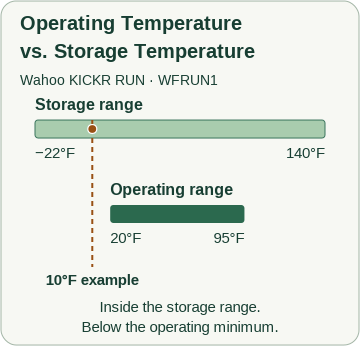
Operating temperature is not storage temperature
Imagine that your garage reaches 10°F overnight.
That temperature falls within Wahoo's published KICKR RUN storage range, but below its minimum operating temperature.
If all other storage requirements are satisfied, the temperature itself is within the documented storage range. You still shouldn't operate the machine at 10°F.
Likewise, warming the surrounding air doesn't necessarily mean the equipment itself has acclimated.
Follow the manufacturer's instructions before operating equipment exposed to cold conditions.
Does an insulated or heated garage make a difference?
It can improve environmental conditions, but it doesn't necessarily resolve manufacturer restrictions.
On a small screen, swipe the table sideways.
| Garage arrangement | What still needs checking |
|---|---|
| Uninsulated garage | Temperature extremes, moisture and dust |
| Insulated garage | Whether temperatures remain within requirements throughout the year |
| Heated garage | Summer temperatures, humidity and moisture |
| Air-conditioned garage | Winter temperatures and conditions when cooling is switched off |
| Fully climate-controlled converted garage | Exact manufacturer permission and warranty eligibility |
| Covered patio or carport | Outdoor exposure and explicit placement restrictions |
Insulation slows heat transfer. It doesn't actively regulate temperature.
A heated garage may remain comfortable in January but become excessively hot in July.
Even a converted garage with reliable climate control needs clarification when the applicable manual explicitly prohibits garage placement.
Why condensation deserves attention
Cold equipment can develop condensation when exposed to warmer, humid air.
This happens when a surface becomes cold enough for moisture in the surrounding air to condense on it.
You may have noticed the same effect on a cold drink brought into a warm room.
Temperature fluctuations inside a garage can create conditions that differ considerably from a consistently conditioned indoor space.
Moisture exposure is particularly important around electrical equipment and components susceptible to corrosion.
There is no universal treadmill humidity limit established by the reviewed documentation.
If the manufacturer prohibits high-humidity environments without specifying a percentage, ask what conditions it considers acceptable.
Do not switch on equipment that may contain condensation or water damage. Consult the manufacturer before returning it to service.
Will putting a treadmill in a garage void the warranty?
It depends on the applicable written warranty and installation requirements.
There are three different kinds of restrictions to look for:
- An owner's manual prohibiting garage placement.
- A warranty requiring a climate-controlled location.
- A warranty excluding damage caused by moisture, corrosion or improper installation.
These restrictions can have different consequences.
SOLE and Matrix, for example, publish conditions stating that unsuitable environmental placement can void warranty coverage.
Other warranties may exclude particular types of damage resulting from environmental exposure.
Read the applicable terms rather than assuming every garage installation produces the same warranty outcome.
An owner reporting five trouble-free years of garage use hasn't necessarily established warranty compliance.
Don't overlook the electrical installation
A garage can meet the temperature requirements and still have an unsuitable electrical circuit.
Certain motorized treadmills require dedicated circuits and identify possible conflicts with GFCI or AFCI protection.
For example, Wahoo specifies a dedicated 120V, 15- or 20-amp circuit for the US KICKR RUN and requires a non-GFCI outlet and breaker.
Garage electrical installations may require GFCI protection under applicable electrical codes.
Do not remove required electrical protection or bypass grounding to accommodate a treadmill.
If the manufacturer's requirements conflict with applicable electrical safety requirements, consult the manufacturer and a licensed electrician. Choose another machine or location if the requirements cannot be reconciled.
Before ordering, check your treadmill's electrical requirements.
Are manual treadmills better for garages?
A manual treadmill eliminates the electric drive motor, but it still contains bearings, fasteners, a running surface and potentially electronic components.
One interesting example is the redesigned AssaultRunner Pro.
Assault Fitness specifically markets the machine for garage use and identifies corrosion-resistant hardware among its features.
Its display uses batteries, while the running belt is powered by the person using it.
However, we haven't established its numerical environmental limits or warranty eligibility for permanent storage in an unconditioned garage.
Corrosion-resistant hardware isn't necessarily corrosion-proof.
The AssaultRunner Pro is an example worth investigating if you're interested in a motorless treadmill, but its marketing doesn't establish that every garage environment is suitable.
Will a treadmill cover or mat help?
A suitable cover may reduce settling dust while the equipment isn't being used.
A mat may help protect an appropriate floor.
Neither establishes temperature control, weather resistance or warranty eligibility.
Don't cover damp equipment, operate the machine while covered or obstruct its required ventilation.
If the manufacturer prohibits your proposed location, a cover isn't a workaround.
Check your garage before buying a treadmill
Use this worksheet to compare the actual environment with the manufacturer's requirements.
On a small screen, swipe the table sideways.
| Requirement | Your findings |
|---|---|
| Exact treadmill model and generation | |
| Applicable owner's manual | |
| Garage placement permitted? | |
| Minimum and maximum operating temperatures | |
| Minimum and maximum storage temperatures | |
| Humidity and moisture restrictions | |
| Insulation requirements | |
| Climate-control requirements | |
| Observed garage temperature extremes | |
| Expected temperatures during operation | |
| Evidence of dampness or condensation | |
| Electrical requirements | |
| Available electrical circuit | |
| Applicable warranty conditions | |
| Written manufacturer clarification | |
| Unresolved requirements |
A min/max thermometer and hygrometer can help document actual conditions.
Measurements collected during one week don't establish year-round conditions.
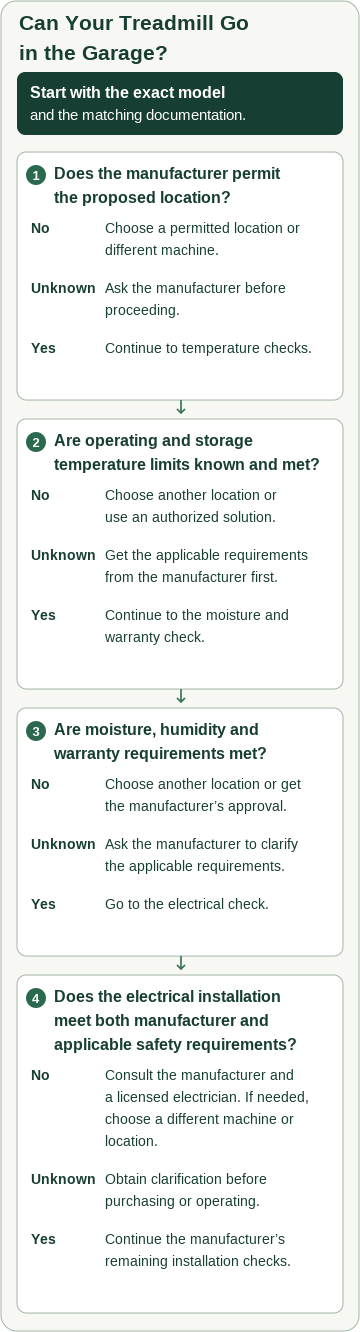
If a documented requirement isn't met, choose another location or resolve the issue through a manufacturer-approved arrangement.
If the requirements remain unclear, obtain clarification before purchasing.
If no environmental conflict is identified, continue checking the remaining installation requirements.
What should you ask the manufacturer?
You can send this message before purchasing:
I am considering purchasing [exact treadmill model and model number].
I intend to place it inside an enclosed garage with [describe insulation, heating, cooling and moisture conditions].
The expected storage temperatures are [range], and the expected temperatures during use are [range].
Does this location comply with the owner's manual and applicable residential warranty?
Please confirm any temperature, humidity, electrical, insulation and climate-control requirements.
Keep the written response with your purchase documentation.
What if your treadmill is already in the garage?
Start by finding the exact manual and applicable warranty.
Check your actual environmental conditions, electrical installation and visible equipment condition.
If you discover moisture exposure, corrosion, visible damage or a prohibited installation arrangement, stop using the machine and consult the manufacturer.
Don't run a cold treadmill simply to warm it up unless the manufacturer expressly supports that procedure.
If an indoor location would be more appropriate, check whether the treadmill will fit through the door and into the room before attempting to relocate it.
Follow the manufacturer's moving instructions, and arrange professional assistance when required.
Research methodology
We compared manufacturer manuals, product specifications, support documentation and warranty terms.
The numerical values are manufacturer-published specifications, not measurements collected by FitRestFuel.
We did not conduct freezing-temperature, humidity, corrosion or garage-durability experiments.
The most important purchasing consideration is whether the manufacturer permits the exact equipment in your intended environment.
Establish that before comparing treadmill features or prices.
Manufacturer and technical sources
Sources checked November 24, 2026.
- Source: Printed page 3, precaution 8. (opens in new tab)
- 2026 Version A manual, printed pages 3 and 29 (opens in new tab)
- 2023 Revision D manual, printed pages 3 and 33 (opens in new tab)
- Find the manual matching your purchase (opens in new tab)
- Historical manufacturer manual, accessible reproduction (opens in new tab)
- Current model information (opens in new tab)
- Owner's guide, printed pages 3–4 (opens in new tab)
- Additional manufacturer information card covering the five residential treadmill families (opens in new tab)
- Manufacturer support (opens in new tab)
- Published warranty policy (opens in new tab)
- Official requirements (opens in new tab)
- Model specifications (opens in new tab)
- Warranty information (opens in new tab)
- North American manual, printed pages 4–5 (opens in new tab)
- Current Peloton specifications (opens in new tab)
- Technical reference (opens in new tab)
- Manufacturer product information (opens in new tab)