Rice Cooker Capacity Explained: 30 Cups Cooked vs. 30 Cups Uncooked
Two listings can both say 30 cups and describe very different amounts of rice. Here's how to compare them without buying a cooker that's too small or much larger than you need.
We may earn a commission from qualifying purchases through these links. As an Amazon Associate I earn from qualifying purchases. Amazon prices are shown on Amazon; dated prices from other retailers are not Amazon quotes. How our links work. Prices, stock, and terms can change.
Sources last checked November 8 and 11, 2026.
Jump to a section
The same 30-cup number can describe two different purchases
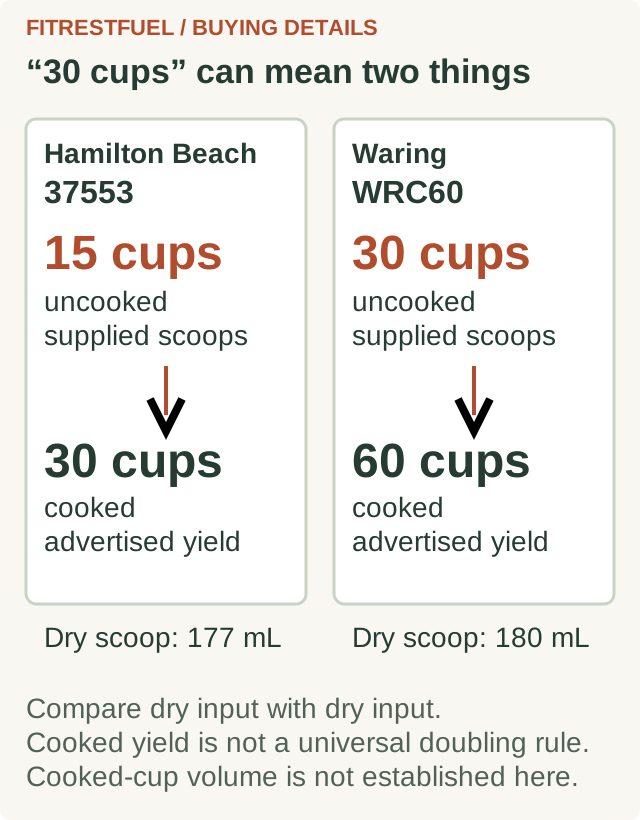
Take Hamilton Beach 37553 and Waring WRC60. The Hamilton Beach advertises 30 cups cooked from 15 cups uncooked; Waring specifies 30 cups raw and 60 cooked. If you compare only the number 30, you're comparing the output of one machine with the input of the other.
There's another wrinkle: their supplied measuring cups aren't quite identical. Using each maker's stated milliliter volume lets us compare the dry-rice quantities fairly.
On a small screen, swipe the table sideways.
| What the number measures | Hamilton Beach 37553 | Waring WRC60 |
|---|---|---|
| Advertised cooked capacity | 30 cups cooked | 60 cups cooked |
| Stated uncooked capacity | 15 supplied rice cups | 30 supplied rice cups |
| One supplied rice cup | 177 mL | 180 mL |
| Calculated dry-rice measuring volume | 15 x 177 = 2,655 mL | 30 x 180 = 5,400 mL |
| Dry volume in US customary kitchen cups | About 11.2 cups | About 22.8 cups |
The last two rows are calculated from the published scoop sizes, using approximately 236.6 mL per US customary cup. They describe dry-rice measuring volume, not water allowance, pot volume or a tested cooked yield. Waring's stated dry capacity is about twice Hamilton Beach's, even though both listings contain '30 cups.'
Don't automatically divide every cooked rating by two. These manufacturers explicitly publish both figures; a listing that gives only cooked capacity still needs its uncooked limit verified.
The same trap appears in a 5.5-cup versus 6-cup cooker
Zojirushi's NS-TSC10 is rated for up to 5.5 cups / 1.0 liter of raw short-grain white rice, measured with its approximately 180 mL cup. The larger NS-TSC18 is rated for 10 cups / 1.8 liters on the same basis. The 5.5-cup label is not saying the cooker produces only 5.5 cups of finished rice.
Aroma's ARC-763C instructions specify up to 3 supplied cups of uncooked white rice, yielding 6 cups cooked. Aroma defines its scoop as three-quarters of a standard U.S. cup; that is not an exact 180 mL specification. Even allowing for the different scoop definitions, the 5.5-cup Zojirushi holds substantially more dry rice than the Aroma advertised as 6 cups cooked. We are not assigning the Aroma's cooked-yield number a scoop volume.
Those headline limits still depend on the grain. For the NS-TSC10, the manual gives a range of 1–5.5 supplied cups for white rice but only 1–4 for brown rice. Our rice-cooker sizing guide explains how to match that batch range to your normal meals.
The cooking method can lower that limit too. Our NS-TSC10 vs. NS-ZCC10 comparison explains why the TSC10's 5.5-cup rice-only rating becomes one supplied cup when rice and food cook together in its basket.
The mistake a regular kitchen cup can cause
Suppose your recipe calls for 12 level US customary cups of dry rice. That's about 2,839 mL. It exceeds the Hamilton Beach's stated 2,655 mL dry-rice capacity, even though 12 sounds comfortably below the big 30 on the box. In its supplied scoop, that recipe would be roughly 16 rice cups, above the listed 15-cup maximum.
That is a reason to choose a larger suitable cooker or split the recipe, not a reason to squeeze in one more scoop. A bigger model's raw capacity must cover your actual batch, and its instructions must also support your grain and recipe.
For your own comparison, multiply the number of dry-rice cups by the volume of the cup you used. Compare that result with the cooker's stated uncooked count multiplied by its supplied cup volume. Keep both sides in milliliters. If your measuring cup is marked 240 or 250 mL, use that marking rather than the 236.6 mL conversion in our example.
Don't substitute a universal grams-per-cup figure either. Volume and weight are different measurements, and the rice variety changes the conversion. If you normally weigh rice, look for a supported dry-rice weight or measure and weigh your own usual rice.
Convert U.S. cups to a 180 mL rice cup
If your exact cooker specifies a 180 mL cup, use U.S. customary cups × 236.6 ÷ 180 to compare dry-rice volume. The table rounds the result to two decimal places. One U.S. customary cup is about 31% larger than a 180 mL scoop; that percentage does not apply unchanged to Hamilton Beach's 177 mL cup or every other manufacturer's measure.
NIST's kitchen guide rounds one U.S. cup to 240 mL and three-quarters of a cup to 180 mL for cooking convenience. Those are approximate equivalents. The calculations here use approximately 236.6 mL per U.S. customary cup instead.
On a small screen, swipe the table sideways.
| Dry rice in U.S. customary cups | Equivalent 180 mL rice cups (approx.) |
|---|---|
| 1 cup | 1.31 |
| 1.5 cups | 1.97 |
| 2 cups | 2.63 |
| 3 cups | 3.94 |
| 4 cups | 5.26 |
These are volume conversions, not instructions for filling a specific cooker. Always stay within the manufacturer's limits for the rice type and program, using its specified cup and water markings.
Why '15 uncooked, 30 cooked' isn't a recipe
You may have heard that rice triples in volume as it cooks. USA Rice gives that as a typical yield, while also directing rice-cooker users to the appliance maker's instructions. That doesn't make a manufacturer's 15-to-30 capacity label a water ratio or a universal expansion rule.
The dry-rice scoop, the unit behind the advertised cooked number, and the serving cup in your kitchen aren't necessarily interchangeable. The product pages establish the supplied scoop sizes, but we aren't assuming their cooked-yield labels use those same milliliters. That's why the comparison converts only the clearly specified dry quantities.
Once you choose a cooker, follow its directions for your rice. Don't calculate water from '30 cooked,' and don't treat a liter rating for the entire pot as the amount of dry rice you can load. Those numbers answer different questions.
Will a 30-cup cooker feed 30 people?
Only after you define the portion and the actual finished yield. For a planning example, 30 people receiving half a US cup each need 15 US cups of cooked rice. At one full cup each, the requirement doubles to 30. Those are example portions, not a promise about appetites, seconds or how much either machine produces.
Here's a way to work backward without trusting the headline: suppose a batch you've actually measured uses two US cups dry and produces six US cups cooked. Your measured yield is three cooked cups per dry cup. The 15-cup serving plan would therefore require about five US cups dry; the 30-cup plan would require about ten. Convert that dry amount into the new cooker's scoop size, then check its allowed batch range.
Treat those figures as a starting estimate if you're changing the rice or cooking method. Before an event, check a batch with the rice and cooker you'll use. A model that can hold enough dry rice still has to finish it before service, and a second batch won't be ready instantly.
If you're cooking ahead, plan storage and reheating separately from capacity. Our meal-prep safety guide covers that part; a keep-warm button is not permission to leave cooked rice out indefinitely.
Sources: 5
Two numbers still worth asking the manufacturer for
First, get the maximum for the rice you intend to cook. Both example listings mention brown rice, but we did not verify a separate brown-rice maximum for either exact model. Don't take support for brown rice as proof that every advertised maximum applies to it. Mixed dishes and porridge need their own instructions too.
Second, get the minimum batch. We could not establish a verified minimum for either model from the material reviewed. If you usually cook a small amount and only occasionally feed a crowd, that's a purchase-critical gap, not a detail to discover after opening the box.
Ask a specific question: 'What are the minimum and maximum dry quantities for my rice, using the cup supplied with this model?' If the answer doesn't cover your normal batch, I'd keep a smaller cooker for everyday meals rather than buy a large one solely for an occasional gathering.
What I'd buy, and what would stop me
For a home batch that fits the confirmed limits, Hamilton Beach 37553 is the lower-cost candidate: $54.99 on its official US listing checked November 8, 2026. Its body measures 14.7 inches wide by 12.4 deep by 10.6 high. Those are body dimensions, not a promise of adequate steam or lid clearance.
For a batch beyond that capacity, Waring WRC60 offers the larger documented raw-rice allowance and is approved for commercial use. The checked listing is $419, a $364.01 difference. Its body is 17.25 inches wide by 21.5 deep, and the lid reaches 31.5 inches high when fully open. The manual says not to run it directly beneath cabinets. Its 120V, 1,800W, 15A requirements also deserve a circuit check before ordering.
I'd consider Waring for a real large-batch requirement, not because the higher price proves better-tasting rice. We haven't tested either machine's cooking consistency, and the unresolved grain-specific and minimum limits still matter. If neither meets your batch range and installation requirements, choose neither. Our large-capacity buying guide covers other sizes and commercial-use considerations.
Before paying, compare the delivered total, the seller's return conditions, warranty coverage for your intended home or business use, and delivery timing. The prices above are snapshots, not tax-inclusive or universally delivered quotes. Both listings include a rice-measuring cup and paddle, so those aren't extra purchases for the standard package.
When it arrives, keep the scoop with the cooker
A matching scoop makes the pot markings much easier to use correctly. Waring instructs you to add the rice, then use the inner pot's measurement lines when adding water. A numbered line is a fill level for the rice-and-water setup, not an instruction to pour that many separate kitchen cups of water into the pot.
If the scoop goes missing, replace its stated measuring volume rather than grabbing an unmarked mug. Check the exact model's instructions before cooking; neither a bigger pot nor extra water makes an over-limit batch acceptable.
Some models use a different cup for a particular setting. Zojirushi's NS-ZCC10/18 manual specifies an approximately 180 mL regular-rice cup and a green 171 mL cup for pre-washed rice. The 180 mL conversion table above does not apply to that green cup. Follow the measuring method and capacity limits for the exact model and setting.
Products in this guide
Compare the exact model, included accessories, delivery, and return terms on the seller’s page.
We may earn a commission from qualifying purchases through these links. As an Amazon Associate I earn from qualifying purchases. Amazon prices are shown on Amazon; dated prices from other retailers are not Amazon quotes. How our links work. Prices, stock, and terms can change.
Hamilton Beach 37553
Choose it for: A lower-cost home candidate when your dry batch and rice type fit its confirmed instructions.
Check before ordering: The 30-cup headline describes cooked capacity, not 30 dry scoops; verify minimum and grain-specific limits.
View on AmazonOpens AmazonWaring WRC60
Choose it for: A commercial-use candidate when a substantially larger dry-rice batch is necessary.
Check before ordering: Check the batch range, open-lid space and electrical supply before choosing the larger machine.
View on AmazonOpens AmazonSources & research notes
Sources checked November 8 and 11, 2026. These are manufacturer-rated capacities and our unit calculations, not cooked-yield or taste tests. We checked the exact US model listings and available instructions; unconfirmed minimum batches and grain-specific limits are identified below. The original Hamilton Beach/Waring comparison and price checks retain their November 8, 2026 date. Added Zojirushi/Aroma examples and measurement references were checked November 11, 2026.
- Hamilton Beach 37553 official listing: 30 cooked, 15 uncooked, 177 mL cup, dimensions, accessories and dated price (opens in new tab)
- Waring WRC60 official listing: 60 cooked, 30 raw, 180 mL cup, electrical specifications, open-lid height and dated price (opens in new tab)
- Waring WRC40/WRC60 instruction manual: rice measurement, water lines, steam placement and commercial approval (opens in new tab)
- NIST Handbook 130, liquid-volume conversion table: 8 US fluid ounces equals approximately 236.588 mL (opens in new tab)
- USA Rice cooking guide: typical cooked yield and following individual rice-cooker instructions (opens in new tab)
- Zojirushi NS-TSC10/18: raw short-grain white-rice capacity in approximately 180 mL cups (opens in new tab)
- Aroma ARC-763C support and quick-start manual: white-rice quantities, cooked yield and supplied-cup definition (opens in new tab)
- Zojirushi NS-TSC10/18 manual: white- and brown-rice cooking ranges (opens in new tab)
- NIST Metric Kitchen: rounded cooking-measurement equivalents, not exact conversion factors (opens in new tab)
- Zojirushi NS-ZCC10/18 manual: regular and green pre-washed-rice measuring cups (opens in new tab)