Bed Too High After a New Mattress? What You Can Change
Check the support underneath your mattress before deciding what to change.
Sources last checked November 16, 2026.
You finally get a mattress you like, put it on your bed, and discover that getting in now feels like climbing onto a kitchen counter.
Before you consider returning the mattress, look at what's underneath it.
You may be able to lower the bed by replacing a tall foundation with a shorter compatible one, using a factory-approved height adjustment on the frame, or changing the support frame while keeping the mattress.
The catch is that a lower support isn't automatically a suitable support.
If you replace an 8-inch foundation with a 2-inch board, the height difference looks wonderful on paper. But that doesn't tell you whether the board is approved for your mattress or whether the bed frame can support it.
Let's figure out which part of your setup can actually change.
Jump to a section
First, what is your mattress sitting on?
The quickest way to narrow down your options is to identify the layer directly beneath your mattress and what holds that layer up.
On a small screen, swipe the table sideways.
| Your current setup | What might lower it | What needs checking |
|---|---|---|
| Mattress on a separate foundation or box spring | A lower-profile compatible foundation | Mattress support rules and whether the frame supports the replacement |
| Mattress directly on a slatted or solid platform | A documented lower support position, if the frame has one | Exact assembly instructions and required slats or center supports |
| Mattress on an adjustable base | Manufacturer-approved leg-height options, if available | Exact base model and permitted configurations |
| Mattress and foundation inside a decorative bed frame | A lower compatible inner support or foundation | Whether the decorative rails actually provide structural support |
Don't assume your bed frame is providing support just because it surrounds the mattress.
Some bedroom sets have decorative side rails with a separate support frame inside. Others have rails and slats that carry the load directly. Those are very different arrangements.
If you're unsure, identify the mattress model, frame model and every separate component before buying anything.
A shorter foundation is often the simplest possibility
Suppose your mattress sits on an 8- or 9-inch foundation, which rests on a separate metal bed frame.
A lower foundation may reduce the finished height without changing the mattress or the frame.
This isn't just a theoretical option.
Saatva currently lists two foundation heights:
- 8.75 inches
- 4.75 inches
It also lists a separate 2-inch bunkie board for certain support arrangements.
Tempur-Pedic documents flat foundations with 2-inch, 5-inch and 9-inch profiles, although not every size is offered in every profile.
These manufacturer examples demonstrate that a tall support layer isn't necessarily your only option.
But the replacement still has to work with both your mattress and the frame underneath it.
A company selling a 4.75-inch foundation does not establish that it can safely replace every 8.75-inch foundation in every bedroom.
Here's how to calculate the height you'll actually save
Start by measuring from the floor to the top of your current mattress.
Then identify the thickness of the support component you might replace.
If the frame, mattress and topper stay unchanged, use:
New bed height = current finished height − old foundation height + replacement foundation height
Here's a hypothetical example:
On a small screen, swipe the table sideways.
| Measurement | Height |
|---|---|
| Current floor-to-mattress-top height | 30 inches |
| Existing foundation | 8.75 inches |
| Compatible replacement foundation | 4.75 inches |
| Calculated new finished height | 26 inches |
That's a 4-inch reduction.
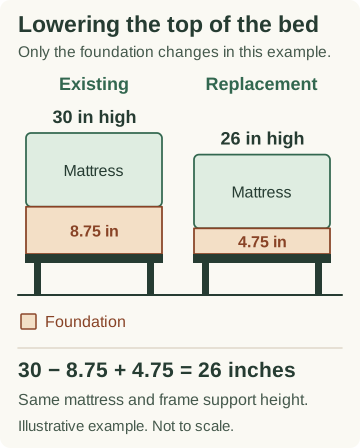
The calculation is useful because it lets you decide whether a particular swap would solve your problem before you order it.
Before ordering, mark 26 inches on a tape measure beside your bed. Would a four-inch drop solve the problem?
There are two important conditions:
- The replacement must be approved for the mattress and supported by the frame.
- The frame's support position and the other layers must remain unchanged.
If you're also moving the support rails or replacing the frame, the calculation needs to account for that change separately.
And don't double-count the frame. If your measurement already runs from the floor to the top of its supporting deck, don't add the legs or decorative rail height again.
Why a 2-inch bunkie board isn't the same as a 2-inch foundation
This is where the easiest-looking fix can go wrong.
A bunkie board and a flat mattress foundation may both be 2 inches thick. They don't necessarily serve the same structural purpose or meet the same manufacturer's requirements.
Consider two real examples.
Saatva: Its foundation product page describes a 2-inch bunkie board that can be used in several specified arrangements, including over slats or with certain supporting frames.
Tempur-Pedic: Its mattress support guidance explicitly says not to use a bunkie board beneath a Tempur-Pedic mattress. The company warns that doing so may affect warranty coverage.
Tempur-Pedic instead recommends suitable flat foundations or adjustable bases. It also permits certain slatted frames when they satisfy its structural and spacing requirements.
So you could encounter two products that are the same thickness, yet one type of support is unacceptable for your particular mattress.
Equal height doesn't mean equivalent support.
Before choosing a replacement, answer three questions:
- Does my mattress manufacturer permit this type of foundation, board or platform?
- Can my existing frame support that component correctly?
- Does the complete arrangement meet any applicable slat, center-support and structural requirements?
If either manufacturer can't confirm compatibility, don't assume the thinner option is safe just because it physically fits.
For a closer look at how much support requirements vary, see our mattress warranty and slat-spacing guide.
Can you just remove the box spring?
Sometimes a separate foundation is unnecessary. Sometimes it's essential.
What matters is what remains underneath the mattress.
If the frame is a suitable platform designed to support the mattress directly, removing an additional foundation might be possible after checking both manufacturers' instructions.
But if removing the foundation leaves the mattress resting on a few widely spaced metal rails, you haven't created a platform bed. You've removed an important support layer.
Saatva illustrates the distinction on its foundation product page. It specifically warns against putting a mattress directly on its Universal Frame without the required supporting component.
That doesn't mean every bed needs a tall foundation. It means the underlying frame has a job, and the component above it may be part of how that job gets done.
Don't remove the support layer until you know what will safely replace its function.
Your current bed frame might already have a lower setting
If your mattress sits directly on a slatted platform, there may be no thick foundation to replace.
In that situation, look for a manufacturer-approved adjustment.
For example, IKEA says the sides of its U.S. MALM Queen bed frame, article 902.494.83, can be adjusted for different mattress thicknesses.
The official assembly instructions show multiple mounting positions in the support-assembly steps.
That makes the manual worth checking if you own this exact frame.
It does not establish a universal height reduction. Your available adjustment depends on the specific frame and how it's currently assembled.
IKEA also specifies that this MALM configuration requires the SKORVA center support beam. A lower position isn't permission to leave required structural components out.
The same rule applies elsewhere: use documented adjustments, not improvised modifications.
Don't cut the legs off a wooden frame, alter metal supports or remove center beams simply to save a few inches.
What if you have an adjustable bed base?
An adjustable base is a different kind of support system.
If yours is too tall, look up its exact model and check whether the manufacturer offers approved leg-height configurations.
Some systems may have options. Others may not.
Don't assume you can remove sections, replace legs with generic parts or set the unit directly on the floor.
You need the base manufacturer's instructions, along with the mattress requirements, before changing the setup.
What if you really want to keep the decorative bed frame?
It's worth separating two questions:
- Can I keep the mattress?
- Can I keep the frame?
Keeping the mattress is often the more achievable goal.
Keeping the frame depends on whether a lower, compatible support arrangement fits inside it.
Suppose you own a traditional wood bed with a tall headboard and side rails, plus a separate metal support frame inside.
The wood furniture may be worth keeping. But if the inner metal frame is what actually supports the foundation, you need to check whether a different approved support system could fit without changing how the mattress is safely supported.
Don't judge by appearance alone. The side rails might be decorative rather than load-bearing.
Measure the actual clearances and identify which component carries the weight.
If no lower compatible support fits, replacing the supporting frame may be necessary. That still doesn't mean you need to replace the mattress.
Check these details before committing to a lower setup
Lowering the mattress surface changes more than the number on your tape measure.
Look at the finished arrangement from the side:
- Side rails: Will the mattress sit too far below the rails, making the edge awkward to use?
- Headboard: Will more of it become visible, and will pillows still sit where you expect?
- Nightstands: Will their tops now be noticeably higher than the mattress?
- Under-bed storage: Could a lower support interfere with drawers or storage boxes?
- Support underneath: Are the required slats, legs and center supports still present and correctly installed?
You don't need to aim for one supposed ideal bed height.
What matters is whether the result works for the people using it and whether the support remains appropriate for the mattress.
The order we'd follow before spending anything
If this were our bed, we'd work through the decision in this order:
1. Measure the current finished height.
Floor to top of mattress, without guessing from the headboard or frame specifications.
2. Identify every supporting component.
Find out whether there's a removable foundation, a true platform, an inner metal support frame or an adjustable base.
3. Check the mattress and frame manufacturers' requirements.
This comes before ordering a thinner replacement.
4. Calculate the possible height reduction.
Use the actual thickness of the component being replaced. If the support position is changing too, measure that change separately.
5. Confirm the complete setup before installing it.
Check support compatibility, the size of the replacement and how the mattress will sit against the rails and headboard.
If you can make a verified change that saves enough height, you may be able to keep everything you like about your mattress.
If not, a lower compatible frame is the next possibility. Replacing a mattress you're happy with should not automatically be the first move.
Sources & research notes
Sources checked November 16, 2026.