Will Your Bed Frame Void Your Mattress Warranty? Slat-Spacing Requirements by Brand
A bed frame can affect your mattress warranty, and there is no universal slat-spacing rule.
Sources last checked November 11, 2026.
One mattress manufacturer allows gaps up to 5.5 inches. Another draws the line at 2 inches. Several also care about slat width, center support, the number of legs under the frame, or whether a solid board is used over the slats.
That means a frame described as "works with memory foam mattresses" or "universal mattress support" can still fail the requirements for the mattress you actually own.
There is another complication. The number on a brand's warranty page is not always the same number shown on its mattress product page.
Before replacing your frame or trying to reinforce it, check the exact mattress and the current manufacturer's instructions.
Jump to a section
Slat-spacing requirements at a glance
These are current manufacturer requirements or published support rules checked November 11, 2026.
On a small screen, swipe the table sideways.
| Brand | Published slat spacing | Important qualification |
|---|---|---|
| Beautyrest | 2 inches or less | Wider open gaps require a solid platform over the slats |
| Amerisleep | 2.75 inches or less | Applies to non-Amerisleep slatted bases |
| Naturepedic | 3 inches or less | Warranty documentation says wider gaps do not provide sufficient support |
| PlushBeds bedroom mattresses | 3 inches or less | Slats must also be at least 2.5 inches wide |
| Purple | 3.5 inches or less | Queen and larger also require center support and 5 to 6 legs |
| Saatva | Less than 4 inches | Queen and larger require center support; Zenhaven has an additional solid-surface requirement |
| Tempur-Pedic | 4 inches or less under the warranty | Slats at least 3 inches wide and proper center support; one support passage says less than 4 inches |
| Brooklyn Bedding | 5 inches or less | More than 5 inches is considered improper support under the current warranty |
| Avocado | 5 inches or less under the warranty | Slats must be at least 2.5 inches wide; newer support guidance recommends a tighter 3-inch gap |
| Helix | 5.5 inches or less under the general warranty | Some individual mattresses publish tighter guidance, including 3.5 inches for the Midnight |
| Leesa | 5.5 inches or less | Wider gaps are considered improper under the current lifetime warranty |
| Casper | No numeric limit in the current mattress warranty | Casper's current FAQ recommends flat wooden slats no more than 4 inches apart |
Do not use this table as permanent approval for your frame. Mattress models and warranty terms change.
It is a screening tool. Check your exact mattress before ordering or modifying anything.
The strictest rule in this group is only 2 inches
Beautyrest's current support guidance is unusually strict for an open slatted platform.
If the gaps between the slats are greater than 2 inches, Beautyrest says a solid platform should be added over the open slats. Using wider open gaps without that platform can damage the mattress and void the warranty.
That means a frame with 3-inch gaps may look closely supported and still fail Beautyrest's published requirement.
Compare that with Leesa, whose current adult mattress warranty considers slat gaps greater than 5.5 inches improper.
Those two mattresses could sit on the same frame and face very different warranty consequences.
This is why shopping for a bed frame by mattress type alone, such as "memory foam compatible," is not enough.
Amerisleep allows 2.75 inches on other brands' frames
Amerisleep's current warranty says a slatted base that was not designed or sold by Amerisleep must have gaps no greater than 2.75 inches.
Improper foundations or platforms can void the mattress warranty.
Amerisleep also publishes an unusual rule for traditional box springs. A box spring may be used only when a 0.75-inch moisture-resistant sheet of plywood covers the entire box spring, creating a solid barrier between the mattress and the springs.
That is useful to know before throwing away an existing base, but do not carry that plywood advice over to another mattress brand.
The support method has to come from the manufacturer of the mattress you own.
Sources: 2
Naturepedic and PlushBeds both stop at 3 inches
Naturepedic's mattress warranty documentation describes sufficient support as a solid platform, bunkie board or sufficiently strong slatted base, with the slats no more than 3 inches apart.
Its warranty documentation states that wider spacing does not provide enough support and can void coverage.
PlushBeds also uses a 3-inch maximum in its current bedroom-mattress warranty, but adds another specification:
The slats must be at least 2.5 inches wide.
So measuring only the gaps is not enough.
A bed frame could have perfectly acceptable 3-inch spacing and still use slats that are too narrow for the manufacturer's requirement.
Purple requires more than close slats
Purple's current warranty limits slat gaps to 3.5 inches when the mattress is used on a slatted frame without an additional foundation.
For Queen, King and California King mattresses, the frame must also:
- include center support
- provide adequate structural support
- have at least 5 to 6 legs
Twin and Full frames require four legs.
Purple also states that it may require proof that the mattress has been consistently used with a sufficient support system before applying warranty coverage.
That turns frame compatibility into something worth documenting now rather than trying to reconstruct years later.
Take a photo of the bare support system while it is easy to do. Include the center rail and support legs.
If you ever have to make a warranty claim, that is more useful than trying to remember what the frame looked like before a problem appeared.
Sources: 5
Saatva's warranty uses less than 4 inches, not 4 inches
Saatva's warranty wording deserves attention because it specifies slats less than 4 inches apart.
That is different from "4 inches or less."
If a measured gap is exactly 4 inches, do not round it down and assume the condition is met.
A separate Saatva platform-bed FAQ says 4 inches or less. Because that differs from the warranty, ask Saatva for written confirmation before relying on an exact 4-inch gap.
Saatva also requires center support on Queen and larger platform beds.
When a standard frame is used with a foundation, its warranty says Queen and larger sizes need a 5- or 6-legged frame with vertical center support.
Zenhaven has an additional requirement
The Zenhaven is an exception to treating the slat-gap number as the whole answer.
Saatva requires a solid surface, such as the type it identifies in its warranty documentation, over platform slats beneath the two-sided Zenhaven.
So even tightly spaced slats are not the complete setup requirement for that mattress.
This is a good example of why a brand-level chart cannot replace the instructions for the exact mattress model.
Tempur-Pedic's warranty allows up to 4 inches, but also specifies slat width
Tempur-Pedic says a slatted platform may be acceptable when the slats are structurally sound, at least 3 inches wide and spaced no more than 4 inches apart.
That matches its current warranty, but another current support passage says less than 4 inches. If your gap is exactly 4 inches, get written confirmation from Tempur-Pedic; for a new frame, spacing below 4 inches avoids that boundary conflict.
The company also calls for proper center support.
Its full warranty documentation says Queen, King and California King bed frames should provide center support and at least 5 to 6 legs. Twin and Full frames need four-leg support.
The especially important part is what not to do.
Tempur-Pedic warns that conventional box springs are not suitable support and states that their use can void the warranty.
Its current support guidance also warns against using plywood or bunkie boards as substitute support.
That directly conflicts with a common piece of online advice:
"If your slats are too far apart, just throw plywood over them."
That may work under one manufacturer's instructions. It is not a universal mattress fix.
Brooklyn Bedding allows up to 5 inches
Brooklyn Bedding's current limited lifetime warranty treats gaps greater than 5 inches as improper support.
Its support documentation says a mattress should be placed on a solid supportive base, such as:
- a platform bed with qualifying slats
- a solid foundation
- a bunkie board
- an appropriate adjustable base
This is noticeably more permissive than Beautyrest, Amerisleep or Purple on slat spacing alone.
It still does not mean every frame with 5-inch gaps is automatically appropriate.
A bowed, broken or under-rated frame can be unsuitable even if the tape measure says the gaps pass.
Avocado's current documents use two different numbers
Avocado is another brand where reading only one page can create confusion.
Its current mattress warranty allows no more than 5 inches between slats on Queen, King and California King slatted frames.
It also requires each slat to be at least 2.5 inches wide, and larger beds need appropriate center support and leg support.
A newer Avocado support guide recommends slats no more than 3 inches apart for adequate support.
Those are not the same number.
If you are buying a new frame for an Avocado mattress, the 3-inch recommendation is the safer specification to shop around.
If you already own a frame with gaps between 3 and 5 inches, do not assume this article can decide warranty eligibility for you. Send Avocado the exact frame specifications and get confirmation in writing.
Helix has a warranty number and product-specific numbers
Helix's general mattress warranty says slat gaps greater than 5.5 inches on its adult mattresses are improper support and will void the limited lifetime warranty.
That does not mean 5.5 inches is necessarily the right number to use when buying a new frame.
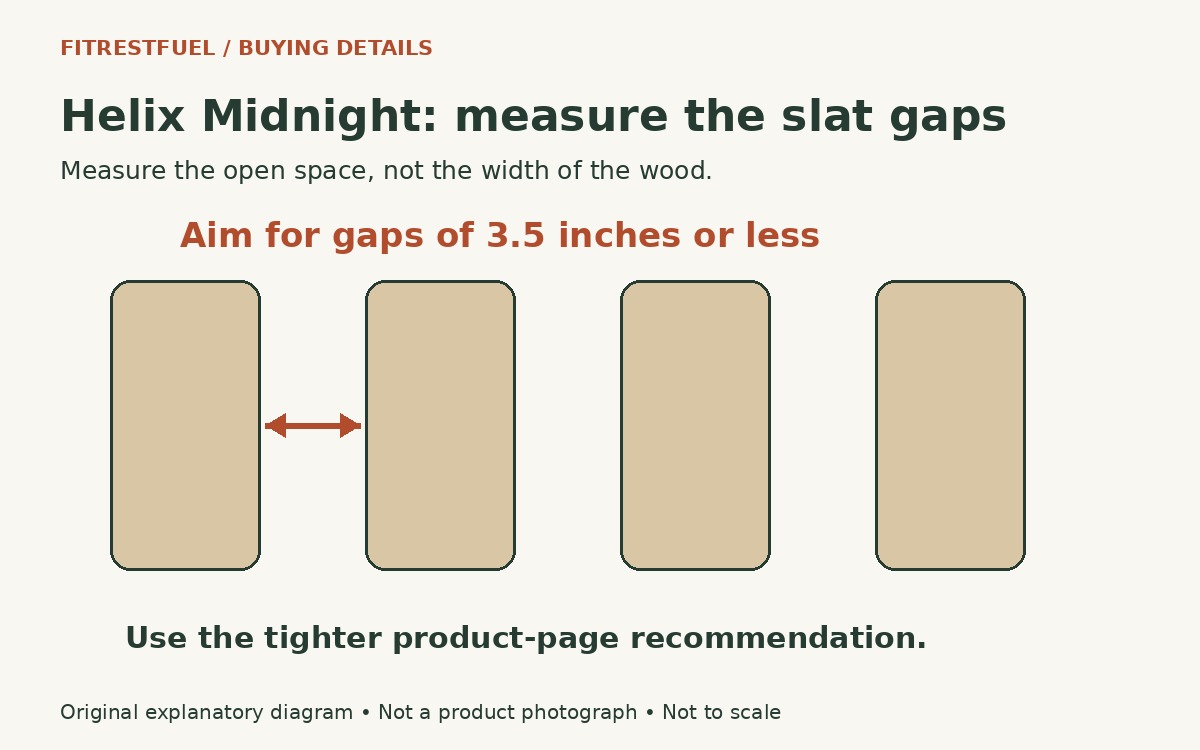
The current Helix Midnight product page tells buyers to use a firm support system with thick slats no wider than 3.5 inches apart.
Helix's own Foundation also uses gaps of about 3.5 inches.
If you are shopping for a Helix Midnight, use the tighter product-specific guidance rather than designing a new setup around the widest number mentioned in the general warranty.
We cover that conflict separately in our Helix Midnight bed-frame requirements guide, including what to do if your existing frame falls between those two published figures.
Leesa allows up to 5.5 inches on its adult mattresses
Leesa's current limited lifetime warranty considers a base improper when the slats are greater than 5.5 inches apart for its regular mattresses.
Leesa Kids mattresses have a different limit.
Its support guidance recommends flat, firm and sufficiently substantial slats. Traditional spring-style box springs generally do not provide the type of support Leesa recommends.
Again, the useful number is the rule for the mattress you own, not the largest gap you have seen another brand accept.
Casper is a good example of recommendation versus warranty language
Casper's current mattress warranty requires a firm, solid-surface bed base that is structurally capable of supporting the mattress and its users.
The warranty language we verified does not give a numerical slat-spacing limit.
Casper's current FAQ does.
It recommends flat wooden slats no more than 4 inches apart.
Those statements work together, but they are not identical.
It would be inaccurate to say Casper's current warranty itself sets a 4-inch cutoff when the number appears in its support guidance rather than the warranty language we reviewed.
For a new Casper setup, following the 4-inch recommendation is straightforward.
For an unusual existing frame where warranty coverage is important, ask Casper to confirm the complete setup rather than treating a FAQ number as a legal interpretation of the warranty.
Measure the gap, not the distance from one slat center to the next
When a manufacturer says slats should be 3 inches apart, measure the empty opening.
Measure from the inside edge of one slat to the inside edge of the next.
Do not measure from the center of one board to the center of another.
Check several locations.
Slats can shift, and an old frame may not have perfectly even spacing. Use the widest gap you find when comparing the frame with the mattress requirement.
While the mattress is off, also look for:
- bowed slats
- cracks
- loose slats
- missing fasteners
- a sagging center rail
- center legs that do not actually reach the floor
- obvious movement in the frame
Passing the spacing requirement does not prove that the support structure is sound.
A Queen or King may need center support even when the slats pass
This is an easy detail to miss because retailers often emphasize the slat count and ignore what is underneath them.
Purple, Saatva, Tempur-Pedic and Avocado all publish additional support conditions for larger mattress sizes.
Depending on the brand, that can include:
- a center rail
- a center leg reaching the floor
- 5 to 6 total legs
- sufficient structural capacity for the mattress and sleepers
A Queen frame with closely spaced slats but no required center support can still fail the manufacturer's setup rules.
Check both.
Do not automatically add plywood when the gaps are too wide
This is probably the most important practical warning in the article.
Different mattress companies give different instructions.
Amerisleep specifically describes moisture-resistant plywood as a way to create an acceptable surface over a box spring.
Saatva tells owners with overly wide platform slats that a suitable solid layer can be added, and its Zenhaven requires a solid surface over slats.
Helix discusses a bunkie board or plywood as a possible way to create firmer support in some setups.
Tempur-Pedic is different. Its current guidance warns against plywood and bunkie boards as substitute support.
So the correct sequence is not:
wide slats → add plywood
It is:
wide slats → check the exact mattress manufacturer's approved fix
That can save you from spending money on a solution that creates a second warranty problem.
If you are buying a new frame, shop to the mattress, not the furniture description
Retail bed-frame listings frequently say things such as:
- no box spring needed
- memory foam compatible
- mattress ready
- works with all mattress types
None of those phrases overrides the mattress warranty.
Before buying the frame, find:
- the largest open gap between its slats
- the slat width if your mattress brand specifies one
- the support structure for Queen or larger sizes
- the total rated load
- whether the mattress manufacturer permits that type of foundation
Then compare those numbers with the exact mattress.
If the frame listing does not provide the dimensions you need, ask the frame manufacturer before buying.
If you already own both, photograph the support now
Some mattress companies request photographs of the support system during warranty claims.
Purple explicitly says it can require proof of consistent use of a sufficient frame and foundation.
Amerisleep says warranty claimants may be required to provide evidence of the quality, design and condition of the supporting frame or foundation.
Tempur-Pedic also asks for photographs of frame and support components in relevant warranty claims.
You do not need to wait until something sags.
Take a few clear photos of the bare frame now, including:
- the full slat layout
- a tape measure across the largest gap
- slat width where relevant
- center rail
- center support legs
- any product or model label
Keep them with the mattress receipt.
That does not guarantee a future claim will be approved, but it preserves useful information about the setup you actually used.
Check your exact mattress in the FitRestFuel Bed Frame Checker
FitRestFuel's Sleep Product Finder includes a Bed Frame Checker that compares your setup with manufacturer support rules we have been able to verify.
It deliberately does not "approve" a warranty.
That decision belongs to the mattress company.
The checker is useful for identifying a problem before you buy, such as an Amerisleep mattress being placed on a third-party base with gaps beyond its published limit.
For Helix Midnight, the checker distinguishes the product page's 3.5-inch recommendation from the general warranty's 5.5-inch threshold. Gaps above 3.5 inches through 5.5 inches are flagged for written Helix confirmation; gaps above 5.5 inches exceed both thresholds. A matching gap alone does not approve the frame or its warranty coverage.
Before you put a new mattress on your old frame
Remove the old mattress and inspect what is actually underneath it.
Measure the widest open slat gap.
Measure slat width if the mattress requires it.
Check the center structure and legs.
Then read the current warranty and support instructions for the exact mattress model.
A bed frame does not become compatible because another mattress used it for ten years without trouble.
And the strictest mattress rule on the internet does not automatically apply to every mattress either.
Use the requirements written for the bed you are actually buying.
That is the safest way to avoid discovering during a future warranty claim that the problem started underneath the mattress.
Sources & research notes
Sources checked November 11, 2026. Manufacturer warranty and support documents checked November 11, 2026. This is a comparison of published instructions, not hands-on frame testing or warranty approval. Conflicting wording is identified where it affects the stated limits. Helix Midnight support guidance and the corresponding checker distinction rechecked November 15, 2026; the other manufacturer research retains its November 11 date.
- Beautyrest: flat-foundation and platform support guidance (opens in new tab)
- Amerisleep: mattress warranty and claim requirements (opens in new tab)
- Naturepedic: current EOS mattress warranty (PDF) (opens in new tab)
- PlushBeds: bedroom and RV mattress warranties (opens in new tab)
- Purple: mattress warranty and frame requirements (opens in new tab)
- Saatva: warranty and Zenhaven support requirements (opens in new tab)
- Saatva: existing box spring, foundation and platform guidance (opens in new tab)
- Saatva: platform-bed FAQ with different 4-inch wording (opens in new tab)
- Tempur-Pedic: current 10-year mattress and flat-foundation warranty (opens in new tab)
- Tempur-Pedic: acceptable bases and prohibited substitutes (opens in new tab)
- Tempur-Pedic: support page with conflicting 4-inch wording (opens in new tab)
- Brooklyn Bedding: limited lifetime warranty (opens in new tab)
- Brooklyn Bedding: required support base (opens in new tab)
- Avocado: warranty and slatted-frame requirements (opens in new tab)
- Avocado: bunkie-board and tighter slat-spacing recommendation (opens in new tab)
- Helix: general mattress warranty (opens in new tab)
- Helix Midnight: model-specific support guidance (opens in new tab)
- Helix Foundation: slat spacing (opens in new tab)
- Helix: existing-base and reinforcement guidance (opens in new tab)
- Leesa: current mattress warranty (opens in new tab)
- Leesa: mattress care and support guidance (opens in new tab)
- Casper: mattress warranty (opens in new tab)
- Casper: support FAQ (opens in new tab)
- Tempur-Pedic: warranty-claim photographs (opens in new tab)