Does Your Treadmill Need Lubrication? Check Your Model Before Adding Silicone
Some treadmills require regular silicone lubrication, while others prohibit it. Check your exact model before following a general maintenance tutorial.
Sources last checked November 24, 2026.
Not every treadmill needs silicone oil. Some require regular lubrication, while others have running surfaces that should not receive additional lubricant during ordinary owner maintenance.
Even treadmills made by the same company can have different requirements.
The SOLE F63, for example, requires periodic lubrication. The SOLE TT8 owner's manual reviewed for this guide expressly prohibits adding lubricant or wax to its running surface.
I maintain my own Matrix T30 using silicone lubricant, but I wouldn't automatically apply that routine to another treadmill.
Before lifting your running belt or ordering a bottle of silicone, check the exact model number and its owner's manual.
Jump to a section
Why do some treadmills need lubrication while others don't?
The running belt is the moving surface beneath your feet. The running deck is the stationary platform supporting that belt.
As the belt moves across the deck, friction develops between the two surfaces. In treadmills designed for periodic lubrication, the approved lubricant helps control that friction.
Different machines use different running-surface treatments.
There are three important maintenance arrangements to recognize.
Silicone systems requiring routine lubrication
These machines require additional approved lubricant at documented intervals.
Depending on the model, the manufacturer may base those intervals on operating hours, distance traveled, calendar time or an inspection of the running surface.
Running surfaces that prohibit additional lubricant
Some systems are designed to operate without routine owner-applied lubricant.
Horizon, for example, identifies waxed running surfaces as systems to which owners should not add substances.
That doesn't mean the entire treadmill is maintenance-free. Cleaning, inspections and eventual component replacement may still be necessary.
Systems requiring authorized service guidance
Some treadmills arrive with factory-applied lubricant but restrict additional substances unless an authorized service representative provides instructions.
The NordicTrack Commercial 1750 model NTL17125.0 is an example.
You shouldn't assume that a belt requiring professional attention needs the same treatment as an ordinary silicone-lubricated treadmill.
Check these lubrication requirements by model
The following examples show how much maintenance instructions can differ.
These are documented manufacturer requirements, not quantities or intervals measured through our own testing.
On a small screen, swipe the table sideways.
| Treadmill or running-surface system | Routine owner lubrication? | Documented interval | Documented lubricant and quantity |
|---|---|---|---|
| SOLE F63, 2026 Version A manual | Yes | 90 operating hours or 90 days, whichever comes first; sooner if dry | SOLE-approved 100% food-grade treadmill silicone, 2–3 oz |
| SOLE F63, 2023 Revision D manual | Yes | 90 operating hours or 90 days, whichever comes first; sooner if dry | SOLE-approved 100% food-grade treadmill silicone, 2–3 oz |
| SOLE TT8, 2023 Revision E manual | No | No scheduled owner lubricant application | Do not add lubricant or wax |
| Horizon confirmed silicone running surfaces | Yes, where the general guidance applies | 150 miles or three months, whichever comes first | 20 mL normally; maximum 30 mL under the documented procedure |
| Horizon confirmed waxed running surfaces | No | No scheduled owner lubricant application | Do not add lubricant |
| Applicable Matrix residential silicone systems | Model-dependent; confirm frame requirements | Three months; published mileage guidance differs between 150 and 300 miles | Follow the applicable frame-specific instructions; see Matrix section below |
| NordicTrack Commercial 1750, NTL17125.0 | Only under authorized service guidance | No independent owner schedule established | Follow authorized service instructions |
| WalkingPad C2, WPS1F, reviewed US-market manual | Yes | Three months | Silicone oil, 5–10 mL |
The quantities are presented in the units used by the manufacturers.
A WalkingPad C2 and a SOLE F63 do not have interchangeable application quantities just because both use silicone oil.
The general Horizon and Matrix guidance still needs to be matched to the exact equipment.
How to find out whether your treadmill needs lubrication
Before performing maintenance, establish four things.
- Find the exact model number. Check the equipment identification label, not just the marketing name printed on the console. Model generations and regional versions can differ.
- Find the matching manual. Look in the maintenance and troubleshooting sections for running-belt or deck lubrication. If the manufacturer supplies different manuals for different purchase periods, make sure you have the correct one.
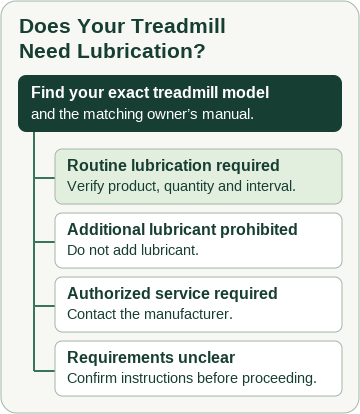
- Determine whether owner lubrication is permitted. Your instructions should establish whether lubrication is required, prohibited or only permitted under authorized service guidance.
- Verify the lubricant, amount and maintenance interval. If your model requires lubrication, use its own requirements instead of copying another machine's schedule.
If you cannot determine which arrangement applies, contact the manufacturer before adding anything.
SOLE F63 and TT8: Why you cannot rely on the brand alone
SOLE provides a particularly useful example of why general treadmill maintenance advice can be misleading.
SOLE F63
The 2026 F63 owner's manual specifies that the belt and deck arrive with lubricant already applied.
Future maintenance is required after 90 operating hours or 90 days, whichever comes first. Lubrication may be needed sooner if the deck is found to be dry.
SOLE also recommends checking the lubrication condition approximately every other month.
The specified product is SOLE-approved, 100% food-grade silicone intended for treadmills. Spray-based and foam-based lubricants are excluded.
The stated quantity is 2–3 ounces per application.
We also reviewed a copy of SOLE's 2023 F63 Revision D manual. It specifies the same maintenance interval and quantity, but its lubrication-reminder reset procedure differs.
Use the manual matching your treadmill rather than assuming every F63 has identical controls.
Maintenance can also affect warranty coverage. The 2026 manual identifies damage resulting from improper maintenance, including inadequate deck lubrication, among its warranty exclusions.
That doesn't mean a single missed maintenance interval automatically eliminates every aspect of warranty coverage.
2026 SOLE F63 manual, printed pages 27 and 29.
SOLE F63 2023 Revision D manual, printed page 30.
SOLE TT8
The TT8 is different.
SOLE's 2023 Revision E manual describes a proprietary deck system and prohibits applying lubricant or wax to its surface.
The owner is still responsible for appropriate cleaning and maintenance.
If the running deck shows significant wear, the manual directs the owner to seek service assistance rather than adding lubricant.
Horizon treadmills: Silicone or wax?
Horizon tells owners to determine whether their treadmill has a silicone or waxed running surface.
For applicable silicone systems, its general maintenance guidance recommends lubrication every 150 miles or three months, whichever comes first.
Its documented procedure uses 20 mL of silicone oil, with another 10 mL permitted when necessary. The maximum is 30 mL for that procedure.
For its waxed systems, Horizon prohibits adding substances to the belt or deck.
What about the current Horizon 7.0 AT?
Horizon identifies the US model sold under SKU HTM1457-01 as using a 1.6 mm silicone belt.
That establishes the belt specification. However, we could not independently match its exact SKU to a complete owner's manual.
Confirm that Horizon's general silicone maintenance guidance applies to your particular version before using its quantity or schedule.
Matrix treadmill lubrication: Why two documents give different mileage intervals
Matrix's residential treadmill support page links two documents containing different silicone lubrication recommendations.
On a small screen, swipe the table sideways.
| Matrix-linked document | Calendar interval | Mileage interval |
|---|---|---|
| Residential Treadmill Guide, printed page 12 | Three months | 300 miles |
| Residential and Light Commercial Treadmill Deck and Belt Guide, September 2021, printed page 4 | Three months | 150 miles |
The residential Treadmill Guide describes a mileage-based maintenance reminder and specifies half of the supplied bottle of 100% silicone lubricant.
The broader technical guide specifies a 20 mL standard application and a maximum of 30 mL under its described procedure.
Both documents are linked from Matrix's own support resources.
Other manufacturer-authored Treadmill Guide copies also contain the 300-mile schedule. However, those documents do not establish that this interval applies to every Matrix frame generation.
The three-month calendar interval agrees across the two main documents, but the mileage interval does not.
That matters if you reach 150 miles before three months have passed.
We could not determine which mileage recommendation applies to every residential Matrix frame.
If you own a Matrix treadmill, provide the manufacturer with your frame model and ask which maintenance document governs your equipment.
A 300-mile console reminder does not necessarily establish that the physical running surface should wait 300 miles between applications.
Matrix residential treadmill support.
Matrix-linked residential Treadmill Guide, printed page 12.
Residential and Light Commercial Treadmill Deck and Belt Guide, printed page 4.
What I do with my Matrix T30
I bought my Matrix T30 in 2025 and have used it for more than a year, typically at least five days a week.
My usual runs are two to three miles at around 7–8 mph.
My treadmill has the TM1017 frame and CTM1027 XIR-02 touchscreen console.
About every three months, I apply Matrix silicone treadmill lubricant beneath the running belt. I also make occasional belt adjustments, generally about once a month.
During the ownership period covered in my review, I haven't experienced belt slipping during runs, unusual vibration or squeaking.
Maintenance has been straightforward for me.
That's my personal maintenance experience. The conflicting mileage recommendations discussed above have not been conclusively resolved for my exact TM1017 frame.
You can read more about my experience maintaining the Matrix T30, including what has worked well and the console problem I encountered shortly after buying it.
NordicTrack Commercial 1750: Why you should check the exact manual
You may find general maintenance articles recommending that NordicTrack owners periodically apply silicone oil.
NordicTrack's own UK maintenance article, published in March 2026, gives a general lubrication recommendation.
However, the US-market Commercial 1750 owner's manual for model NTL17125.0 is more restrictive.
It describes a factory-lubricated belt and restricts the addition of substances to the belt or walking platform unless an authorized service representative provides instructions.
The manual warns that inappropriate products can damage the running belt and contribute to excessive wear.
That restriction covers more than aerosol sprays.
Buying liquid silicone instead of spray does not automatically make owner lubrication appropriate.
If you believe the machine needs additional lubricant, contact authorized service support.
Commercial 1750 NTL17125.0 owner's manual, printed page 29.
WalkingPad C2: A smaller amount of silicone is required
The WalkingPad C2, model WPS1F, provides a useful contrast with a full-size treadmill.
The reviewed US-market owner's manual specifies a silicone oil application of 5–10 mL every three months.
It also warns that excessive lubricant can cause belt slipping.
Copying the quantity from a full-size SOLE treadmill would therefore be inappropriate.
WalkingPad identifies WPS1F as the C2 in its model-specific troubleshooting guidance.
If your walking pad has a different model number, use that machine's instructions.
Frequent use also doesn't mean you can ignore the equipment's operating limits. Some walking pads require breaks between sessions regardless of whether maintenance is current.
See our guide to manufacturer limits for daily walking pad use if you intend to use yours throughout the workday.
Does a new treadmill need lubrication before you use it?
Not necessarily.
The 2026 SOLE F63 arrives pre-lubricated, but its manufacturer requires additional lubrication later.
The reviewed NordicTrack Commercial 1750 also arrives with a treated belt, yet its instructions restrict additional owner-applied substances.
Both machines have factory-treated running surfaces, but their future maintenance requirements differ.
Read the setup instructions for your exact treadmill.
If the manufacturer specifies an initial owner application, follow it. If the machine arrives ready to use with factory-applied lubricant, there is no reason to add more solely because it is new.
A bottle of silicone included in the packaging may be intended for later maintenance.
How often should you lubricate your treadmill?
Use the maintenance triggers specified for your machine.
Some manufacturers measure operating time. Others use distance or a calendar interval.
For example, the 2026 SOLE F63 uses both 90 operating hours and 90 days.
If you use it for 30 minutes every day, you will accumulate only about 45 hours over 90 days. The calendar interval still applies.
If you use it for 90 minutes every day, you will reach 90 operating hours in 60 days.
In the second example, the usage threshold arrives before the calendar threshold.
The same principle applies to machines with mileage-based maintenance schedules.
For a treadmill that specifies 150 miles or three months, someone accumulating 15 miles per week reaches the mileage threshold after ten weeks.
These are illustrative calculations, not universal maintenance recommendations.
Can you wait for the lubrication reminder?
Not if the manufacturer also specifies calendar-based or inspection-based maintenance that becomes due sooner.
The F63's documented reminder is triggered by operating hours. Matrix's residential Treadmill Guide describes a mileage-based reminder.
Neither example establishes that the console directly measures the lubricant remaining beneath the belt.
A treadmill used infrequently may reach its calendar maintenance interval before a reminder appears.
Keep a simple maintenance record:
On a small screen, swipe the table sideways.
| Record | What to enter |
|---|---|
| Date of last lubrication | Your actual maintenance date |
| Operating hours or mileage | Recorded machine usage |
| Lubricant used | Exact approved product |
| Amount applied | Your model's specified quantity |
| Next maintenance check | Based on the applicable instructions |
Reset maintenance reminders only after completing the required work, following the instructions for your exact model and console.
Where does treadmill lubricant go?
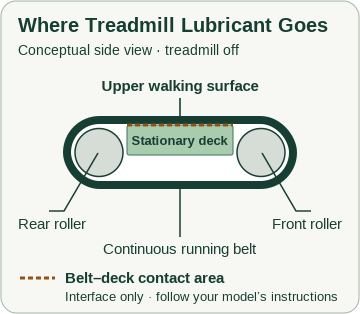
On the machines covered here that permit routine owner lubrication, the lubricant belongs at the contact area between the running belt and deck.
It does not belong on the upper surface where you place your feet.
The internal drive belt is a different component and should not be treated as the running belt.
Before performing an authorized lubrication procedure, stop the treadmill, switch it off and unplug it.
Some application methods involve loosening the belt, while others use an applicator without that step.
Follow your model's procedure, including any required tension and alignment checks.
Keep hands, clothing and tools clear of the belt and rollers before reconnecting power.
Do not apply lubricant while the belt is moving.
Follow the manufacturer's post-application instructions rather than copying a speed or duration from a different treadmill.
Which treadmill lubricant should you use?
Start with the approved lubricant listed in your owner's manual.
Several covered machines specify silicone oil, but that does not make every silicone product interchangeable.
A silicone spray is not automatically an acceptable substitute for treadmill silicone oil.
Likewise, do not substitute a general-purpose penetrating oil, household oil, grease or wax because it happens to be available.
If you already have a lubricant bottle, check its intended application against the treadmill manufacturer's requirements.
Buying lubricant is unnecessary if your running surface prohibits owner-applied substances.
Can you use too much treadmill lubricant?
Yes.
The WalkingPad C2 manual explicitly warns that excessive lubricant can make the belt slip.
Horizon also establishes a maximum amount for its documented silicone application procedure.
If the belt starts slipping after maintenance, stop using the machine and check the model's troubleshooting instructions.
The problem could involve excess lubricant, incorrect belt tension or another issue.
If excess lubricant needs to be removed, use the manufacturer's approved cleanup instructions. Avoid household solvents or other unapproved chemicals.
When lubrication is not the answer
A treadmill that feels sluggish or makes an unfamiliar noise doesn't necessarily need more silicone.
Several different problems can produce similar symptoms.
On a small screen, swipe the table sideways.
| What you notice | What to check |
|---|---|
| Scheduled lubrication is due | Confirm the maintenance requirements and approved lubricant |
| A lubrication reminder appears | Check the model's documented reminder trigger and maintenance procedure |
| Belt moves toward one side | Investigate the model's alignment requirements |
| Belt hesitates beneath your feet | Stop and investigate slipping, tension, wear or other possible causes |
| Belt becomes slippery after lubrication | Check for excess or incorrectly applied lubricant |
| Belt or deck is visibly damaged | Stop using the machine and seek manufacturer guidance |
| Burning smell, smoke or uncontrolled movement | Stop using the machine immediately and disconnect power when safe |
NordicTrack's Commercial 1750 manual, for example, includes belt tension and electrical supply among the checks relevant to a walking belt that slows under load.
You do not need to diagnose an internal electrical or mechanical fault yourself.
If maintenance hasn't restored normal operation, contact the manufacturer rather than repeatedly adding lubricant or opening electrical components.
Check your manual before your next maintenance session
If your treadmill requires routine lubrication, follow its documented interval and application quantity.
If it prohibits additional lubricant, leave the running surface alone.
If lubrication requires authorized service guidance, contact the manufacturer before attempting it.
A few minutes spent checking the correct manual is more useful than following maintenance advice intended for somebody else's machine.
Sources and research notes
Sources last checked November 24, 2026.
This guide is based on manufacturer documentation and the author's established Matrix T30 ownership experience.
We did not independently test lubricant quantities, compare lubricant brands, measure running-surface friction or evaluate long-term wear across these models.
Manufacturer manuals and support documents:
- SOLE F63, 2026 Version A (opens in new tab)
- SOLE F63, 2023 Revision D (opens in new tab)
- SOLE TT8, 2023 Revision E (opens in new tab)
- SOLE manual directory (opens in new tab)
- Horizon silicone lubrication guidance (opens in new tab)
- Horizon 7.0 AT specifications (opens in new tab)
- Matrix residential treadmill support (opens in new tab)
- Matrix residential Treadmill Guide (opens in new tab)
- Residential and Light Commercial Treadmill Deck and Belt Guide (opens in new tab)
- Additional manufacturer-authored Matrix Treadmill Guide copy (opens in new tab)
- NordicTrack Commercial 1750 NTL17125.0, manufacturer-authored third-party-hosted manual (opens in new tab)
- NordicTrack UK general lubrication article (opens in new tab)
- WalkingPad C2 WPS1F US-market manual, manufacturer-authored copy hosted by Lowe's (opens in new tab)
- WalkingPad model-specific belt guidance (opens in new tab)