Resistance bands vs. dumbbells: what should you buy first?
Both can make a home workout harder. The better purchase depends on your space, your exercises, and how you want to track progress.
Sources last checked October 24, 2026.
Jump to a section
Choose bands when storage and setup are the real problem
Bands are worth considering if your equipment has to fit in a drawer, travel in a bag, or disappear when you finish. They can be a sensible first purchase when the alternative is buying nothing because a full dumbbell setup costs too much.
But choose the style for the exercises you intend to do. Short loops used around the legs, long continuous loops, flat therapy bands, and tubes with handles aren’t interchangeable. A set with many pieces can still be the wrong set if none of them makes your main exercises convenient.
Before ordering, write down three movements you want to perform. Then watch the manufacturer’s setup instructions for those movements. Do you need a door anchor? Can you use it on your door safely? Does a handle come with the kit? If the plan involves awkward workarounds before the first repetition, keep looking.
If travel is the main reason for buying, consider the place you’ll actually train. A hotel room with no suitable anchor is different from a home where you can install one. Portable equipment still needs an appropriate setup.
For exact kit contents, anchoring restrictions and buying options, see our resistance-band buying guide.
Sources: 2
Choose dumbbells when simple progression matters most
Dumbbells make it easier to keep a plain training log: exercise, weight, sets, and repetitions. That simplicity is useful if you want to repeat the same routine and gradually make it harder. You can still make progress with bands, but you have more setup details to keep consistent.
Check the lightest weight as carefully as the heaviest. A pair that’s comfortable for rows may be too heavy for smaller movements. Also look at the available increments. Moving from one setting to the next should make sense for the exercises you plan to do.
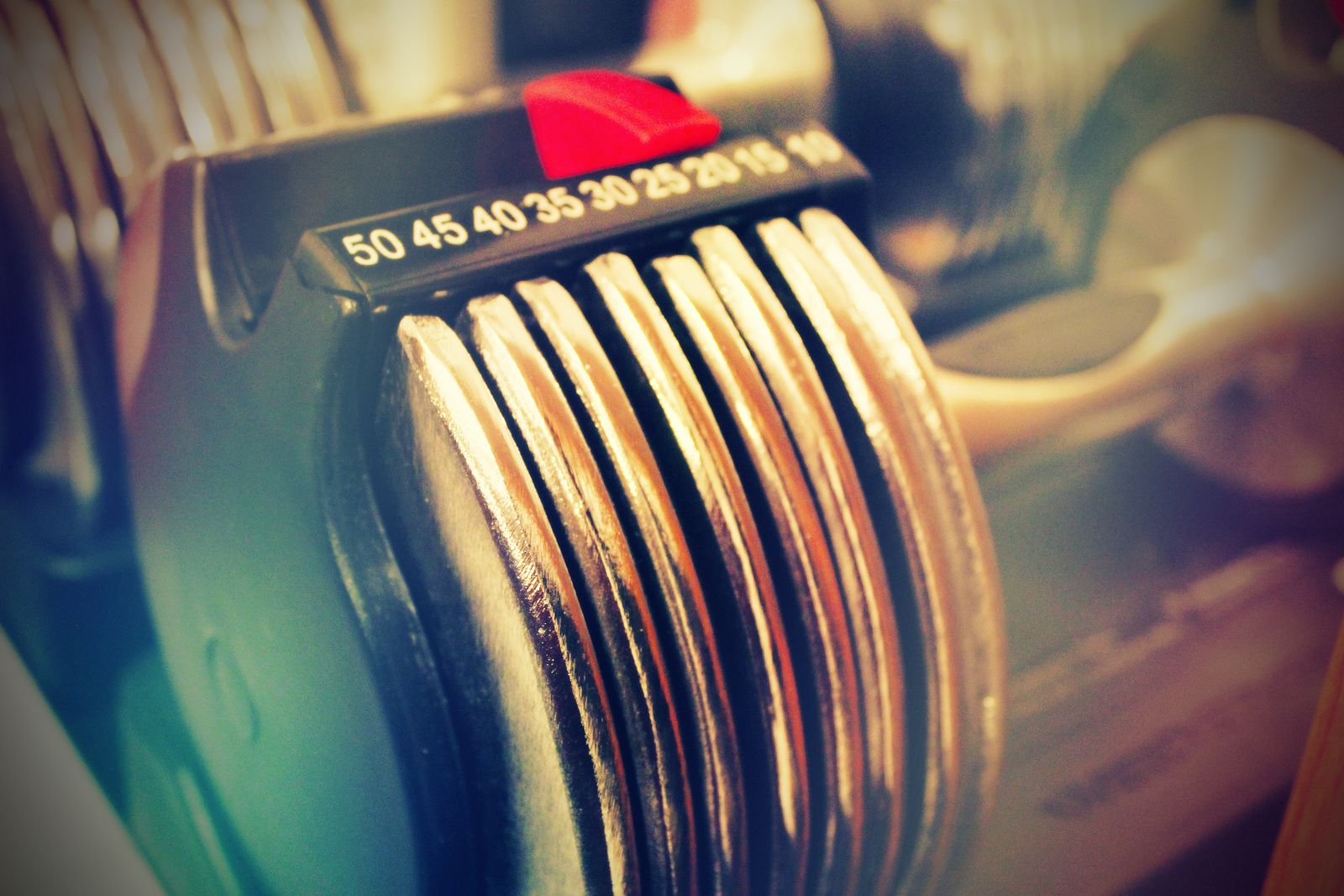
Fixed dumbbells are straightforward, but collecting several pairs takes space. Adjustable models concentrate more weight choices into one storage area. The tradeoffs are the adjustment mechanism, handle shape, and how long changes take. Those details are covered in the PowerBlock vs. Ironmaster comparison.
For someone already lifting regularly, the deciding question may be whether the set provides enough resistance for their strongest movements. Buying an inexpensive pair that becomes limiting almost immediately isn’t much of a saving.
Storage and progression tradeoffs
On a small screen, swipe the table sideways.
| What matters | Resistance bands | Dumbbells |
|---|---|---|
| Small storage area | Usually easier to pack away | Adjustable models reduce the number of separate pairs |
| Tracking progression | Record band and setup as well as reps | Record load and reps |
| Resistance feel | Changes with stretch and setup | Fixed mass; exercise leverage still changes |
| Before buying | Check band style, anchors, material, and instructions | Check weight range, increments, handle, and storage |
The biggest difference is how the resistance feels
A dumbbell has a stated mass. A 20-pound dumbbell still weighs 20 pounds at the bottom and top of a curl, although how hard the movement feels changes with your position and leverage. With a band, the resistance generally increases as you stretch it. How far you stand from an anchor and where you grip the band change the exercise.
That’s why a band labeled with a resistance range isn’t a direct replacement for a dumbbell with the same number on it. A band’s rating depends on how the manufacturer measures stretch. Don’t add up the numbers on several bands and assume you now own the equivalent of that much free weight.
Picture doing rows. With a dumbbell, you can record the weight and repetitions. With a band, you also need to keep the anchor, starting position, and band length consistent. Otherwise, a harder workout could simply mean you stood farther away.
Sources: 2
Compare the whole purchase, not the headline price
For bands, count the pieces you’ll actually use: the right resistance levels, suitable handles, an approved anchor, and replacement availability. For dumbbells, include the weight range you need, storage, and any stand you intend to buy. Compare two complete setups rather than one bare-bones listing against a bundle.
Here’s a practical example. Someone who exercises in a shared bedroom and puts everything away every morning may get more use from a small band kit. Someone with a permanent workout corner who dislikes adjusting anchors may prefer a pair of adjustable dumbbells. Neither person needs the other person’s equipment.
Customer reviews can help you spot questions about handles, clips, odors, adjustment problems, or replacement service. Read descriptions of the exact model. A star average from several products combined doesn’t tell you much about the one in your cart.
What the strength research establishes
A 2019 systematic review and meta-analysis found no clear advantage for elastic or conventional resistance in the strength outcomes studied. Bands are a legitimate option. That does not mean every band routine matches every dumbbell routine, or that the findings establish identical muscle growth.
Sources: 1
Bands need inspection, and dumbbells need sensible handling
Follow the instructions for the exact product. THERABAND tells users to inspect bands for damage, pay attention to connection points, and replace worn material. Its guidance also addresses eye protection. If a band is cracked, torn, or damaged, stop using it. A band failing while stretched isn’t the time to discover that the attachment was questionable.
Check the material if you have a latex allergy, and use only an anchoring method the manufacturer allows. Don’t improvise a door setup that can pull open toward you. Storage instructions matter too, because the product is designed to be used within particular limits.
With dumbbells, keep the floor clear and follow the adjustment and locking instructions. Don’t assume an adjustable model can be dropped because a fixed gym dumbbell sometimes is. Buy for the training you can perform with control.
Add the other tool when a limitation appears
Try a week of your usual movements with the equipment you already own. If rows run out of resistance, look at heavier dumbbells or a band arrangement that fits the movement. If travel breaks your routine, a packable band may solve that problem. Buy for the gap you actually found.
CDC guidance calls for muscle-strengthening work on at least two days a week, covering the major muscle groups. Choose equipment that lets you complete that work consistently.
Sources: 4
A few more questions
Can resistance bands replace dumbbells?
They can cover many strength exercises, but they do not feel the same and are not a direct pound-for-pound substitute. Check whether the bands and setup can challenge the movements you want to do.
Do beginners need both bands and dumbbells?
No. Start with one setup that suits your budget and space. Add the other only when it solves a clear problem in your training.
Sources & research notes
Sources checked October 24, 2026.
- Lopes et al. (2019): elastic vs. conventional resistance and strength (opens in new tab)
- Performance Health: THERABAND resistance-band FAQ and safety guidance (opens in new tab)
- Performance Health: band inspection, replacement, and eye protection (opens in new tab)
- CDC: adult physical activity recommendations (opens in new tab)