How Big Are PowerBlocks Compared With Regular Dumbbells?
PowerBlocks save a lot of storage space compared with owning a full rack of fixed dumbbells.
Sources last checked November 11, 2026.
That does not mean every PowerBlock is physically smaller than a regular dumbbell at the same weight.
At 50 pounds, the current PowerBlock Pro 50 is shorter than the conventional 50-pound rubber hex dumbbell we compared it with.
At 90 pounds, the Elite USA 90 is slightly shorter and substantially narrower.
At 100 pounds, the situation reverses in one direction. The Pro 100 EXP is longer than our conventional 100-pound hex example, although it remains narrower across the body.
So there are two different questions:
How big is the dumbbell in your hand?
and
How much room does the whole weight collection take to store?
PowerBlocks perform very differently depending on which one you mean.
Jump to a section
Current PowerBlock dimensions
PowerBlock currently publishes these maximum dimensions for its main residential models:
On a small screen, swipe the table sideways.
| PowerBlock | Maximum weight per hand | Dimensions |
|---|---|---|
| Sport 24 | 24 lb | 10 × 5.5 × 5.5 in |
| Pro 32 | 32 lb | 12 × 5.75 × 5.5 in |
| Pro 50 | 50 lb | 13 × 7 × 7.25 in |
| Elite USA 90 | 90 lb | 16.25 × 6 × 6 in |
| Pro 100 EXP | 100 lb | 19.21 × 7.63 × 7.72 in |
Those are length × width × height.
The expandable Elite USA and Pro 100 become larger as expansion stages are added. The dimensions above represent the full model configurations published by PowerBlock, not a promise that every selected weight has the same lifted dimensions.
That distinction matters when you are deciding whether the heaviest version will feel manageable in a particular exercise.
Compare them with real fixed hex dumbbells
"Regular dumbbell" is not one standardized shape.
Rubber hex, round urethane, pro-style and iron dumbbells can all have different dimensions at the same weight.
For a consistent comparison, we used Torque's current commercial rubber hex line because Torque publishes individual dimensions from 5 through 100 pounds.
Here are several useful comparisons.
On a small screen, swipe the table sideways.
| Weight | PowerBlock | PowerBlock length | Torque fixed hex | Fixed length |
|---|---|---|---|---|
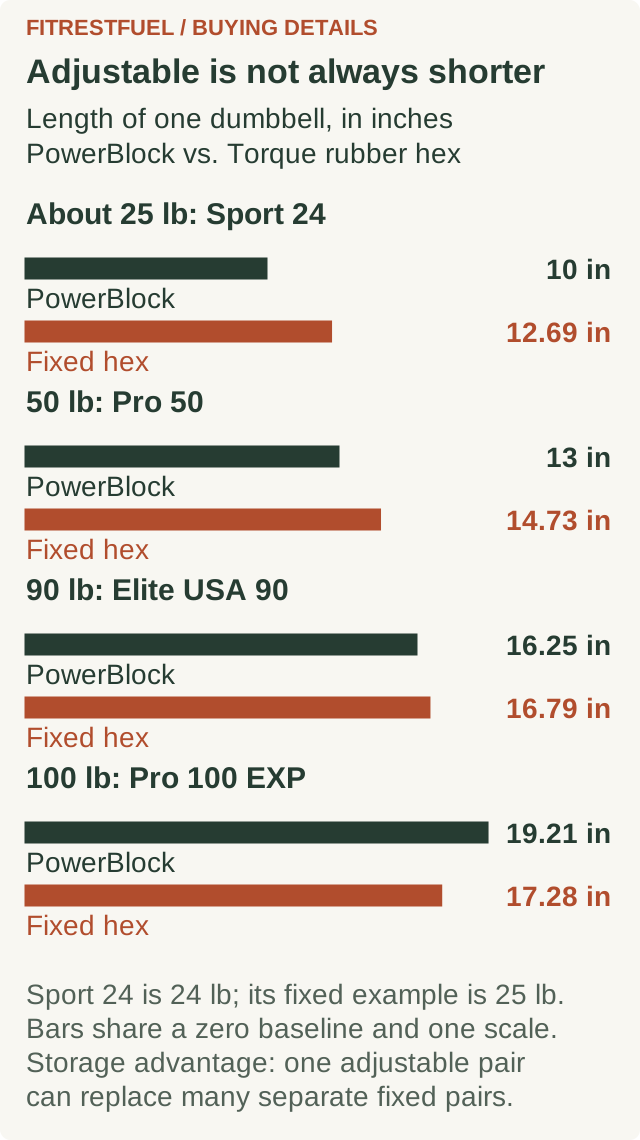
| About 25 lb | Sport 24 | 10 in | 25 lb hex | 12.69 in |
| 50 lb | Pro 50 | 13 in | 50 lb hex | 14.73 in |
| 90 lb | Elite USA 90 | 16.25 in | 90 lb hex | 16.79 in |
| 100 lb | Pro 100 EXP | 19.21 in | 100 lb hex | 17.28 in |
The first comparison is not exactly weight-for-weight because the Sport 24 stops at 24 pounds, while the conventional example is 25 pounds. It is still useful for showing the size range around that load.
The other three use the same nominal weight.
At 50 pounds, the PowerBlock is shorter
The Pro 50 measures:
13 inches long
Torque's 50-pound rubber hex dumbbell measures:
14.73 inches long
Difference:
14.73 - 13 = 1.73 inches
The PowerBlock is therefore about 1.7 inches shorter end to end in this comparison.
Crosswise dimensions are much closer.
PowerBlock lists the Pro 50 at 7 inches wide. Torque lists its 50-pound hex dumbbell at 6.88 inches wide.
So the Pro 50 is shorter, but not narrower.
That is why "compact" needs context.
A rectangular adjustable dumbbell can save length while remaining fairly substantial around your hand.
At 90 pounds, the Elite USA is especially compact across the body
The Elite USA 90 measures:
16.25 × 6 × 6 inches
Torque's 90-pound rubber hex dumbbell measures:
16.79 inches long × 8.41 inches wide
The length difference is small:
16.79 - 16.25 = 0.54 inch
The crosswise difference is much larger:
8.41 - 6 = 2.41 inches
That does not automatically mean the Elite USA will work better for every exercise.
The shapes are completely different.
The fixed dumbbell has two large heads connected by an exposed handle. The PowerBlock places your hand inside a rectangular nested-weight structure.
Still, if you are wondering whether a 90-pound PowerBlock is an enormous object compared with a conventional 90, the published dimensions say no.
The Elite USA is slightly shorter than this particular fixed 90 and considerably narrower across its published width.
At 100 pounds, the Pro 100 becomes long
This is where the simple "PowerBlocks are smaller" explanation stops working.
The Pro 100 EXP measures:
19.21 inches long
Torque's fixed 100-pound rubber hex dumbbell measures:
17.28 inches long
Difference:
19.21 - 17.28 = 1.93 inches
The Pro 100 is almost 2 inches longer in this comparison.
It is narrower, however.
PowerBlock:
7.63 inches wide
Torque:
8.82 inches wide
Difference:
8.82 - 7.63 = 1.19 inches
So the shapes trade space in different directions.
The conventional 100 is shorter but has larger heads.
The PowerBlock is longer but narrower.
If your concern is two dumbbells touching during a press, overall length may matter more.
If your concern is how large the weight feels beside your torso, the crosswise dimension may matter more.
Measure for the exercise that is actually causing the concern.
The Pro 100 is noticeably larger than the Elite USA 90
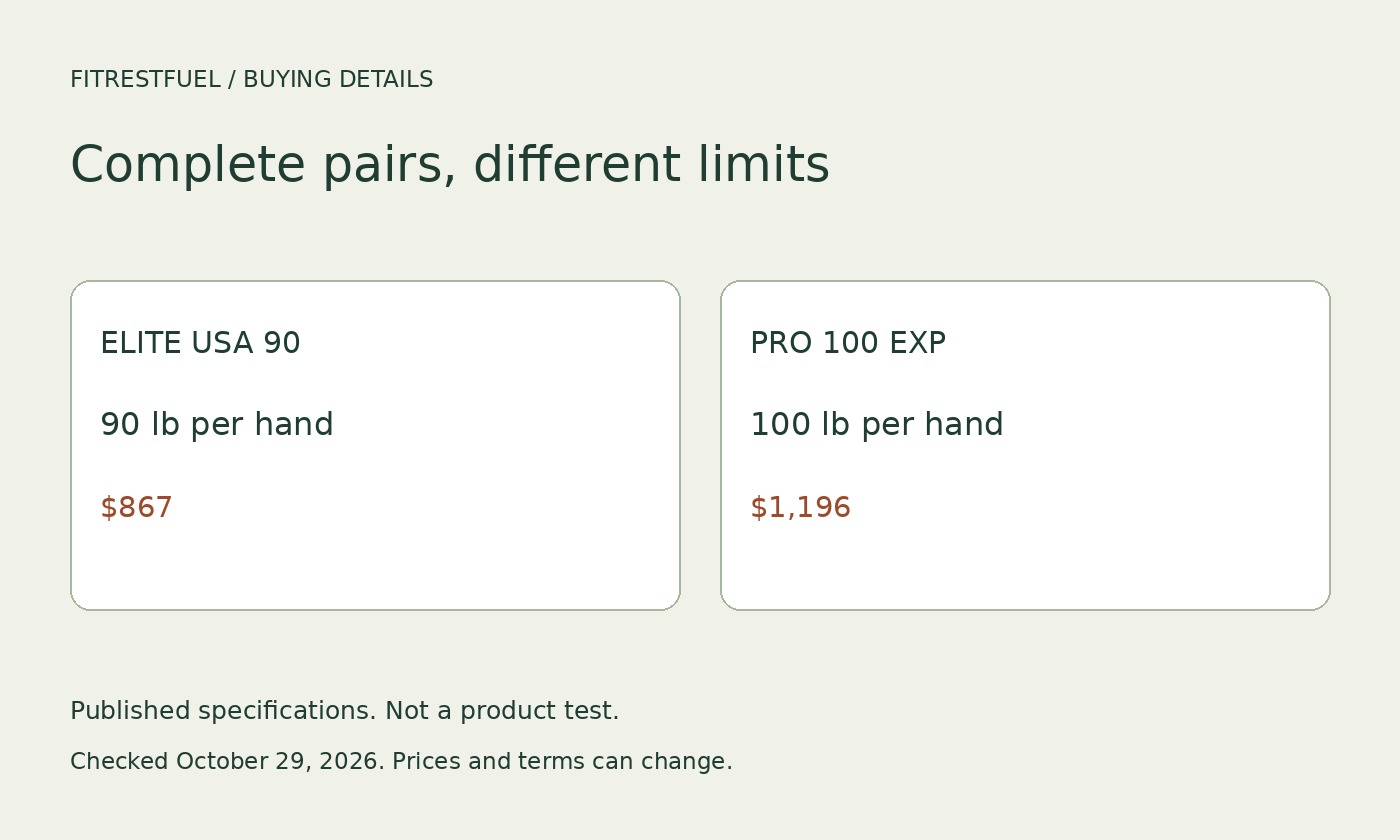
FitRestFuel already compares these two PowerBlocks as complete systems.
These two models differ in both design and maximum weight, so compare their dimensions directly.
Elite USA 90:
16.25 × 6 × 6 inches
Pro 100 EXP:
19.21 × 7.63 × 7.72 inches
The Pro is:
19.21 - 16.25 = 2.96 inches longer
It is also:
7.63 - 6 = 1.63 inches wider
and:
7.72 - 6 = 1.72 inches taller
If 90 pounds per hand is already enough for your training, the Elite USA gives you a smaller maximum dumbbell.
If you need 100 pounds, that additional capacity comes with additional physical size.
Sources: 1
PowerBlocks do not look or move like ordinary fixed dumbbells
Dimensions only tell part of the story.
A conventional fixed dumbbell normally places your hand between two separate heads.
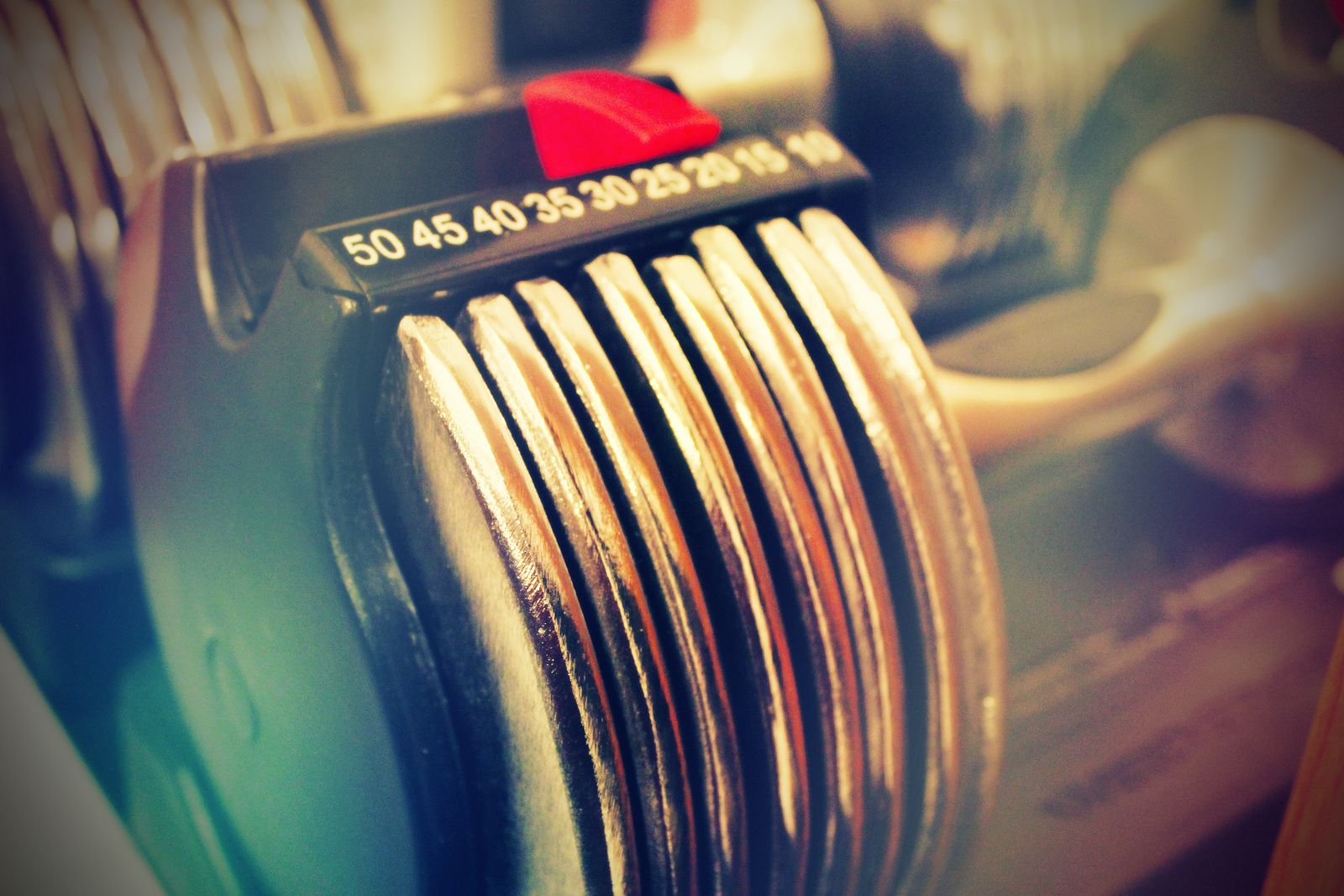
PowerBlocks use nested rectangular weight plates around the handle.
That changes where the mass and frame sit relative to your hand.
PowerBlock publishes grip lengths of roughly 4.75 to 4.88 inches across its current residential lineup, depending on the model.
Conventional fixed dumbbells can have longer exposed handles. Rogue, for example, currently uses a 6-inch handle on its urethane dumbbells.
Neither arrangement is automatically better.
They are simply different geometries. For a comparison with a plate-loaded adjustable design, see PowerBlock vs. Ironmaster.
If you already know that dumbbells tend to hit each other or your body during a particular movement, compare the exact dimensions instead of assuming that an adjustable dumbbell will behave like the fixed one you use at a gym.
Presses make overall length worth checking
Imagine holding two dumbbells over your chest.
The longer each dumbbell is, the sooner the inner ends can approach each other as your hands move closer together.
That does not prevent pressing with a long dumbbell.
It means the available space between the two implements changes.
This is more relevant to the 19.21-inch Pro 100 than the 13-inch Pro 50.
It is also why someone who only plans to use 40 or 50 pounds per hand should not judge every PowerBlock by the maximum dimensions of the 100-pound model.
The current lineup ranges from only 10 inches long for the Sport 24 to more than 19 inches for the Pro 100 EXP.
"PowerBlock size" is not one number.
Sources: 1
The block shape matters for curls and close-to-body exercises
Length is not always the relevant dimension.
During curls, carries and some rowing variations, the dumbbell may pass relatively close to your legs or torso.
PowerBlocks have flat rectangular outer surfaces rather than round or hexagonal heads.
That can change where the dumbbell makes contact if your normal movement brings the weight close to your body.
The correct conclusion is not that one shape is more comfortable.
FitRestFuel has not personally tested every current PowerBlock against every conventional dumbbell.
The useful conclusion is that buyers should consider shape as well as dimensions, particularly if they already dislike bulky dumbbells.
A fixed dumbbell gets physically larger as the weight rises
Torque's rubber hex line makes this easy to see.
Its published length increases from:
9.66 inches at 5 pounds
to:
14.73 inches at 50 pounds
to:
16.79 inches at 90 pounds
to:
17.28 inches at 100 pounds
Its published width increases too:
3.07 inches at 5 pounds
6.88 inches at 50 pounds
8.41 inches at 90 pounds
8.82 inches at 100 pounds
There is no single conventional dumbbell size.
Heavy fixed dumbbells get physically large as the manufacturer adds more material.
That is important when someone compares a maximum-capacity PowerBlock with the 20-pound dumbbell they already own.
Use the same weight whenever possible.
Sources: 2
The real PowerBlock space saving happens when the weights are stored
This is where PowerBlocks have a much larger advantage than the individual-dumbbell measurements suggest.
A pair of Pro 100 EXPs can cover weights from 5 to 100 pounds per hand.
PowerBlock says that one pair replaces 30 pairs of traditional dumbbells.
The company describes that as replacing roughly a 7-foot rack of conventional dumbbells while the PowerBlock pair itself takes about 1.75 feet of space. Those figures are a manufacturer comparison in linear feet, not a floor-area measurement. PowerBlock does not specify the rack layout or dumbbell arrangement behind the claim, so use the product dimensions and any stand’s footprint when planning your room.
PowerBlock’s comparison chart lists the Elite USA 90 as replacing up to 28 pairs of traditional dumbbells.
The same comparison chart lists the Pro 50 as replacing 19 pairs.
It lists the Sport 24 as replacing 8 pairs.
That is the space-saving argument.
It is not:
one PowerBlock is always much smaller than one fixed dumbbell
It is:
one PowerBlock can perform the jobs that would otherwise require many separate fixed dumbbells
Those are very different claims.
The storage advantage depends on how many weights you actually need
Suppose you only need one pair of 25-pound dumbbells.
Buying an adjustable pair does not magically save a room full of space, because you were never going to own a room full of fixed dumbbells.
Now suppose your training requires:
- 15 pounds for lateral raises
- 25 for curls
- 40 for shoulder presses
- 60 for rows
- 80 for leg work
Fixed dumbbells require multiple separate pairs.
An expandable PowerBlock lets one pair cover those loads.
The more weights you actually need, the more meaningful the storage advantage becomes.
That is a better way to judge the space claim than counting every possible selector setting whether you use it or not.
You do not necessarily need a dumbbell rack
Conventional dumbbells are often stored on a horizontal or vertical rack once the collection gets large.
PowerBlocks nest into their own weight stacks.
You can store them on the floor or add a compatible PowerBlock stand for easier access.
A stand adds its own footprint, so include it when planning the room.
For example, choosing a stand may make weight changes more convenient but reduce some of the raw floor-space advantage compared with placing the dumbbells directly on the floor.
Compare the setup you would really own:
fixed dumbbells + rack
versus:
PowerBlocks + optional stand
not an empty PowerBlock against a fully equipped commercial dumbbell area.
Expansion changes the amount of equipment you store
The Elite USA and Pro 100 EXP grow through additional weight stages.
PowerBlock says the Elite USA begins at 5 to 50 pounds and can expand to 70 and then 90.
The Pro 100 begins at 5 to 40 and can expand to 60, 80 and finally 100.
The additional plates nest into the existing system.
You are not adding another complete pair of dumbbells each time.
That keeps the storage system consolidated, although the dumbbell becomes physically larger as the full stack grows.
If you are unsure which expansion belongs to your set, see our Which PowerBlock expansion kit fits your dumbbells? guide before ordering.
Which PowerBlock is smallest?
Among PowerBlock's current residential lineup, the Sport 24 has the smallest published dimensions:
10 × 5.5 × 5.5 inches
It reaches only 24 pounds per hand.
The Pro 32 grows to:
12 × 5.75 × 5.5 inches
The Pro 50 is:
13 × 7 × 7.25 inches
From there, the expandable heavy models become substantially longer.
This is why choosing a PowerBlock solely for maximum possible weight can backfire.
If you know you will never need more than 50 pounds per hand, the compact Pro 50 gives you a noticeably smaller object than the 100-pound Pro model.
Buy enough capacity for the exercises you plan to do, not the largest PowerBlock because it exists.
How much room should you plan around the dumbbells?
The storage dimensions tell you where the dumbbells can sit.
They do not tell you how much exercise space you need.
You still need room for:
- your arms to move through presses and raises
- the dumbbells to clear a bench
- rows and split-stance exercises
- getting the dumbbells on and off a stand
- changing the selector pin
- safely setting the dumbbells down
Do not design a workout corner around a rectangle exactly the same size as the stored weights.
The dumbbells are small compared with a complete fixed set.
Your body still needs normal training space around them.
Which size should you worry about most?
If you are comparing PowerBlocks with fixed dumbbells, look at three things.
Overall length
This becomes increasingly important on heavy models and during exercises where two dumbbells move toward each other.
The Pro 100 is the one that stands out here at 19.21 inches.
Width and height
These tell you how bulky the block is around your hand.
The Elite USA 90 is unusually compact at 6 × 6 inches for a dumbbell reaching 90 pounds.
Complete storage footprint
This is where adjustable dumbbells have their largest advantage.
Ask how many fixed pairs you would otherwise buy and where you would put them.
One PowerBlock pair replacing five fixed pairs is a meaningful space saving.
One PowerBlock replacing the only fixed pair you planned to own is a much smaller difference.
Before buying PowerBlocks because your gym is small
Do not rely on a product photo.
Check the exact model's maximum dimensions.
Then compare those measurements with:
- the fixed dumbbell weight you normally use
- your bench width
- the storage spot
- your heaviest planned dumbbell exercise
- the stand, if you intend to buy one
For heavy PowerBlocks, pay particular attention to overall length.
For fixed heavy dumbbells, pay attention to head diameter or width.
The two designs become bulky in different ways.
The simplest answer
PowerBlocks generally save far more storage space than a complete set of regular dumbbells.
Individually, the comparison is more nuanced.
The Pro 50 is shorter than the 50-pound fixed hex dumbbell in our comparison.
The Elite USA 90 is slightly shorter and substantially narrower than the 90-pound fixed example.
The Pro 100 EXP is longer than the conventional 100-pound dumbbell we compared it with, although it is narrower.
So do not buy PowerBlocks because you expect every selected dumbbell to be tiny.
Buy them for the much stronger advantage:
one compact adjustable pair can replace the many separate dumbbell pairs you would otherwise have to buy and store.
Sources & research notes
Sources checked November 11, 2026. Dimensions, configurations and grip lengths were checked against current manufacturer specifications. Replacement counts and the rack-space comparison are PowerBlock claims. Calculated differences use the published inch values; the Sport 24 versus 25 lb comparison is approximate. This is a specification comparison, not hands-on comfort or exercise testing.
- PowerBlock comparison chart: maximum configurations, L × W × H and manufacturer replacement counts (opens in new tab)
- Torque commercial rubber hex dumbbells: exact weight-specific length and width table (opens in new tab)
- PowerBlock Pro 100 EXP: stages, grip length and attributed rack-space claim (opens in new tab)
- PowerBlock Elite USA 90: stages, dimensions and grip length (opens in new tab)
- PowerBlock Pro 50: non-expandable dimensions, grip length and weight range (opens in new tab)
- PowerBlock Pro 32: dimensions, grip length and weight range (opens in new tab)
- PowerBlock Sport 24: dimensions, grip length and compact-model claim (opens in new tab)
- Rogue urethane dumbbells: 6-inch exposed handle specification (opens in new tab)