Can You Store a Walking Pad Upright? Check Your Model First
Can you store a walking pad upright? Compare WalkingPad X21, R2, C2, Z1 and UREVO SpaceWalk 5L guidance, then check your exact model.
Sources last checked November 16, 2026.
A walking pad that folds in half looks like it should be easy to stand behind a door. Sometimes it is. But the hinge, transport wheels and pictures of someone tilting it upright don't necessarily mean the manufacturer approves leaving it that way.
The short answer: Some walking pads and folding treadmills are designed for upright storage. Others need to stay flat. You have to check the exact model.
For example, WalkingPad explicitly describes upright wall storage for its X21 and R2. UREVO says vertical storage is not recommended for its SpaceWalk 5L.
If you already own a machine, start with its label and manual. You may not need to buy anything. You just need to know which storage position your particular unit supports.
Jump to a section
Which walking pads can actually be stored upright?
Here is what the manufacturers' current U.S. product information establishes for five models.
On a small screen, swipe the table sideways.
| Model | Manufacturer-supported storage | Configuration and important limits | Source |
|---|---|---|---|
| WalkingPad X21 (U.S.) | Yes. Flat or vertically against a wall. | Uses a double-fold design. WalkingPad describes transport wheels and a handrail for moving it. The inspected page does not establish freestanding storage or provide every locking step. | WalkingPad X21 |
| WalkingPad R2 (U.S.) | Yes, against a wall. | WalkingPad describes the folded R2 leaning against a wall and occupying approximately 0.11 m² of floor space. The product page does not establish an unsupported, freestanding position. | WalkingPad R2 |
| UREVO SpaceWalk 5L (U.S.) | Vertical storage is not recommended. UREVO directs owners to store it flat. | The manufacturer suggests storage under suitable furniture and says the opening should provide more than 6.1 inches of clearance. | UREVO SpaceWalk 5L |
| WalkingPad C2 (U.S. listing) | Flat storage is documented. U.S. upright approval is not established by the inspected product page. | Folds in half for storage under a bed or sofa. A separate WalkingPad-named help-center article says C2 storage should be horizontal, but its applicability to every current U.S. unit was not independently established. | WalkingPad C2 · C2 support article |
| WalkingPad Z1 (U.S.) | Flat storage is explicitly described. Upright storage permission remains unclear from the inspected U.S. product instructions. | Folds in half. WalkingPad shows it tilted onto its transport wheels, but that image does not establish permission to leave it standing. | WalkingPad Z1 |
Manufacturer information checked November 16, 2026. These findings apply to the identified listings, not automatically to every regional version or production revision. The manual and warning labels supplied with your unit take priority when they provide more specific instructions.
Why the X21 and SpaceWalk 5L are different
The X21's product page actually describes vertical storage against a wall. It identifies a double-fold design and explains that the folded machine can be placed flat or upright.
UREVO is just as clear in the other direction. Its SpaceWalk 5L FAQ says vertical storage is not recommended and tells owners to keep it flat.
That is why we wouldn't decide based on whether a machine looks capable of standing up. Two compact machines can have completely different storage instructions.
Not recommended also deserves its exact meaning. UREVO's wording is a manufacturer recommendation against vertical storage. We shouldn't silently turn that into a claim that the company has documented inevitable damage, or that every other UREVO walking pad follows the same rule.
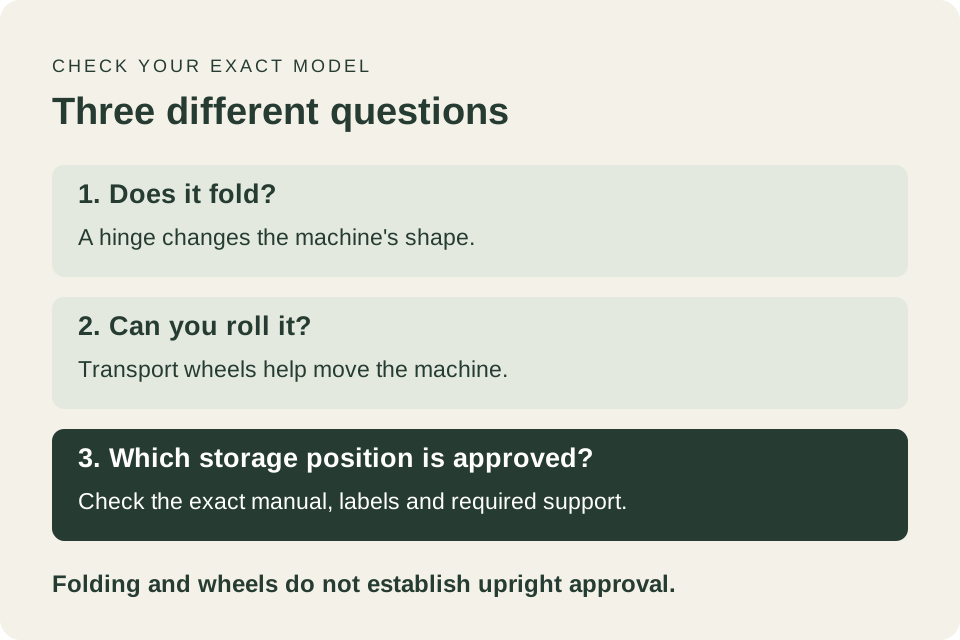
Folding, rolling and upright storage are three different things
A few product descriptions can be misleading if you read them quickly.
A folding deck: The walking surface bends at a hinge, usually making the machine shorter. That tells you its folded shape, not every approved storage orientation.
Transport wheels: You may need to tilt a machine briefly to roll it across the floor. That does not mean it can remain on end for hours or days.
Upright against a wall: The manufacturer allows a particular folded position with wall support. That does not automatically mean the machine can stand unsupported in the middle of a room.
And storage on its side is another question entirely. Permission to store a treadmill upright does not automatically permit resting its weight on a long side edge.
The distinction is especially important when shopping for a WalkingPad. Walking pad is a general description used for many compact treadmills. WalkingPad is also a particular brand. Even within that brand, storage guidance varies by model.
WalkingPad's general FAQ identifies several upright-capable models, including the X21, X214, X25, X218 and G5i. It also tells owners to check model-specific storage positions, folding dimensions, locking mechanisms and safety instructions.
What about the WalkingPad C2 and Z1?
These are the models where we would slow down and read the instructions that came in the box.
WalkingPad's current U.S. C2 page promotes folding the machine and sliding it beneath furniture. A separate WalkingPad-named help-center article says the C2 should be stored horizontally because its rounded front lacks the floor pads needed for vertical storage.
That support answer is worth noting, but we could not independently establish that it covers every current U.S. version. For a U.S. C2 owner, we would use the documented flat-storage arrangement unless the exact unit's manual or WalkingPad support confirms something different.
The Z1 is a different kind of uncertainty. Its U.S. product page tells owners to fold it in half and store it beneath a bed or sofa. It also shows a person tilting the folded machine onto its wheels. The picture tells us how it can be moved, but it doesn't settle whether the machine may be left upright.
If a photograph, website description and the warning label on your actual unit seem to disagree, don't choose the interpretation that saves the most space. Ask the manufacturer to clarify the instructions for your exact version.
For a closer look at the dimensions and other differences among these compact models, see our WalkingPad C2 vs. Z1 vs. A1 Pro comparison.
How to check a model we haven't listed
You can get surprisingly far with four checks.
- Identify the exact model. Look at the product label, not just the retailer's title. Record any model number, version and country-specific information.
- Read the storage section of the supplied manual. Look for terms such as vertical, upright, horizontal, flat and folded. Check warning stickers on the machine too.
- Find out what the approved position requires. A model may need a particular fold, engaged lock, lowered component or supporting wall. Use the manufacturer's instructions for those details. Don't improvise a bracket, strap or wedge to make an unapproved position seem workable.
- If the answer is still unclear, ask support directly. Give them the full model identifier and ask: “Can this exact version remain stored vertically when not in use? If so, what support and locking arrangement is required?”
Until you have that answer, an unsupported position is a question mark, not permission.
Measure the storage position, not just the machine
Suppose your walking pad is approved for flat storage. You still need to know whether it will pass beneath your furniture.
UREVO lists the SpaceWalk 5L at 6.1 inches high and specifically calls for more than 6.1 inches of storage clearance. A six-inch opening isn't enough, even if the machine looks slim in a product photo.
For a folding pad, use its folded dimensions, not the dimensions while you're walking on it. Also measure the actual opening and the route into the storage spot. Bed-frame rails, sofa supports and tight turns can prevent a machine from reaching a space that otherwise appears big enough.
For an upright-approved model, check the folded height, floor contact area, required wall support and access around it. Make sure doors, walkways and everyday movement won't disturb the stored machine. Follow the manufacturer's precautions, particularly in homes with children or pets.
None of those storage measurements tells you whether the treadmill fits safely while operating. Exercise clearance, walking surface and desk height are separate checks.
If your real question is whether a compact pad can replace a larger treadmill or work beneath a desk, our walking pad vs. treadmill guide covers that decision. The X21's vertical-storage design, for example, does not by itself establish that it will work beneath your standing desk.
What if your room only has upright storage space?
If you already own a model whose manufacturer advises flat storage, we'd look for an approved flat location before considering a replacement. That could mean checking another room or a different piece of furniture with a suitable opening and access route.
If there genuinely isn't one, don't force the machine into a vertical position simply because it balances when you try it. The way it stands for a few seconds tells you very little about whether the maker approves storing it that way.
For someone still shopping, storage orientation belongs on the shortlist of requirements before price, motor claims or folding convenience.
Frequently asked questions
Can every foldable walking pad be stored upright?
No. Folding describes what the deck or frame can do. Upright storage must be supported separately for the exact model.
Is leaning a walking pad against a wall safer than letting it stand by itself?
A wall is part of the approved storage arrangement for models such as the WalkingPad X21 and R2. It does not make vertical storage acceptable for a model whose manufacturer recommends keeping it flat.
Can I leave a walking pad on its side?
Only if your exact manufacturer's instructions permit that orientation. Approval to fold or store upright does not automatically cover side storage.
What if my manual conflicts with a product photo?
Use the instructions and warnings supplied with your particular unit, and contact the manufacturer for clarification before trying a different storage position. Photos can illustrate moving or folding without documenting unattended storage.
The bottom line
Check the model before you stand the machine up.
WalkingPad's X21 and R2 have explicit manufacturer support for storage against a wall. UREVO advises keeping the SpaceWalk 5L flat. For a C2 or Z1, don't treat folding photographs as a substitute for the instructions supplied with your unit.
The right answer might be “yes,” “keep it flat,” or “ask the manufacturer.” Getting that answer before clearing a spot behind the door is the useful part.
Sources & research notes
Sources checked November 16, 2026. Manufacturer-source verification, not hands-on product testing. Storage permission applies to the identified listing and exact unit; uncertain regional applicability remains qualified.
- WalkingPad X21: flat or upright against a wall (opens in new tab)
- WalkingPad R2: wall-supported storage and 0.11 m² claim (opens in new tab)
- UREVO SpaceWalk 5L: flat storage and more than 6.1-inch opening (opens in new tab)
- WalkingPad C2: U.S. flat-storage listing (opens in new tab)
- Separate C2 help-center guidance: horizontal storage, applicability qualified (opens in new tab)
- WalkingPad Z1: flat storage and transport imagery (opens in new tab)
- WalkingPad general FAQ: model-specific storage methods (opens in new tab)