Can You Fold a Memory-Foam Mattress to Move It?
Can you fold a memory-foam mattress for moving? Compare Tempur-Pedic, Casper, Nectar and Tuft & Needle instructions before folding, rolling or packing.
Sources last checked November 16, 2026.
Your memory-foam mattress arrived rolled into a surprisingly small box. Now you're moving, and that same mattress barely fits through the bedroom doorway.
So why not fold it, roll it back up or use a vacuum bag?
Some mattresses can be folded temporarily for moving, but others shouldn't be folded again after they've expanded. The answer depends on the manufacturer's instructions for your mattress, not just whether it contains memory foam.
Here's a useful example: Tempur-Pedic allows a temporary fold when necessary to move a mattress, but says to transport and store it flat. Casper recommends against folding or rolling its mattresses after unboxing. Nectar says its mattresses are not designed to be refolded once expanded.
That's a bigger difference than the phrase memory-foam mattress suggests.
Jump to a section
What the manufacturers actually say
These are the published handling instructions we could verify. They are general manufacturer statements, so check your exact model and purchase year before moving it.
On a small screen, swipe the table sideways.
| Manufacturer | Folding while moving | Transport and storage | Rolling or recompressing |
|---|---|---|---|
| Tempur-Pedic | Permits a temporary fold when absolutely necessary, with the sleeping surface facing inward. | Says to transport and store the mattress flat, not folded or on its side. Discourages leaving it folded for long periods. | The checked guidance does not authorize home vacuum compression or rerolling. |
| Casper | Recommends against folding its mattresses after unboxing, despite discussing foam flexibility generally. | Its moving guide recommends laying the mattress flat when possible and storing it flat. | Specifically discourages rolling after unboxing. No home recompression permission was established. |
| Nectar | Says the mattress is not designed to be refolded after expansion. | Recommends protecting the mattress with a moving bag. The checked FAQ does not specify every permitted transport orientation. | Its dedicated article describes factory compression but does not authorize doing it again at home. |
| Tuft & Needle | Its moving FAQ does not explicitly approve folding. | Says temporary storage on the side should be acceptable and that straps used to secure the mattress during transport should not damage the foam. | Explicitly says its mattresses cannot be recompressed after expanding. |
Manufacturer sources: Tempur-Pedic folding FAQ and product-care instructions; Casper moving guide; Nectar FAQ and refolding explanation; Tuft & Needle moving FAQ.
Sources checked November 16, 2026. These findings do not establish that every model, hybrid version or older mattress from each manufacturer has identical instructions.
The most important takeaway isn't that one brand is more flexible than another. It's that permission to bend a mattress briefly does not automatically include permission to transport it folded, store it folded or compress it back into a roll.
A temporary doorway fold is different from folded transportation
Imagine that you have a Tempur-Pedic mattress that can't make the turn at the top of your stairs.
Tempur-Pedic's guidance gives you a possible solution. If necessary for moving, you may fold the mattress with its sleeping surface facing inward.
But there's an important second instruction on its product-care page: the mattress should be laid flat for transportation and storage, and the company doesn't recommend leaving it folded for an extended period.
In other words, a temporary fold to get around an obstacle isn't blanket permission to keep the mattress folded throughout a long drive.
Tempur-Pedic also gives a temperature-specific warning. If the mattress has been folded in cold conditions, don't force it open. The company says to let it return naturally as it warms.
Those instructions are specific to Tempur-Pedic's published guidance. We wouldn't apply the same folding direction or cold-weather procedure to another brand without checking.
What if the mattress is a Casper?
Casper's moving guide presents an interesting distinction.
It explains that memory foam is flexible and can return to shape after compression. But when discussing its own mattresses, Casper specifically recommends against folding or rolling them after unboxing.
So we wouldn't use the general statement about foam flexibility as permission to fold a Casper.
The brand-specific recommendation is the part that matters.
Why can't you just vacuum-pack it again?
Because factory-compressed delivery and home recompression are different operations.
When Nectar describes its original packaging process, it explains that the mattress is compressed using specialized factory machinery. Nectar also says the mattress isn't designed to be refolded after it's expanded.
Tuft & Needle similarly states that its expanded mattresses cannot be recompressed.
These are not claims that every memory-foam mattress will suffer identical damage from a household vacuum bag. They establish something more practical: two major mattress manufacturers explicitly advise against returning their expanded products to a compressed state.
A vacuum bag sold for moving doesn't override those instructions.
Neither does the fact that your mattress arrived in a box.
Before attempting to roll or vacuum-compress an expanded mattress, you'd need specific approval from its manufacturer for that model and method. We didn't establish that approval for any of the mattresses discussed here.
What about using straps or standing the mattress on its side?
This is where the Tuft & Needle instructions are particularly helpful.
Tuft & Needle says straps used to secure a mattress during a move should not damage the foam. It also says temporarily keeping the mattress on its side should be acceptable.
That doesn't mean you can tighten straps until the expanded mattress becomes a compact roll.
The manufacturer separately says its mattresses cannot be recompressed.
It also doesn't mean the same side-storage rule applies to Tempur-Pedic. Tempur-Pedic specifically calls for flat transport and storage.
The position, pressure and duration all matter. What one manufacturer permits for moving should not be treated as a general rule for every foam mattress.
Check these four things before you move
You don't need to become an expert in mattress construction. You do need to identify what you're moving and what you're asking it to do.
1. Find the exact mattress model.
Check the law label, your order confirmation or the manufacturer's support records. Include the approximate purchase year.
Don't assume an all-foam model and a hybrid with the same brand name have identical handling instructions.
2. Separate the three questions.
Look for instructions addressing:
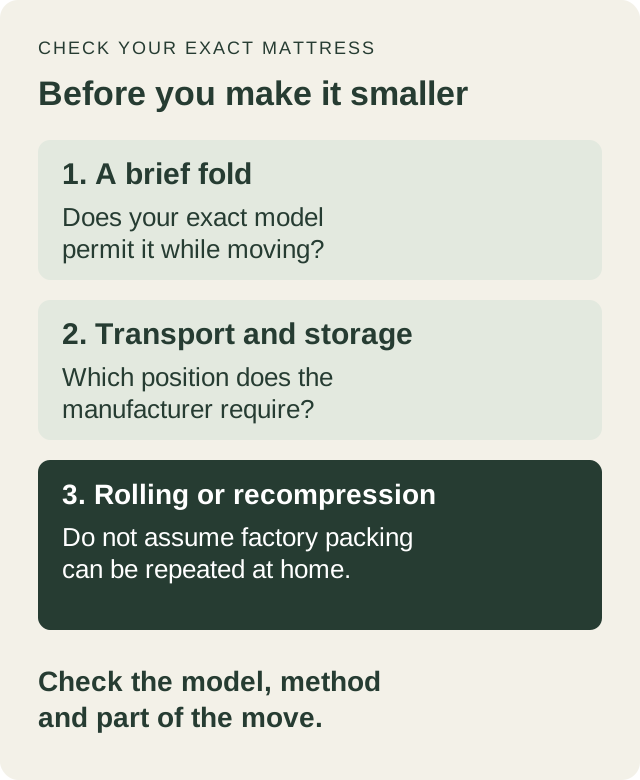
- A brief fold to pass through a doorway or stairwell.
- The required position during transportation and storage.
- Rolling or vacuum-compressing the mattress after expansion.
An answer to one question isn't automatically an answer to the others.
3. Work out where the mattress actually gets stuck.
Is the issue one tight turn in the house, fitting through a vehicle opening or remaining compact during an entire journey?
That distinction matters. A temporary fold may solve a doorway problem without being approved for a long period of folded transportation.
4. Ask support for a specific ruling if the instructions are unclear.
Here is a question you can copy:
I have a [full mattress model], purchased around [year]. I need to move it through [doorway/stairwell/vehicle] and expect it would need to remain [folded/on its side/rolled/compressed] for approximately [duration]. Is that handling position permitted for my exact mattress, and are there any folding-direction, support or storage restrictions?
That gives the manufacturer enough context to answer the situation you're actually facing.
Don't assume that compatibility with an adjustable bed means a mattress can withstand a tight moving fold. Those are different uses.
What if the manufacturer doesn't approve folding?
First, see whether the move can be completed without reducing the mattress's shape.
A correctly sized mattress-moving bag can protect it during handling. Both Nectar and Tuft & Needle recommend this kind of protection.
If the mattress won't fit through your intended route or vehicle without an unapproved fold, consider a different route, a larger suitable vehicle or professional moving assistance.
We wouldn't try increasingly tight straps or a household vacuum to force the mattress into a space it wasn't approved to fit.
You also don't need to replace a perfectly usable mattress just because it is difficult to move. Work out the handling restrictions and practical alternatives first.
Frequently asked questions
Can I fold any all-foam mattress in half?
No. An all-foam construction may be flexible, but the manufacturer can still recommend against folding it after expansion. Casper and Nectar provide clear examples.
Can I keep a memory-foam mattress folded overnight during a move?
There is no universal safe duration. Tempur-Pedic advises against leaving its mattress folded for long periods and calls for flat transportation and storage. Check your exact manufacturer's instructions rather than borrowing a time limit from another brand.
Will a folded mattress definitely be damaged?
Not necessarily. Tempur-Pedic permits a temporary fold under its stated conditions. But a mattress appearing to recover after a bend doesn't establish that folding, rolling or prolonged compression is approved.
Does a mattress-in-a-box have to be vacuum-packed again for moving?
No. The fact that it was compressed for delivery doesn't create a requirement or permission to recompress it. A mattress may need to travel at its expanded size.
The bottom line
If your memory-foam mattress is awkward to move, check the manufacturer's handling instructions before trying to make it smaller.
Tempur-Pedic permits a temporary fold for moving but specifies flat transport and storage. Casper discourages folding or rolling after unboxing. Nectar says its expanded mattress should not be refolded, while Tuft & Needle allows certain moving arrangements without permitting recompression.
The useful question isn't simply, “Can memory foam bend?”
It's “What does the manufacturer allow me to do with this exact mattress, for this part of my move?”
That answer can save you a lot of unnecessary wrestling with an expensive bed.
Sources & research notes
Sources checked November 16, 2026. Manufacturer guidance, not hands-on testing. Tempur-Pedic product-care instructions were corroborated using its support FAQ and a retailer-hosted copy of its manufacturer care document. Check the instructions for your exact model and purchase year.
- Tempur-Pedic folding FAQ: inward fold and cold-weather caution (opens in new tab)
- Tempur-Pedic product care: flat transport/storage and temporary folding (opens in new tab)
- Casper moving guide: brand-specific folding/rolling restriction and flat storage (opens in new tab)
- Nectar FAQ: expanded mattress and moving-bag guidance (opens in new tab)
- Nectar refolding explanation: factory machinery and refolding advice (opens in new tab)
- Tuft & Needle moving FAQ: recompression, straps, side storage and moving bag (opens in new tab)
- Tempur-Pedic product-care instructions: retailer-hosted manufacturer document (opens in new tab)