The Other Mattress Deadline: Sleep Trials vs. Arbitration Opt-Outs
A source-linked comparison of mattress sleep trials, arbitration opt-out deadlines and the documents shoppers should save before ordering.
Under some published mattress terms, you may have a year to decide whether to keep a mattress and only 30 days to decline an arbitration agreement. Those two clocks can start at different times.
We examined the published policies for 17 mattress brands selling directly to US shoppers. We could read the general terms for 15. Five brands published a procedure for initially opting out of arbitration, and all five specified 30 days. Purple expressly allows more time where applicable law requires it. Four allow email in their opt-out instructions; Purple specifies a mailed letter.
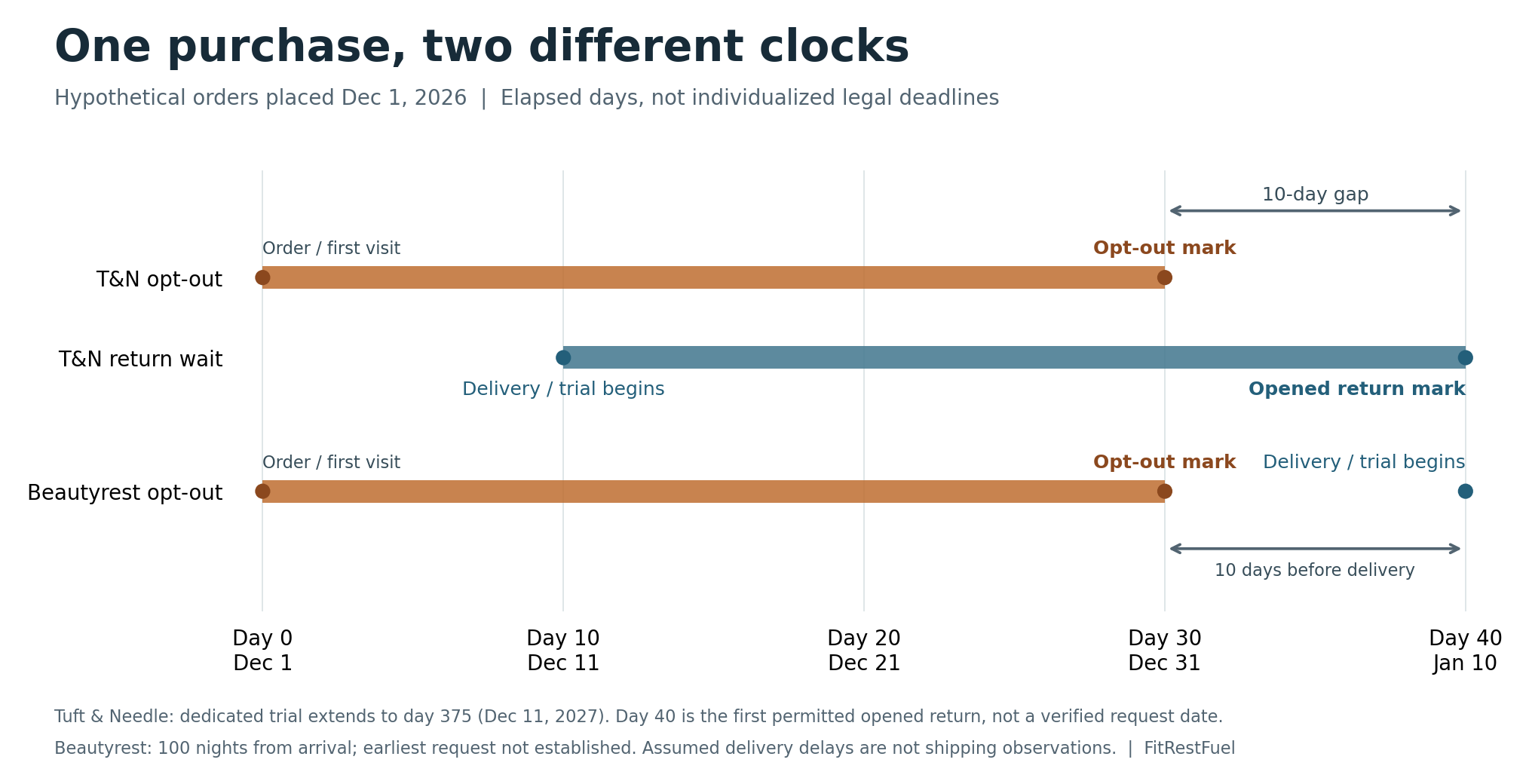
Tuft & Needle provides the clearest worked example. Its terms give customers 30 days after their first website use or purchase, whichever is later, to decline arbitration. Its dedicated mattress trial gives customers 365 nights from delivery but bars the return of an opened mattress before 30 days after delivery. With even a short delivery delay, the opt-out window can end before the first permitted opened-mattress return. The trial policy describes return eligibility, rather than the earliest day customer service will accept a request.
Beautyrest uses a similar opt-out trigger but a 100-night trial beginning at arrival. With a delivery delay longer than 30 days in the scenario below, its stated opt-out period can end before the customer has slept on the mattress at all.
Arbitration is a process in which a neutral decision-maker resolves a dispute outside a conventional court trial. A binding arbitration agreement can affect how disputes are handled. An opt-out is a published way to decline that agreement, where the terms provide one. Return eligibility is a separate question. This comparison describes current public documents; the terms applicable to your purchase and your legal rights depend on your circumstances and applicable law.
Download the 17-brand comparison CSV or the complete research ZIP.
Jump to a section
Two clocks on the same purchase
Consider a hypothetical customer who first visits the website and places an order on December 1, 2026. They open and use their eligible mattress as soon as it arrives and meet the ordinary return conditions.
Tuft & Needle: a ten-day delivery delay.
On a small screen, swipe the table sideways.
| Event | Illustrative date | Days since order |
|---|---|---|
| First site use and purchase | Dec 1, 2026 | 0 |
| Mattress delivered, trial begins | Dec 11, 2026 | 10 |
| 30-day opt-out mark | Dec 31, 2026 | 30 |
| First permitted opened-mattress return mark | Jan 10, 2027 | 40 |
| 365th day after delivery | Dec 11, 2027 | 375 |
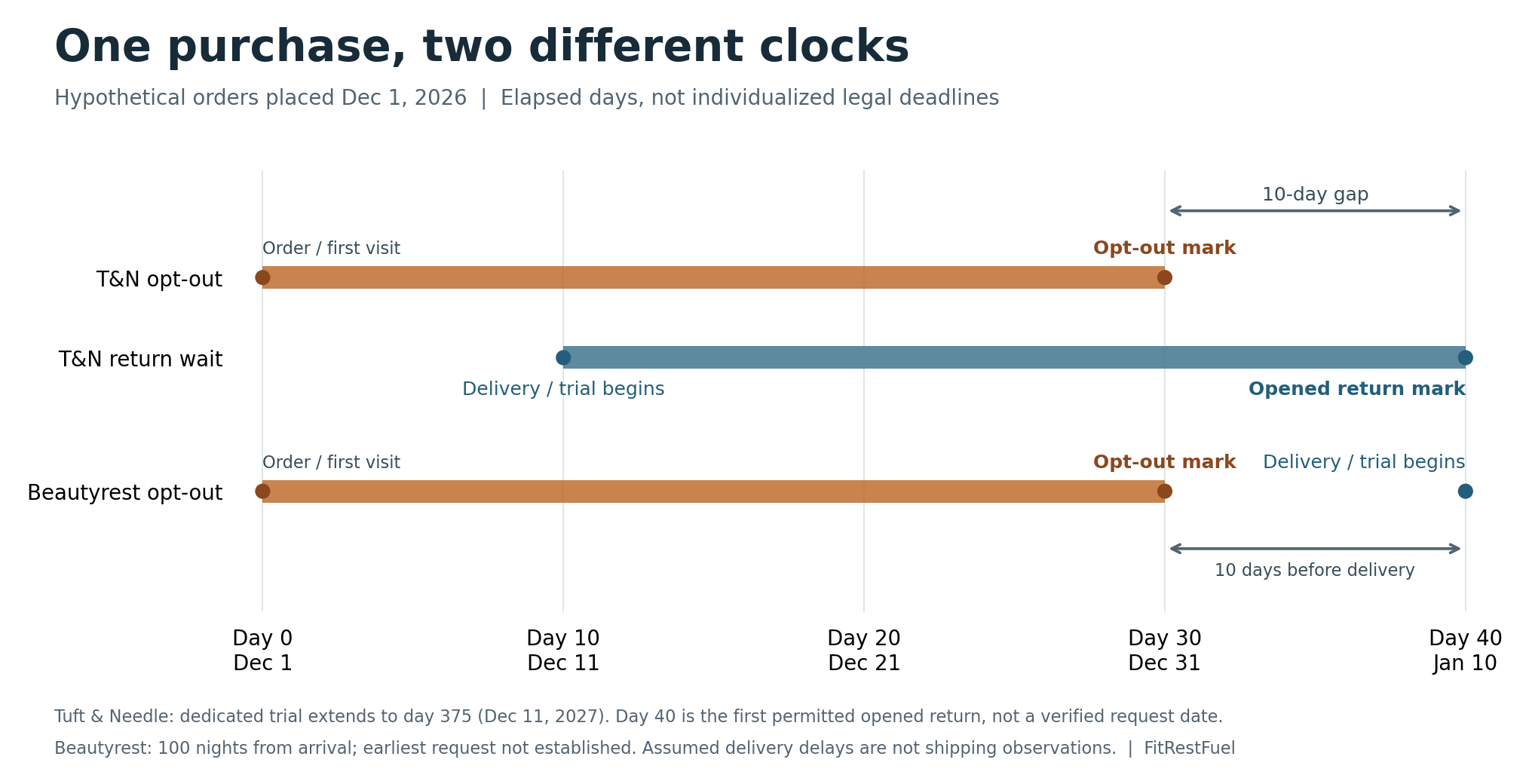
The two 30-day periods are separated by the ten days between ordering and delivery. At the 30-day opt-out mark, the customer has had the mattress for 20 days. The dedicated trial's return restriction lasts another ten days, and the ordinary trial continues for much longer.
There is a document version worth checking: the general terms, effective January 27, 2017, still refer to a 100-night policy. The dedicated trial policy, effective November 19, 2026, specifies 365 nights for mattresses. Our example uses that newer dedicated policy. The older terms link to the warranty page, which also contains dispute language and a section reference that does not match the general terms. Keep copies of the terms and policy that accompany your purchase.
Beautyrest: a forty-day delivery delay. Under its terms, the same first-visit-and-order date puts the 30-day opt-out mark at December 31. If delivery occurs January 10, 2027 instead, the opt-out mark comes ten days before arrival. Its direct return policy begins the 100-night trial at arrival. We couldn't establish a mandatory minimum or an exact earliest ordinary request from that page.
These examples use assumed shipping dates, not measured delivery times. Dates are simple elapsed-day illustrations, not a calculation of anyone's legal filing deadline. The relevant terms, notice rules and applicable law should govern any actual deadline.
The five published initial opt-out procedures
A 30-day duration is only part of the answer. The starting event and delivery method matter, too.
On a small screen, swipe the table sideways.
| Brand | Event that starts the opt-out period | Trial length | Ordinary minimum or restriction | Notice method |
|---|---|---|---|---|
| Tuft & Needle | Later of first site use or purchase | 365 nights from delivery | Opened returns barred before 30 days after delivery | Writing, including email |
| Purple | First online purchase and/or site visit | 100 calendar days from delivery | 21 days sleeping on mattress | Postal mail |
| Saatva | Earlier of first acceptance of terms or first site purchase after posting | 365-night home trial | No mandatory minimum | Email or postal mail |
| Nest Bedding | First agreement to terms | 365 nights from delivery for eligible models | 30-night adjustment period; early-return deduction language | |
| Beautyrest | Later of first site use or purchase | 100 nights from arrival | Not stated in direct return page reviewed | Writing, including email |
Tuft & Needle and Beautyrest both direct initial opt-out notices to their respective support email addresses, rather than the legal addresses used to start a dispute. The comparison dataset records the published destinations and required identifying details.
Saatva: no required break-in, but an earlier starting event
Saatva's home-trial page explicitly allows returns without a mandatory minimum. A qualifying mattress return carries a $99 pickup processing fee.
The Terms of Use, located on the privacy and terms page, tell shoppers in section 17(o) to count from the earlier of their first acceptance of the terms or their first purchase on the site after the terms were posted. If both occurred December 1 and the mattress arrived January 10, the 30-day opt-out mark would fall before the first opportunity to sleep on it. If a qualifying acceptance occurred earlier, the mark could move earlier still. The home-trial page doesn't expressly identify the initial start date in the wording we reviewed, so we haven't assigned an exact trial-end date to this example.
Saatva also explicitly says that declining arbitration leaves other provisions in place, including its class-action waiver, jury-trial waiver, choice of law and limits on liability, subject to applicable law. Opting out of arbitration and opting out of every other dispute-related provision are different things.
Purple: a mailed letter and an ambiguous trigger
Purple's terms use “and/or” between the first online purchase and website visit. We have not replaced that wording with an earlier-of or later-of rule. The terms specify a mailed letter, including the shopper's name, address and a clear statement of intent. They also recognize a longer period if required by law. The opt-out clause doesn't expressly say whether the postmark or receipt controls. Section 23 has a general notice rule for mailed notices with a return receipt, including a five-business-day deemed-notice period, but lists a different department and suite number. How that rule applies to the opt-out letter is unclear.
Purple's return policy requires 21 days of sleeping on the mattress and provides 100 calendar days from delivery to return it. A valid return also depends on mattress condition, the law tag and photos. Check the current terms well before relying on that return window to make decisions about arbitration.
Nest Bedding: the ordinary rule has an early-return qualification
Nest's terms say a customer must complete 30 nights of adjustment before starting a comfort return. They also discuss possible deductions for reasonable disposal or recycling expenses if an opened and used mattress is returned in that initial period.
That makes the earliest possible return less clear than a simple 30-night waiting period would suggest. We have retained both provisions rather than assuming every early return is refused or automatically approved. The opt-out period is 30 days after first agreeing to the terms, with written notice sent by email. The 365-night trial applies to eligible adult mattresses; check product exclusions.
Ten other readable terms and two incomplete routes
The remaining brands matter because a mattress agreement may contain a dispute process without an obvious initial opt-out, or may point to a different document. Here is the rest of our roster. A missing procedure means we did not locate one in the documents reviewed.
On a small screen, swipe the table sideways.
| Brand | What we found in dispute documents | Published ordinary mattress trial |
|---|---|---|
| Casper | General terms describe litigation; mattress warranty describes arbitration | 100 nights from delivery; 30-night minimum |
| Avocado | General terms specify BBB arbitration; no initial opt-out located | 365 or 100 nights by eligible model, from delivery; 30-night minimum |
| Nectar | Intro refers to arbitration; linked process has no arbitration procedure in its body | 365 nights from delivery; 30-day minimum for opened mattresses |
| DreamCloud | Same document discrepancy as Nectar | 365 nights from delivery; 30-day minimum for opened mattresses |
| Helix | General terms specify NAM arbitration; separate AAA warranty language | 365 nights from delivery; 30-night minimum |
| Brooklyn Bedding | NAM arbitration in general terms and separate warranty | 365 nights from delivery; 30-night minimum |
| Leesa | General terms specify NAM arbitration; separate AAA warranty language | 365 nights from delivery; 30-night minimum |
| Bear | General terms specify NAM arbitration; separate AAA warranty language | 365 nights from delivery; 30-night minimum |
| Nolah | General terms specify NAM arbitration; separate AAA warranty language | 365 nights for eligible new purchases; delivery is night one; 30-night minimum |
| WinkBeds | No arbitration provision located in reviewed general terms or published mattress warranty | 365 nights from delivery; 30-night minimum |
| Sealy | Full terms/warranty inaccessible in our review | 90 nights from delivery; 30-night guidance, binding minimum unclear |
| Tempur-Pedic | Full terms/warranty inaccessible in our review | 90 nights from delivery; 30-night recommendation, binding minimum unclear |
For the source links, document dates, exact scope and qualifications behind each row, see the public comparison dataset and source register.
Several brands illustrate why the warranty and linked dispute documents deserve their own place in the comparison.
Casper's website terms direct disputes to litigation before a judge, with a jury waiver. Section G of its mattress warranty describes binding arbitration and expressly refers to purchase-related disputes and the website terms. The documents give different instructions. We couldn't determine which would control any particular dispute.
Nectar and DreamCloud both name Ashley Digital LLC. Their terms (Nectar, DreamCloud) refer to arbitration in the introduction. The linked dispute-resolution documents (Nectar, DreamCloud), effective August 11, 2026, instead set out informal dispute procedures and jury and class-action waivers, without an arbitration procedure in their bodies. We recorded the discrepancy in both brand routes and grouped the common framework once.
A different shared framework appears in the general terms for Helix, Brooklyn Bedding, Leesa, Bear and Nolah. All five identify Brooklyn Bedding LLC and describe a process involving a signed dispute notice by certified US mail, followed by a 60-day negotiation period from receipt of the completed notice. That period is for handling a dispute that has arisen, rather than declining arbitration at the start of a purchase. The Brooklyn Bedding warranty also specifies NAM arbitration. The other four brands publish separate warranty language naming the American Arbitration Association (AAA), with wording about rights and remedies not created by Title I of the Magnuson-Moss Warranty Act. Their sale and return policies remain brand-specific.
Avocado also publishes terms in two places. Its March 2024 website terms and August 2026 support version both contain BBB arbitration provisions. Check which version accompanies the purchase. For Sealy and Tempur-Pedic, the accessible trial guidance describes a 90-night period and a nonrefundable $175 return fee plus applicable tax. Their underlying terms and warranties remain unavailable in this review.
What to check before you order
Start with the product you are actually buying and the seller handling the transaction. Then save the website terms, any separate terms of sale, the mattress warranty and the trial policy, including their dates or version identifiers. If the terms link to a separate dispute document, save that as well.
Look for the arbitration section and any initial opt-out wording. Note the event that starts its clock, the stated number of days, the exact destination, the information required and whether the notice must be sent, received or postmarked by a certain point. Save a dated copy of the notice and any delivery evidence if you choose to send one. Ask a qualified consumer-law attorney about unclear or conflicting terms or your particular rights.
Next, check when the sleep trial begins, when a used mattress first qualifies for an ordinary comfort return, and when you must initiate and complete the return. Look for limits on opening the package, mattress condition, labels, support, fees and pickup. Keep your order confirmation and delivery record. If you're also buying an adjustable base, our six-purchase mattress and base return comparison shows how a separate return deadline can affect the amount you recover.
How we researched the comparison
We started with eight pilot brands and froze a 17-brand roster using the short recommendation lists in two mattress-buying publications, cross-checked against a direct-seller brand directory. We inspected publicly accessible terms, sale and trial documents, warranties and relevant linked dispute policies for new adult mattresses ordered through brand-operated US sites. Children’s mattresses, third-party retailer contracts, financing, text-message agreements, commercial purchases and final-sale products are outside the baseline.
Fifteen general terms were readable. We located five explicit initial opt-out procedures on separate brand-specific terms pages, each with a 30-day duration. Four allowed email and one required mail. The two inaccessible contract routes remain in the dataset. For the 15 readable routes, we grouped only two confirmed shared general-terms frameworks, leaving ten descriptive comparison groups. That group count reflects the documents and entities we identified, rather than a count of independent legal contracts. The five opt-out procedure pages remain separate because they identify their own notice instructions. The sample describes selected sellers, not the US mattress market.
The complete research download, methodology, data dictionary, source register, frozen roster and hypothetical scenarios are freely available. The research records 65 source documents, including five discovery and ownership sources. Four legal documents could not be retrieved. The next recommended review date is December 28, 2026. Read the actual terms accompanying your order because these policies can change.
Suggested citation: Christopher Fairfield, FitRestFuel, The Other Mattress Deadline: Sleep Trials vs. Arbitration Opt-Outs, November 28, 2026.
Read the methodology and data dictionary. Additional files: reproduce_counts.py · validation.json · timeline.png.