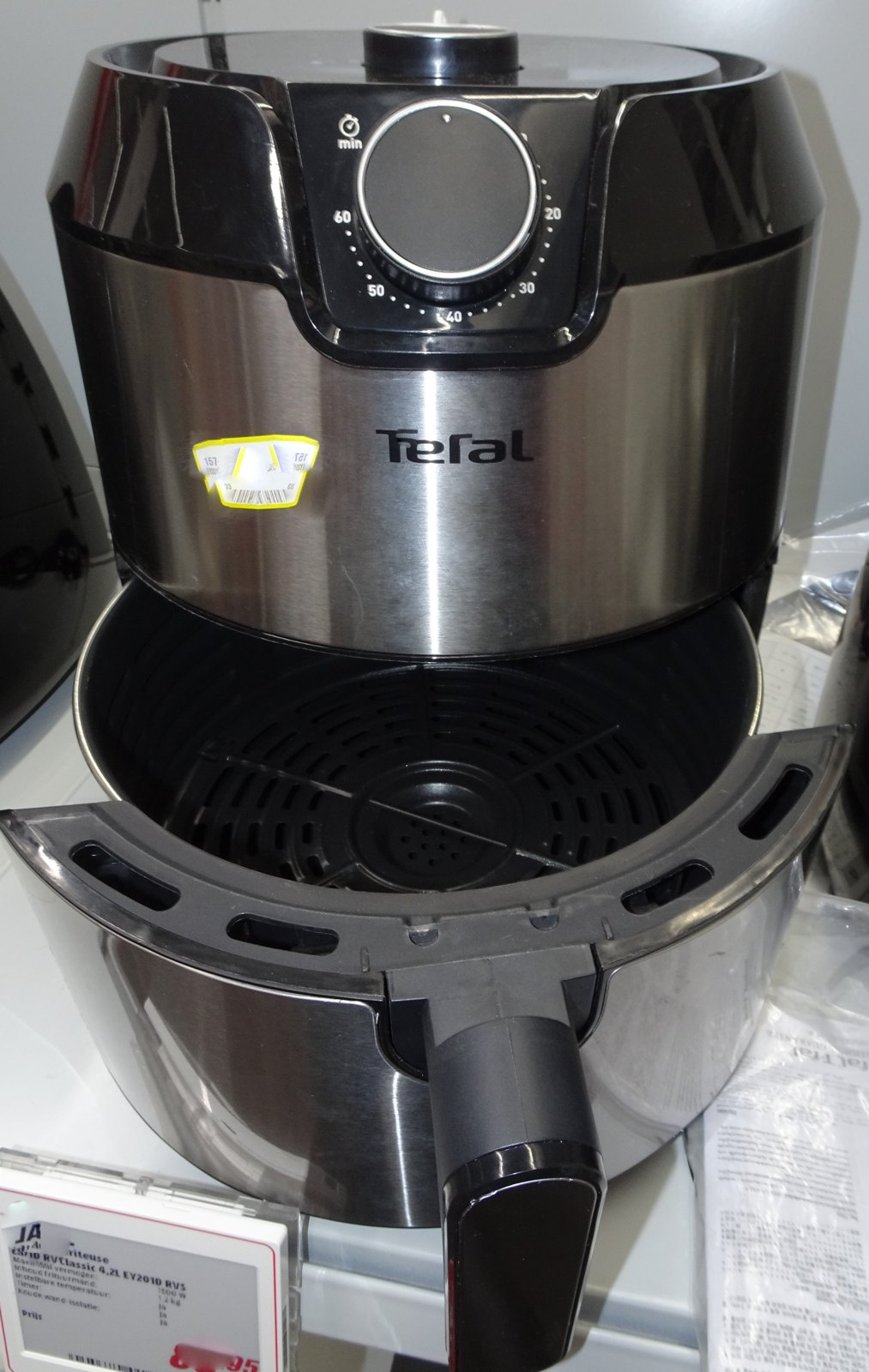
Chefman 3.5-Qt vs. Ninja AF141 5-Qt: Is the Bigger Air Fryer Worth the Counter Space?
The Ninja AF141 has a five-quart basket. The Chefman TurboFry has a 3.5-quart basket.
Sources last checked November 15, 2026.
That's a 43% difference in advertised capacity, which sounds like an obvious reason to buy the Ninja. But it doesn't tell you whether a pound of frozen fries will cook more evenly, whether your dinner will fit in one layer, or whether the larger machine has enough space to operate safely on your counter.
There is also a meaningful price difference.
When we checked Target on November 15, 2026, the exact Chefman RJ38-35T-V2 was listed at $59.99. The Ninja AF141 was on sale for $89.99, down from $129.99.
That gave the Ninja a $30 premium during our check, not the $70 difference implied by comparing Chefman's price with Ninja's regular price. Sales and availability can change, so the actual checkout totals matter.
The more useful question is:
Will the Ninja's additional basket space eliminate a cooking problem you already have?
If the answer is yes, the larger model becomes much easier to justify. If you're mostly heating one lunch or preparing a small side, the Chefman may cover your needs while leaving more money and counter space available.
This comparison is based on manufacturer documentation and independent testing published by other organizations. We have not personally tested these two machines.
Start with the meals you make
Before considering the specifications, think about your three most common air-fryer meals.
Perhaps you mostly reheat one serving of leftovers, cook frozen nuggets, or prepare vegetables alongside a meal made on the stove.
For that routine, the main benefit of a five-quart basket might go unused.
Now imagine you often cook a protein and a substantial side together, or you're regularly splitting a batch because the ingredients won't spread out without overlapping.
That is where a larger cooking surface may save time and effort.
The important distinction is between basket volume and space available to cook food effectively.
A tall pile of fries can fit inside a basket without having the airflow needed for even browning. Spreading food across the cooking surface often matters more than using every cubic inch.
The key specifications
On a small screen, swipe the table sideways.
| Detail | Chefman TurboFry | Ninja Air Fryer Pro |
|---|---|---|
| Exact model | RJ38-35T-V2 | AF141 |
| Advertised capacity | 3.5 qt | 5 qt |
| Rated power | 1,300W | 1,750W |
| Highest advertised temperature | 450°F, Air Fry mode | 400°F |
| Cooking functions | Air Fry, Bake, Dry, Frozen | Air Fry, Roast, Reheat, Dehydrate |
| Automatic shake reminder | Yes, in applicable modes | No dedicated reminder |
| Automatic Bake preheat | Yes | No dedicated automatic preheat program |
| Published body dimensions | 14.29 × 9.64 × 8.46 in; axes require confirmation | 14.84 D × 11.34 W × 10.55 H in |
| Manufacturer weight | 6.48 lb | 10.67 lb |
| Rear and overhead ventilation | At least 6 in | Adequate space required; no universal distance stated in reviewed guide |
| Warranty | 1-year assurance | 1-year limited warranty |
These are the exact RJ38-35T-V2 and AF141 models. Specifications from other Chefman TurboFry or Ninja Pro models should not be substituted.
What do the extra 1.5 quarts buy?
Ninja advertises a basket capable of fitting up to four pounds of French fries.
That is a statement about what can fit. It is not a guarantee that four pounds will cook as evenly or turn out as crisp as a smaller batch.
Ninja's AF141 cooking guidance includes separate examples for one- and two-pound portions of frozen fries. Those are more useful starting points for cooking than treating the maximum advertised load as an everyday recommendation.
Its instructions also recommend checking and shaking food during cooking.
Independent testing gives us something more concrete.
RTINGS measured the AF141's cooking chamber at approximately 5.1 quarts and its single-layer cooking surface at 64.9 square inches.
That surface-area measurement matters because it describes how much space is available to spread food rather than simply stacking it.
Unfortunately, we could not verify an equivalent independent cooking-surface measurement for the exact Chefman RJ38-35T-V2.
That means we can't honestly tell you that Ninja provides 43% more crisping area. Its advertised volume is 43% greater, but those are different measurements.
We also can't calculate how many additional wings, fries, or chicken pieces the Ninja will cook successfully compared with this exact Chefman.
An easier way to decide
Look at the food you normally prepare.
If your main problem is overlapping food, the Ninja's larger basket is worth considering. Its tested cooking surface gives us reason to believe it offers practical single-layer space, although the exact advantage over this Chefman remains unmeasured.
If you usually cook one modest portion, ask what problem another 1.5 advertised quarts would solve.
One useful check before buying is to place the food you normally cook on a plate. Notice how much uninterrupted space it needs when arranged without stacking. That gives you a better sense of your needs than a serving-count claim on a product box.
Don't treat the plate as an exact basket template, though. We don't have the Chefman's verified interior dimensions for an apples-to-apples fit calculation.
If even 3.5 quarts sounds larger than your usual meal, our Chefman 2-Qt versus COSORI Lite 2.1-Qt comparison examines the smaller-batch alternative.
The Ninja has real independent cooking evidence
RTINGS tested the exact Ninja AF141.
Its results were encouraging for common frozen foods. The reviewers found that frozen fries and similar prepared foods generally browned well, although some pieces were still underdone or overdone.
They also found limitations with bulky or moisture-heavy foods.
Chicken wings could remain unevenly browned, and the five-quart basket still had limitations when trying to arrange larger foods in a single layer.
That matters because a five-quart machine is not an unlimited-capacity fryer. It can still require thoughtful food placement and occasionally a second batch.
RTINGS also found that the AF141 recovered and maintained cooking temperature effectively.
Read the independent Ninja AF141 review at RTINGS
We did not find equivalent controlled cooking tests for the exact Chefman RJ38-35T-V2.
Therefore, we cannot make a legitimate head-to-head declaration that Ninja cooks faster, browns more evenly, or produces better food than Chefman.
The Ninja has stronger published performance evidence. That is different from proving it is the stronger performer in this pairing.
The Chefman does something interesting with frozen food
The Chefman's four cooking functions deserve closer attention than the number four.
Its exact model-series manual lists:
- Air Fry: 300–450°F
- Bake: 200–350°F
- Dry: 90–200°F
- Frozen: A selected cooking temperature of 300–400°F, preceded by a five-minute stage at 200°F
That Frozen function is more specific than a button that simply recalls a temperature setting.
According to Chefman's manual, food goes into the basket before the cycle begins. The machine starts at 200°F for five minutes and then increases to the temperature you selected.
The five-minute stage is part of the total cooking time, not an additional preheat.
Chefman describes this sequence for frozen foods, including certain frozen proteins.
It isn't a substitute for checking that meat or poultry has reached a safe internal temperature. Food size and starting conditions still matter.
The Bake mode also has its own preheat behavior.
The fryer displays its preheating status, then starts its cooking countdown after heating. The manual advises waiting until preheating is complete before adding the food.
Meanwhile, Chefman's Air Fry and Frozen programs can provide shake reminders during applicable cooking cycles.
That is a practical advantage if you often leave the appliance running while doing something else nearby.
What about the 450°F maximum?
Chefman can reach 450°F in Air Fry mode, while the AF141's published maximum is 400°F.
Those extra 50 degrees offer another selectable temperature for recipes that call for higher heat.
They don't establish that Chefman cooks every meal faster or produces consistently crispier results.
Heating design, airflow, temperature stability, basket loading, and food moisture also affect cooking outcomes.
And Chefman's 450°F ceiling does not apply to all four modes. Its Bake, Dry, and Frozen settings have their own lower maximums.
Someone who wants to dehydrate food should pay more attention to the Dry mode's 90–200°F range than to the headline 450°F number.
Ninja's cooking functions are more conventional
The Ninja AF141 provides:
- Air Fry
- Roast
- Reheat
- Dehydrate
Its settings can be customized for the food you're preparing.
For ordinary leftovers, the dedicated Reheat function may be convenient. Roast gives another familiar program for proteins and vegetables.
These functions don't mean the Chefman is incapable of warming leftovers or roasting ingredients. A named button is not proof of a unique heating capability that another fryer lacks.
Ninja doesn't provide Chefman's dedicated automatic shake reminder.
Its cooking guidance recommends checking and shaking food yourself when appropriate.
There is also a preheat difference worth knowing.
Chefman's Bake mode includes an automatic preheat sequence. Ninja's guide recommends allowing approximately three minutes for preheating before certain cooking tasks, but the AF141 doesn't have a separate automatic preheat program that performs that sequence for you.
Neither arrangement is inherently difficult. They're simply different routines.
If you want the fryer to manage its Bake preheating and remind you about shaking food, Chefman's implementation may be more useful.
If the Ninja's larger cooking surface is what prevents repeated batches, those smaller control differences may not affect your decision much.
Counter space: the Ninja is bigger, but there's a complication
The Ninja AF141 has well-documented exterior dimensions:
- 14.84 inches deep
- 11.34 inches wide
- 10.55 inches high
Chefman's manufacturer page lists three dimensions:
14.29 × 9.64 × 8.46 inches
But it doesn't label the axes.
Different retail listings for the exact black variant disagree about whether 9.64 or 8.46 inches is the height.
One lists 14.29 inches deep, 9.64 inches wide, and 8.46 inches high. Target's Chefman Direct listing instead specifies 14.29 inches deep, 8.46 inches wide, and 9.64 inches high.
The discrepancy matters for tight spaces.
The Ninja is wider than either reported Chefman width, but someone choosing a tight shelf or clearance-sensitive location should confirm the Chefman's exact dimensions rather than relying on a guessed order.
Chefman's real operating-space requirement
Chefman's RJ38-35T-V2 manual specifies at least six inches of free space above and behind the appliance during use.
Using the consistently reported 14.29-inch depth, that means you should initially allow at least:
14.29 + 6 = 20.29 inches
That is the body depth plus required rear clearance, before accounting for additional space to pull the basket forward.
Overhead clearance matters too.
Depending on which retailer's height label proves correct, adding six inches gives an initial vertical requirement of either 14.46 or 15.64 inches.
Until that dimension is confirmed, don't plan a tight installation based on the smaller number.
Even these measurements are not permission to operate the fryer beneath any cabinet that happens to be high enough. Heat, airflow, surrounding materials, and the manufacturer's complete safety instructions still matter.
Ninja doesn't give us a universal clearance number
The AF140-series owner guide applicable to the AF141 tells users to provide adequate ventilation space above and around the appliance.
It doesn't specify a universally applicable five- or six-inch distance in the reviewed guide.
We therefore won't invent one.
For Ninja, start with the body dimensions, leave room for ventilation and basket removal, and confirm a suitable location using the manufacturer's instructions.
Neither air fryer should be treated as safe to operate in an enclosed cabinet simply because its body fits there.
A quick counter check
Before ordering either machine:
- Measure the available counter depth.
- Check for cabinets or other surfaces overhead.
- Confirm enough free space behind the appliance for hot exhaust.
- Make sure the basket can be pulled out without hitting a wall, handle, or nearby item.
- Confirm a stable, heat-resistant location with a suitable outlet.
A slightly smaller body isn't useful if the only available spot fails the ventilation requirements.
The electrical difference is worth knowing
Chefman lists 1,300 watts.
Ninja lists 1,750 watts, or approximately 14.6 amps at 120 volts.
That is a 450-watt difference in rated electrical input.
It's not proof that Ninja always cooks faster.
The AF141's independent performance review does show that it can cook many foods quickly, but there's no matching controlled test of the exact 3.5-quart Chefman to establish a direct speed difference.
For a shopper, the more immediate issue may be electrical setup.
Ninja's owner guide specifically instructs users not to operate the appliance with an extension cord.
Chefman's manual provides conditions for extension-cord use rather than issuing that exact same blanket instruction.
Follow the instructions for the appliance you actually purchase.
It's sensible to avoid running another high-draw countertop appliance on the same circuit while the air fryer is operating. If your kitchen frequently trips a breaker, find out why before adding a high-powered appliance.
We would not declare that every AF141 requires a dedicated 20-amp circuit. That is not a universal requirement established by the documentation reviewed here.
Basket coatings and cleanup
Chefman markets the RJ38-35T-V2's nonstick coating as PFAS-free ceramic.
That is a manufacturer claim about its described coating. It should not be expanded into a guarantee about every component or food-contact surface unless the manufacturer clearly documents that broader coverage.
The Ninja requires even more care in describing its materials.
RTINGS identifies the AF141's removable crisper plate as ceramic-coated and its basket chamber as PTFE-coated.
However, the Ninja AF140-series owner's guide uses ceramic-coating language for a removable basket, and manufacturer responses on retailer pages have not been fully consistent.
We cannot reconcile all those descriptions from the public documentation reviewed.
If avoiding a particular coating is essential to your purchase, obtain exact, current confirmation from Ninja for the AF141 configuration and components you're buying. Don't assume that a ceramic-coated plate means every cooking surface is ceramic.
These materials descriptions are not evidence about medical outcomes or long-term durability.
Everyday cleaning
Chefman says the cooled basket and crisper rack are top-rack dishwasher-safe.
Ninja's guide identifies the basket and crisper plate as dishwasher-safe, while recommending handwashing the basket to help extend its usable life.
Neither electrical housing goes in the dishwasher.
This is not a strong enough difference to decide the purchase by itself. Both involve removable nonstick cooking parts that require reasonable care.
How much more should you pay for the Ninja?
Our November 15 retailer check produced a useful example:
On a small screen, swipe the table sideways.
| Exact configuration | Checked retailer price |
|---|---|
| Chefman RJ38-35T-V2-BLACK, Target, sold by Chefman Direct | $59.99 |
| Ninja AF141, Target sale price | $89.99 |
| Difference during this check | $30.00 |
The Ninja listing also showed a regular price of $129.99.
This is a dated comparison, not a price guarantee. Check the exact seller, stock, shipping, taxes, and current discount before purchasing.
At a $30 premium, the Ninja is more appealing if its extra capacity is likely to save you from making a second batch several times each week.
At a $70 premium, we'd be much more demanding. The shopper should have a clear, recurring need for that additional space rather than assuming five quarts must be better.
If your regular portion already fits, the extra capacity may solve nothing.
If you repeatedly cook in two batches because the food won't spread out, additional space can change your routine.
The limitation is that we don't have equivalent measured Chefman cooking-area data. So the exact reduction in batches cannot be promised.
Our buying recommendation
For someone cooking modest single-person meals on a tight budget, the Chefman RJ38-35T-V2 is the practical starting point.
Its manual documents several genuinely useful controls, including the shake reminder, automatic Bake preheat, low-temperature Dry mode, and a Frozen program that starts with lower heat.
It also costs less in the retailer snapshot we verified.
But don't buy it solely because a retailer calls it compact. Check the six-inch rear and overhead clearances, and resolve the conflicting height labels if your available space is tight.
The Ninja AF141 becomes worth the premium when additional single-layer cooking space is a recurring need.
Its exact-model RTINGS review gives us meaningful evidence about its cooking surface and performance. It can handle a variety of frozen foods effectively, although bulky foods and large batches still have limits.
The extra power and larger basket are real specifications. They're not guarantees of universal cooking superiority.
Here's the decision we'd make:
Write down the foods you cook most often. If a modest single-basket load is enough, keep the savings. If a larger uninterrupted cooking area would regularly prevent a second batch, the Ninja deserves the extra money.
For a different situation, where you need to cook two foods at separate temperatures at the same time, neither appliance solves that problem. Our single-versus-dual-basket guide covers that distinction.
And if you need space for pans, toast, or larger baked dishes, an air fryer versus countertop oven comparison is more relevant than simply moving from 3.5 to five quarts.
Check the exact models
- Chefman TurboFry 3.5-Qt RJ38-35T-V2: manufacturer details
- Chefman RJ38-35T-V2-BLACK: retailer listing
- Ninja AF141: retailer listing
Verify the model and configuration shown by the seller before ordering. Retailer prices and availability can change.
Sources and research notes
Sources reviewed November 15, 2026:
- Chefman RJ38-35T-V2 manufacturer product page (opens in new tab)
Model, capacity, weight, dimensions as published without axis labels, power, functions, coating claim, and warranty.
- Chefman RJ38-35T-V2-series user guide (opens in new tab)
Exact cooking-mode ranges, Frozen stage, Bake preheat, shake reminder, six-inch operating clearances, extension-cord conditions, and cleaning instructions.
- Ninja AF140-series owner guide (opens in new tab)
Manufacturer-authored operating, ventilation, extension-cord, preheating, cleaning, and safety guidance. The guide covers a series; not every depicted function applies to AF141.
- RTINGS' independent Ninja AF141 review (opens in new tab)
Exact-model independent measurements, cooking observations, control limitations, and coating identification.
- Target Chefman RJ38-35T-V2-BLACK listing (opens in new tab)
Exact retailer configuration and dated price.
- Target Ninja AF141 listing (opens in new tab)
Exact model and dated sale price.
Research limitations:
- No independent, directly comparable cooking-performance test or measured cooking surface was verified for the exact Chefman RJ38-35T-V2.
- Chefman's published dimension axes are disputed across sellers.
- Ninja AF141 coating descriptions are inconsistent across the reviewed documentation.
- The dated retailer prices are not current-price guarantees.